The Transport Capacity of a Wireless Network is a Subadditive Euclidean Functional
The transport capacity of a dense ad hoc network with n nodes scales like \sqrt(n). We show that the transport capacity divided by \sqrt(n) approaches a non-random limit with probability one when the nodes are i.i.d. distributed on the unit square. W…
Authors: Radha Krishna Ganti, Martin Haenggi
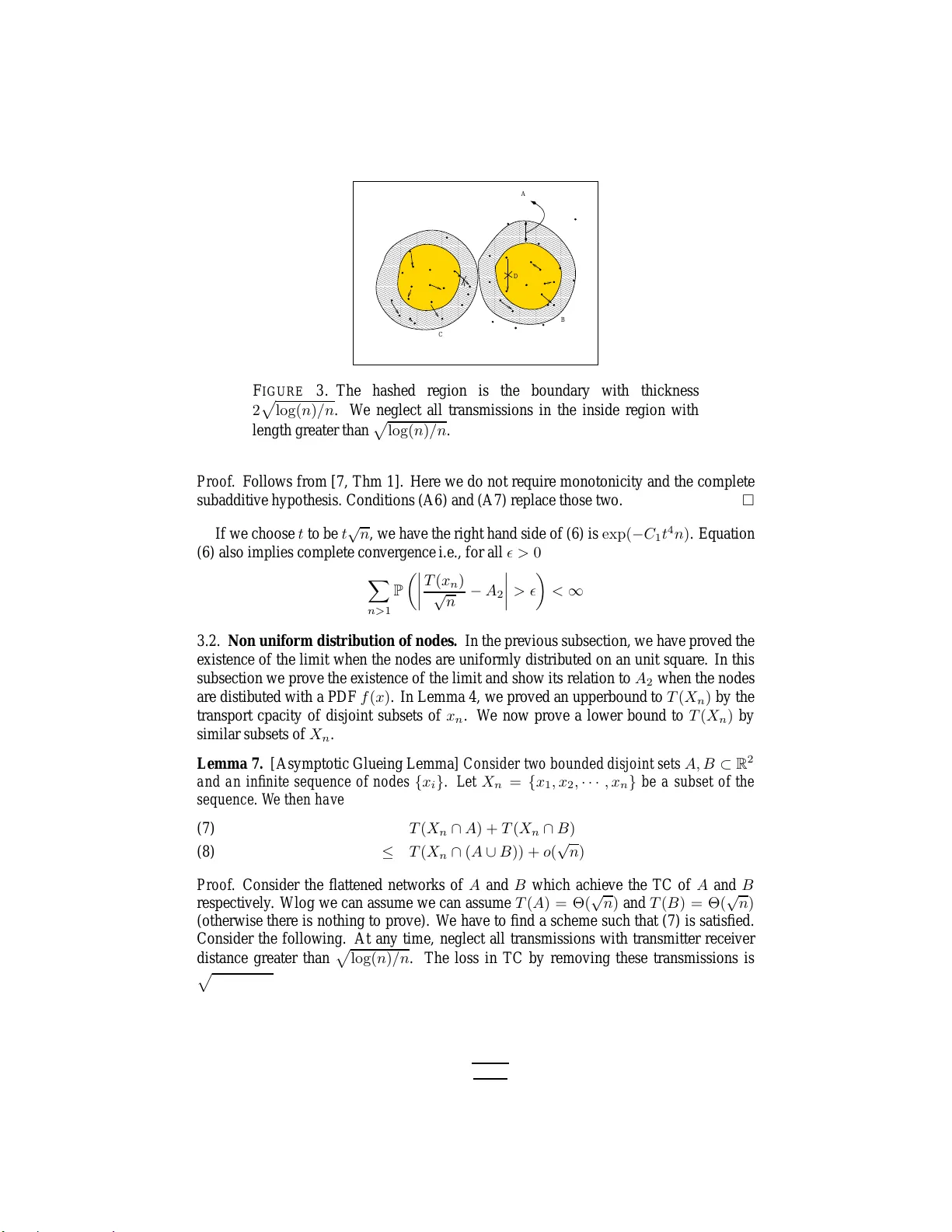
THE TRANSPOR T CAP A CITY OF A WIRELESS NETWORK IS A SUB ADDITIVE EUCLIDEAN FUNCTIONAL RADHA KRISHN A GANTI AND MAR TIN HAE NGGI DEP AR TME NT OF ELECTRICAL ENGINEERING UNIVERSITY OF NO TRE D AME INDIANA- 46556, USA {RGANTI,MHAENGGI}@ND.EDU A B S T R A C T . The transport capacity of a dense ad hoc network with n nodes scales like √ n . W e sho w that t he transport cap acity di vided by √ n ap proaches a non-ran dom limit with probab ility one when the nodes are i.i.d. dist ribut ed o n the unit square. W e prov e that the t ransport cap acity under the protoco l model is a suba dditi v e Euclidean functio nal and use the machiner y of subadditi ve funct ions in the spiri t of Steele t o sho w the e xiste nce of the limit. 1. I N T RO D U C T I O N Consider a wireless network of n nodes in a unit square on the plane. Finding th e ca- pacity region of this setup is an unsolved pro blem. Transport capacity is a metric which, in a loose sense, indicates the sum r ate of the network wh ile incorporating the notion o f distance. It was s hown in [1] and [2] that the transpo rt capacity (TC) is Θ( √ n ) . More pre- cisely wh en n o c ooperative commu nication techniqu es ar e used (except for pur e relayin g of packet), the transport capacity T is bo unded by [1, 2] C 2 √ n < T ( X n ) < C 1 √ n when X n = { x 1 , · · · , x n } are n no des u niform ly d istributed on the unit square and n is large. The lower b ound is provided by Franceschetti eta l. using per colation theo ry . When cooperativ e communica tion techniques are used, the transport capacity scales like n [3]. When o ne restricts the network to act like a packet network witho ut any coop erative technique s ( except packet relaying), TC exhibits a nice geo metric beh avior . While it has been proved that TC scales like √ n , the question whether the limit (1) lim n →∞ T ( X n ) √ n exists remained open when the n nodes x i , 1 ≤ i ≤ n are i.i.d distributed in a unit square. In this paper we sho w that (1) conv erges to a constant with prob ability one. T his technique can be easily extended t o show that lim n →∞ T ( X n ) /n ( d − 1) /d = A d a.s. when the nodes x i are distributed i. i.d in [0 , 1] d , d ≥ 2 and A d is a constant depend ing only on the system parameters and the dimension d . W e show that transport capacity has a geometric fla vor similar to the minimum spanning trees (MST), Euclidean matching (EM) problem and Eu clidean tra velling salesman problem (TSP). T he existence of a lim it is mo re 1 1-4244-2575 -4/08/$20.00 c 2008 IEEE of a mathematica l interest, b ut the techniq ues used in proving the limit will help in a better understan ding of schedu ling and routing mechanisms. The paper i s organized as follows. In Section 2, we introduce the communic ation m odel and the defin ition of TC. I n Section 3, we present the ge ometrical properties of TC and derive th e limit. In Theorem 2 we pr ove the con vergence re sult when th e nodes are i.i.d unifor mly d istributed on a unit square. Theorem 3 provides a similar result when the nodes are i.i.d distributed wit h a gener al PDF f ( x ) . 2. S Y S T E M M O D E L W e assum e the pro tocol mo del [ 1] for comm unication betwee n two no des, i.e., a node located at x i can commun icate successfully to a node located at x j if the ball centered around x j with radius β | x i − x j | , β > 1 , does not contain any other transmitter . When t he commun ication is successful, we assume one packet of informa tion is transmitted 1 Definition 1. T ransport Capacity: F or n nod es { x 1 , x 2 , · · · , x n } ⊂ R 2 , the transport capacity of these n nodes is defined as T ( { x 1 , x 2 , · · · , x n } ) = sup S X ( i,j ) ∈ [1 , 2 ..n ] 2 λ ij | x i − x j | wher e the supr emum is taken over the supp ortable rate pa irs S . The set S can also be though t of a s the set of all sc heduling and r outing a lgorithms. The set S contain s sched- uling algorithm wi th fi xed sou r ce and destin ation pa irs. λ ij denotes the information rate that node x i can communic ate to x j (we don’t count the r elayin g nodes). Ob serve that the definition o f T ( { x 1 , · · · , x n } ) depends only on the location of the nodes x i , 1 ≤ i ≤ n . W e make the following assumptions: (1) Ti me is discretized. (2) Message set for each sour ce destination pair is independent . (3) No coo perative communica tion tec hniqu es ar e used. (4) T ( { x 1 } ) = 0 W e will consider two cases. O ne with no constraint on λ ij and the other with the follo wing constraint. Constraint 1: λ ij > 0 for some j for e very i , i .e., max j λ ij > 0 , ∀ i Notation : Let B ( x, r ) denote a b all of radius r centered around x . For a set A , the com- plement is denoted by the set A c . F or a finite set A , | A | denotes the cardina lity of the set A . W e will use ( A → B ) to de note the set of tran smissions with transmitters in A an d receivers in B . 3. L I M I T T H E O R E M S In this section we sho w the existence of th e limit (1) using tools fr om subadditiv e se- quences. A sequence { a m } is sub additive if a m + n ≤ a m + a n . By a theo rem of Fekete, we have th at lim a m /m = inf ( a m /m ) exists. Sim ilar results h old wh en th e sequence is superadd itiv e. Mo st o f the geometrical quan tities like the length of a m inimum sp anning tree on n p oints, or a Euclid ean matching of n po ints are no t strictly subadditive. They have a small correction factor , i.e., of the form a m + n ≤ a m + a n + c ( m, n ) . If the growth 1 Basical ly we are negl ecting noise. Neglec ting noise can make t he achie vable rate unbounded . S o we c ap the link capac ity to unity . A lterna ti vel y we can assume a packet of information transmitte d. of c ( m, n ) can be co ntrolled, the existence o f the limit can be proved. When the underlyin g sequences are ran dom variables, the existence o f the limit is p rovided by a classical result of Kingm an [4]. Steele has u sed such a frame work to prove the existence of the limit of a weak ly subadd itiv e sequences in the geom etrical setting [5]. The geometr ical quantities which e xhibit such subadditivity are coined “Subadditivie Euclidean functiona ls”. W e will use the f ramework of Steele to prove the existence of the limit ( 1). For doing so, we fir st es- tablish the weak subadditivity of TC and other required properties. W e start by introducing the following bound on TC which was proved in [6]. W e state it for convenience. Lemma 1. [Sphere packing bou nd] The tr ansport capacity of n nod es { x 1 , x 2 , · · · , x n } located in a square [0 , t ] 2 is bou nded by C t √ n , wher e C is a co nstant no t depend ing on the location of nodes or n . Pr o of. See Sectio n 2.5 in [6] 3.1. Basic properties of TC. I n this subsection, un less ind icated, X n = { x 1 , x 2 , · · · , x n } are deterministic poin ts on the plan e. From the definition of T , we can con sider T as a function al on finite subsets of R 2 . W e then have (A0) T ( X n ) is a continu ous function of { x 1 , x 2 , · · · , x n } and hence measurable. (A1) T ( aX n ) = aT ( X n ) for all a > 0 . (A2) T ( X n + x ) = T ( X n ) fo r all x ∈ R 2 where X n + x = { x 1 + x, x 2 + x, · · · , x n + x } (A1) and (A2) imply T is a Euclidean function al. (A3) Monoton e pr op erty : T ( X n ∪ { x } ) ≥ T ( X n ) . The a bove mono tone relation does not hold true with constraint 1 . (A4) Finite variance: V ar T ( { x 1 , x 2 , · · · , x n } ) < ∞ when x i are independen tly and unifor mly distributed on [0 , 1] . This follows from Lemma 1. The next lemm a provides an estimate, whic h is used to bound the c orrection factor in the subadditivity of TC. Lemma 2. Consider the scena rio in which no des in a square S = [0 , t ] 2 ⊂ R 2 can only be transmitters th at ha ve to commun icate with r ece ivers outside the squa r e S in a sing le hop. If we r estrict the maximum Tx-Rx dista nce to be c 1 t , then the tr ansport capacity in this setup is upper bound ed by c 2 t . Pr o of. For a transmitter receiver pair ( x k , y k ) denote D k = ∪ x ∈ line ( x k ,y k ) B x, ( β − 1) 2 | x k − y k | i.e., the ( β − 1) 2 | x k − y k | neig hborh ood of the line join ing x k and y k . See Figure 1. For all the successful Tx-Rx pairs, the regions D k are disjoint. The proo f of the above is identical to Theorem 3.3 in [6]. In our case we ha ve that the transmitters are inside the square [0 , t ] 2 . Let the con tending tran smitter-recei ver distances be { r 1 , r 2 , · · · , r n } . Sinc e the receivers are outside the box and each transmitter-recei ver pair cuts the bound ary , we ha ve 2 β − 1 2 ( r 1 + r 2 + · · · + r n ) ≤ 4 t Hence the single hop transport capacity in this case is upper bound ed by 4 t/ ( β − 1) F I G U R E 1 . Illustration of the Proof. The coloured regions represent D k From the previous lemma we observe that the TC is constrained by the perimeter of the domain A which c ontains the nodes, when th e transmissions are from th e set ( A → A c ) . In some sense th is indicates th at TC is maxim ized wh en the co mmunicatio n is local, i.e., short hops. In the n ext lemma we prove that the bottleneck in a multiho p network for achieving TC is the maximum packin g of scheduling on a plane. Loosely speak ing unconstrained TC metric is mor e suitable for a single-hop network. Lemma 3 . Multihop to single-h op conv ersion [ Flattening the network ]: Any scheme which achieves th e TC consists of only single hops, i.e., every pac ket r e aches the destination fr om sour ce in a single hop. Pr o of. Sup pose a flo w λ ij is helped by n no des. Now instead of assisting this flow , each o f these n nod es send their own in depend ent packets fo r a sin gle hop they serve. By simple triangle inequality th is p rocedu re gua rantees a single hop scheme tha t achie ves the same or larger TC. In th e next lemma we p rove a form of subadditivity . W e use the fact that the n etwork can be visualized of as a single-hop network and the id ea that the TC is maximized by local commun ications. See Figure 2, for a graphic al illustration of the pr oof. Lemma 4. [ Cutting Lemma ]: Consider a squa r e A = [0 , t ] 2 ⊂ R 2 and let X = { x 1 . . . x k } ⊂ A d enote a set of k nodes. Divide A into m 2 squar es of equ al sides with length t/ m and denote each squar e by A i . W e then have T ( X ) ≤ m 2 X i =1 T ( X ∩ A i ) + C mt Pr o of. Let som e scheme achieve the TC of X . By Lemma 3 the scheme that achieves TC is a single ho p scheme . W e now focus on a sing le squ are A i . There are three types of transmissions, ( A i → A i ) , ( A i → A c i ) a nd ( A c i → A i ) . See Figure 2. The co ntribution of transm issions from A i into A i to the TC, can be u pper bou nded by T ( X ∩ A i ) . Hence the total contribution by ( A i → A i ), 1 ≤ i ≤ m 2 is upper bounded 2 by P m 2 i =1 T ( X ∩ A i ) . The only transmissions which in v olve A i , to be accounted are ( A i → A c i ) and ( A c i → A i ) . Denote the contribution of the se tr ansmissions to the TC by ˜ T . Let F ( A k ) d enote the set 2 This is true since we consider T ( X ∩ A i ) as only a fu nction of X ∩ A i . 0000 0000 0000 0000 0000 0000 1111 1111 1111 1111 1111 1111 00 00 00 00 11 11 11 11 0000 0000 0000 0000 0000 0000 1111 1111 1111 1111 1111 1111 0000 0000 0000 0000 0000 0000 1111 1111 1111 1111 1111 1111 00 00 00 00 11 11 11 11 0000 0000 0000 0000 0000 1111 1111 1111 1111 1111 000 000 000 000 000 111 111 111 111 111 0000 0000 0000 0000 0000 0000 1111 1111 1111 1111 1111 1111 000 000 000 000 000 000 111 111 111 111 111 111 000 000 000 000 000 111 111 111 111 111 00000 00000 00000 00000 00000 00000 00000 11111 11111 11111 11111 11111 11111 11111 00 00 00 00 11 11 11 11 000 000 000 000 000 111 111 111 111 111 000 000 000 000 000 111 111 111 111 111 000000 000000 000000 000000 000000 000000 000000 000000 000000 000000 000000 111111 111111 111111 111111 111111 111111 111111 111111 111111 111111 111111 000 000 000 000 111 111 111 111 00000 00000 00000 00000 00000 00000 00000 00000 00000 00000 11111 11111 11111 11111 11111 11111 11111 11111 11111 11111 00000000 00000000 00000000 00000000 00000000 00000000 00000000 00000000 00000000 00000000 00000000 00000000 11111111 11111111 11111111 11111111 11111111 11111111 11111111 11111111 11111111 11111111 11111111 11111111 00000000000000000000000000000000 11111111111111111111111111111111 A F I G U R E 2 . Proof techniqu e: The blue hashed circles (dark hashed) cor- respond to ( A i → A i ) and the TC contribution ca n b e b ound ed by T ( A i ) . The ye llow unhashed circles corr esponds to ( A i → A c i ) . How- ev er the se can not contribute mu ch to the TC by Lemma 2. The max imum contribution from them is cm 2 t/m = cmt . There is a trade-o ff between ( A i → A c i ) and the lar ge transmissions denoted by hashed yellow region on the top corner . Observe that when th e Tx-Rx distance is grea ter than a = 2 √ 2 t/ ( m ( β − 1)) , there can be a maximum of one transmission per square (as in the green comb circle on the righ t corner). of f easible tr ansmitters in squ are A k with recei vers in A c k . By the sp here packing bou nd we hav e m 2 X k =1 X ( x,y ) ∈ F ( A k ) | x − y | 2 ≤ C t 2 Let b k = P ( x,y ) ∈ F ( A k ) | x − y | . So we r equire to bo und ˜ T = sup n P m 2 k =1 b k o where the supremum is taken over all the fea sible transmissions. L et the n umber o f squares with all of their transmission distance less t han a = 2 √ 2 t/ ( m ( β − 1)) be η . Den ote this set of squ ares by C a ⊂ 1 , · · · , m 2 . So we h ave | C a | = η and ˜ T = sup n P k ∈ C a b k + P k ∈ C c a b k o . Let A k ∈ C c a . W e th en h av e | F ( A k ) | = 1 . Hence P k ∈ C c a b k is upp er b ound ed by (since the maximum number of transmitters is m 2 − η ) c 1 t p m 2 − η For the other set C a with Tx-Rx distances less than a , by Prop osition 2, the c ontribution P k ∈ C a b k to the transport capacity is upper boun ded by c 2 t m η So we have ˜ T ≤ c 1 t p m 2 − η + c 2 t m η , 0 ≤ η ≤ m 2 The maximum value of the righ t hand s ide for the given range of η is c tm . Theorem 1. Let Q i : 1 ≤ i ≤ m 2 be a partition of th e square [0 , 1 ] 2 into squa r es with edges parallel to the axis and length m − 1 . Let tQ i = { x ; x = ty , y ∈ Q i } . (A5) Suba dditivity: Let X = { x 1 , x 2 · · · x n } . W e then have (2) T ( X ∩ [0 , t ] 2 ) ≤ m 2 X i =1 T ( X ∩ tQ i ) + C tm Pr o of. This follows immediately from Lemma 4. Equation (2), does not imp ly sub additivity , but on ly a weaker fo rm of it. Nevertheless it is denoted as subadditive property for con venience. Theorem 2. Let x i , 1 ≤ i ≤ n , and x i ar e i.i.d un iformly distributed in [0 , 1] 2 . If λ ij is not constrained then (3) lim n →∞ T ( { x 1 , x 2 , · · · , x n } ) √ n = A 2 with pr oba bility one. A 2 is a constant dependin g only on β . Pr o of. The co nditions (A1) to (A5) in dicate that T is a monoton e, Euclidean functio nal with finite variance and satisfies su badditivity . (3) follows from the subadditive Euclidean conv ergence theorem by Michael Steele [5, Thm 1]. Observe that in th e above the orem, m onoton icity of T is necessary . Hence it does not hold with constraints on λ ij , i.e., constraint 1. T o ov ercome this we require to prove th e smoothness of T . Let Q i , i ∈ { 1 , 2 , 3 , 4 } be a p artition of the unit square in to 4 eq ual square s. By Th eo- rem 2 we hav e (A6) T ( F ) ≤ 4 X i =1 T ( F ∩ Q i ) + C where F is any finite set in [0 , 1] 2 . The above result follo ws from (A5) but we numbered it for con venience. In the next Lemma we prove t he smoothn ess of T ( A ) with respect to the cardinality of A . Observe that this sense of continu ity is different from (A0). Lemma 5. (A7) [ Smooth ness]: F or finite point sets F, G ⊂ [0 , 1 ] 2 (observe F an d G need not be disjoint), we have (4) | T ( F ∪ G ) − T ( G ) | < c p | F | wher e c is a constant that does not depend on F a nd G . Pr o of. W e use the same trick as we did in T heorem 4. W e flatten the network of F ∪ G . The transmissions can b e partitioned into ( G → G ) , ( F → F ) , ( G → F ) , ( F → G ) . The contribution of the transmissions ( G → G ) to TC can be upp er boun ded by T ( G ) . Observe tha t the maximum car dinality of the remainin g tr ansmissions can b e | F | . So we have T ( F ∪ G ) < T ( G ) + c p | F | If we d o not assume any constraint on λ ij , then we are done by the mono tonicity . If Constraint 1 has to be satisfied, we n hav e to prove T ( F ∪ G ) ≥ T ( G ) − c p | F | W e use time sharing to prove this. By Lemma 1, we h av e T ( F ) < c 1 p | F | . So we can assume T ( G ) > T ( F ) ( otherwise th ere is no thing to be proved). W e use tim e sharing between the set of nodes, G and F . By time sharing the constraint that each node transmits some data of its own is satisfied. So we obtain a transport capacity of λT ( G ) + (1 − λ ) T ( F ) (5) Choose 1 − λ = 1 T ( G ) T ( F ) − 1 So if T ( G ) > 2 T ( F ) , we ha ve (1 − λ ) < 1 and T ( G ) − ( T ( G ) − T ( F ))(1 − λ ) = T ( G ) − T ( F ) Otherwise we have 0 < T ( G ) − T ( F ) ≤ T ( F ) . So from (5), we have T ( G ) − ( T ( G ) − T ( F ))(1 − λ ) ≥ T ( G ) − T ( F )(1 − λ ) ≥ T ( G ) − T ( F ) i.e., any time sharing will gi ve a transport capacity greater than T ( G ) − T ( F ) . So by time sharing we have constru cted a scheme which ob eys constrain t 1 and has a TC o f at least T ( G ) − T ( F ) . Sinc e T ( F ∪ G ) is the suprem um over all such schemes we hav e, T ( F ∪ G ) ≥ T ( G ) − T ( F ) ( a ) ≥ T ( G ) − c p | F | where ( a ) follows from the sphere packin g bound on the set F . (B-1) W e also hav e the following. Let F and G be any finite subsets of [0 , 1 ] 2 . Then | T ( F ) − T ( G ) | ( a ) ≤ | T ( F ) − T ( F ∩ G ) | + | T ( G ) − T ( F ∩ G ) | ( b ) ≤ c n p | F \ ( F ∩ G ) | + p | F \ ( F ∩ G ) | o ≤ √ 2 c n p | F \ ( F ∩ G ) | + | G \ ( F ∩ G ) | o = √ 2 c p | F △ G | where ( a ) follows from triangle inequ ality and ( b ) fo llows from Lemma 5. W e now use the theor em fro m Rhee [7] to prove the existence o f the limit when Con- dition 1 is satisfied. From th e cond itions (A1) to ( A8) we h av e the fo llowing con vergence of the m ean and concen tration arou nd the m ean. This result holds even with Constraint 1 unlike Theorem 2. Lemma 6. Let X n = { x 1 , x 2 , · · · , x n } d enote n i.i. d n odes in [0 , 1] 2 . F or the transport capacity we have that lim n →∞ E T ( X n ) √ n = A 2 and P ( | T ( X n ) − E T ( X n ) | ≥ t ) ≤ C exp − C 1 t 4 n (6) 000000000000 000000000000 000000000000 000000000000 000000000000 000000000000 000000000000 000000000000 000000000000 000000000000 000000000000 000000000000 000000000000 000000000000 000000000000 000000000000 000000000000 000000000000 000000000000 000000000000 000000000000 000000000000 000000000000 000000000000 000000000000 000000000000 111111111111 111111111111 111111111111 111111111111 111111111111 111111111111 111111111111 111111111111 111111111111 111111111111 111111111111 111111111111 111111111111 111111111111 111111111111 111111111111 111111111111 111111111111 111111111111 111111111111 111111111111 111111111111 111111111111 111111111111 111111111111 111111111111 00000000000000 00000000000000 00000000000000 00000000000000 00000000000000 00000000000000 00000000000000 00000000000000 00000000000000 00000000000000 00000000000000 00000000000000 00000000000000 00000000000000 00000000000000 00000000000000 00000000000000 00000000000000 00000000000000 00000000000000 00000000000000 00000000000000 00000000000000 00000000000000 00000000000000 11111111111111 11111111111111 11111111111111 11111111111111 11111111111111 11111111111111 11111111111111 11111111111111 11111111111111 11111111111111 11111111111111 11111111111111 11111111111111 11111111111111 11111111111111 11111111111111 11111111111111 11111111111111 11111111111111 11111111111111 11111111111111 11111111111111 11111111111111 11111111111111 11111111111111 B C A D F I G U R E 3 . Th e hashed region is the b ounda ry with thickness 2 p log( n ) /n . W e n eglect all transm issions in the in side region with length greater than p log( n ) /n . Pr o of. Follows f rom [7, Thm 1] . Here we do not req uire mo noton icity and th e co mplete subadditive hypothesis. Con ditions (A6) and (A7) replace those two. If we choose t to be t √ n , we ha ve the right hand side of (6) is exp( − C 1 t 4 n ) . Equation (6) also implies complete con vergence i.e., for all ǫ > 0 X n> 1 P T ( x n ) √ n − A 2 > ǫ < ∞ 3.2. Non uniform dis tribution of nodes. In the previous subsection, we ha ve proved the existence of the limit when the nod es are u niform ly distributed on an un it squar e. In th is subsection we prove the existence of the limit and show its relation to A 2 when the no des are d istibuted with a PDF f ( x ) . In Lem ma 4, we proved an u pperb ound to T ( X n ) by the transport cpacity o f d isjoint subsets of x n . W e now prove a lower bou nd to T ( X n ) by similar subsets of X n . Lemma 7. [ Asymp totic Glueing Lemma ] C onsider two bound ed disjoint sets A, B ⊂ R 2 and an infinite sequence of n odes { x i } . Let X n = { x 1 , x 2 , · · · , x n } be a subset of the sequence. W e the n have T ( X n ∩ A ) + T ( X n ∩ B ) (7) ≤ T ( X n ∩ ( A ∪ B )) + o ( √ n ) (8) Pr o of. Conside r the flattened networks of A and B which achieve the TC of A and B respectively . Wlog we can assume we can assume T ( A ) = Θ( √ n ) and T ( B ) = Θ ( √ n ) (otherwise there is nothing to prove). W e have to find a scheme such th at (7) is satisfied. Consider the following. At any time, n eglect all tran smissions with transmitter receiver distance greater than p log( n ) /n . The loss in TC b y removin g these transmissions is p n/ log( n ) . This is b ecause, the loss is gi ven by ma x P ( i,j ) ∈T d ij with the following constraints ( P ( i,j ) ∈T d 2 ij < A d ij > q log( n ) n where T is the set of all feasible tr ansmissions with Tx-Rx distan ce gre ater than p n/ log( n ) . The solution to the above problem is p An/ log( n ) . See Fig ure 3. Now neglect all the nodes alo ng the boundar y of A and B in a strip of width 2 p log( n ) /n . The maximu m penalty because of this is c r log( n ) n √ n = c p log( n ) Now operate A and B n etworks togeth er except for the nodes in the strip as mention ed above and the tr ansmissions with Tx Rx leng ths greater than p log( n ) /n . So we a re still left with a transport capacity of (that can be achiev ed by the union). T ( A ) + T ( B ) − c r n log( n ) − c 2 p log( n ) = T ( A ) + T ( B ) − o ( √ n ) W e can operate the neglected strips of A and B , the neglected transmissions and the others in a time sharing fashion with time shares 1 − 1 n , 1 3 n , 1 3 n , 1 3 n In the resulting network Constraint 1 is satisfi ed. W e have th e fo llowing lem ma r equired to prove the limit when the no des ar e n ot uni- formly distributed. W e can genera lize the previous Lem ma to s disjoint squares to prove the following. Lemma 8. (A-9 ) Let Q i , 1 ≤ i ≤ s be a finite collection of d isjoint squ ar es with edges parallel to the axes and let x i ∈ R 2 , 1 ≤ i < ∞ an infi nite sequenc e. L et X n = { x 1 , x 2 , · · · , x n } . W e then have s X i =1 T ( X n ∩ Q i ) ≤ T ( X n ∩ ∪ s i =1 Q i ) + o ( √ n ) Pr o of. Follows from Lemma 7. W e now prove the limit theorem when the n odes are i.i.d . distributed with a b locked distribution. A blo cked distribution is of th e fo rm φ ( x ) = P s i =1 1 Q ( i ) ( x ) whe re Q ( i ) are disjoint squares with edges parallel to th e axes. W e use th e h omoge neous prop erty of TC and the glueing lemma to prove the next lemma. Also observe that φ ( x ) looks like a simple function . Exten ding the result to general distrib utions is of more technical nature and is stated in Theorem 3. Lemma 9. Let Y i , 1 < i ≤ n b e a sequ ence of i.i.d rando m va riables with bound ed support an d n o si ngula r part [8] . Let the absolu tely co ntinuou s pa rt be g iven by φ ( x ) = P s i =1 1 Q ( i ) ( x ) wher e Q ( i ) ar e disjoint cubes with edges parallel to the ax es. Let Y n = { Y 1 , · · · , Y n } One then has lim n →∞ T ( Y n ) √ n = A 2 R d p φ ( x ) dx Pr o of. W e follow the m ethod provide d in [5]. W ithout loss of ge nerality , we a ssume that the support of R V Y i lies in [0 , 1] 2 . Since the Q ( i ) are disjoint we ha ve by Theorem 2, T ( Y n ) ≤ s X i =1 T ( Y n ∩ Q ( i )) + C s (9) W e have that Y n ∩ Q ( i ) is un iform on Q ( i ) except for the un-normalized measure m ( Q ( i )) . Using (A-1) and Theorem 2, we have lim n →∞ T ( Y n ∩ Q ( i )) √ P n j =1 1 Q ( i ) ( y j ) = A 2 p m ( Q ( i )) By the law of large number s we have, n X j =1 1 Q ( i ) ( y j ) ∼ nα i m ( Q ( i )) a.s So lim n →∞ T ( Y n ∩ Q ( i )) √ n = A 2 √ α i m ( Q ( i )) So using (9), we obtain lim sup n →∞ T ( Y n ) √ n ≥ A 2 p φ ( x ) dx By Lemma 8, (10) T ( Y n ) ≥ s X i =1 T ( Y n ∩ Q ( i )) + o ( √ n ) By using a similar procedure on (10), we have a similar result on lim inf and henc e the lemma follows. The next th eorem chara cterizes the limiting behavior of TC when the nodes ar e not unifor mly distributed. Theorem 3. Let y i be i.i.d r ando m varia bles, with PDF f ( x ) (i.e., no singular pa rt w .r .t Lebesgue measur e) and bounded support. W e then have lim n →∞ T ( y 1 , y 2 , · · · , y n ) √ n = A 2 R 2 p f ( x ) dx Pr o of. Follows from (B-1), Lemma 9 and Theorem 3 in [9] (Observe the abov e theorem is not proved when the measure of y i has singular suppor t). W e immediately observe that the constan t A 2 R 2 p f ( x ) dx is max imized when y i are unifor mly distributed. 4. C O N C L U S I O N In this paper we hav e shown that the transport capacity of n n odes distributed i.i.d with bound ed support, when scaled by √ n ap proache s a non- random limit. The existence of a limit is more o f a mathematical intere st, but the tech niques u sed in proving the limit will help in a better understand ing of scheduling and routing mechan isms. R E F E R E N C E S [1] P . Gupt a and P . Kumar , “ The capacity of wireless networks, ” Information Theory , IEEE T ransacti ons on , vol. 46, no. 2, pp. 388– 404, 2000. [2] M. Franceschet ti, O. Dousse, D. Tse, and P . Thiran, “Closing the gap in the capacit y of random wireless netw orks, ” Information Theory , 2004. ISIT 2004. Proce edings. Internatio nal Symposium on . [3] A. ÖzgÜr , O. LÉvÊque, and D. Tse, “Hierarchica l Coope ration Achiev es Optimal Capaci ty Scaling in Ad Hoc Networks, ” Information Theory , IEEE T ransac tions on , vol. 53, no. 10, pp. 3549–3572, 2007. [4] J. Kingman, “The Ergodi c Theory of Subadditi ve Stochasti c Processe s, ” Journal of the Royal Stati stical Societ y . Series B (Methodolo gical ) , vol. 30, no. 3, pp. 499–510, 1968. [5] J. Ste ele, “Subadditi ve Euclidean funct ionals and nonl inear gro wth in ge ometric prob ability , ” Ann. Prob , vol. 9, pp. 365–3 76, 1981. [6] P . K umar and F . Xue, Scaling Laws for Ad-Hoc W ir eless Networks: An Information Theor etic Approac h . No w Publishers Inc, 2006. [7] W . Rhee, “A matching problem and suba dditi ve Euclide an functionals, ” Ann. Appl. Probab , vol. 3, no. 3, pp. 794–801, 1993. [8] G. B. Folland, Real Analysis, Modern T ech niques and Their Applicatio ns . Wile y , 2 ed., 1999. [9] J. Steele, “Gro wth ra tes of Euclidean minimal spanning trees with po wer weighted edges., ” Ann. Pro bab , vol. 16, no. 4, pp. 1767 –1787, 1988.
Original Paper
Loading high-quality paper...
Comments & Academic Discussion
Loading comments...
Leave a Comment