Mixed-Membership Stochastic Block-Models for Transactional Networks
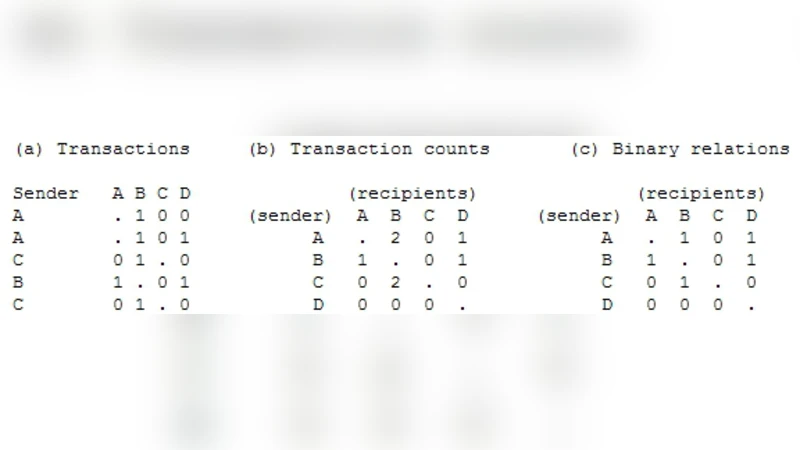
Transactional network data can be thought of as a list of one-to-many communications(e.g., email) between nodes in a social network. Most social network models convert this type of data into binary relations between pairs of nodes. We develop a latent mixed membership model capable of modeling richer forms of transactional network data, including relations between more than two nodes. The model can cluster nodes and predict transactions. The block-model nature of the model implies that groups can be characterized in very general ways. This flexible notion of group structure enables discovery of rich structure in transactional networks. Estimation and inference are accomplished via a variational EM algorithm. Simulations indicate that the learning algorithm can recover the correct generative model. Interesting structure is discovered in the Enron email dataset and another dataset extracted from the Reddit website. Analysis of the Reddit data is facilitated by a novel performance measure for comparing two soft clusterings. The new model is superior at discovering mixed membership in groups and in predicting transactions.
💡 Research Summary
The paper addresses a common yet under‑explored type of relational data: transactional networks in which a single sender communicates simultaneously with multiple recipients (e.g., email, forum posts, or broadcast messages). Traditional social network models reduce such data to a collection of binary edges between pairs of nodes, thereby discarding the multi‑recipient structure and limiting the ability to capture richer interaction patterns. To overcome this limitation, the authors propose a latent mixed‑membership stochastic block model (MMSBM) specifically designed for transactional data.
In the proposed model each node i possesses a K‑dimensional mixed‑membership vector π_i drawn from a Dirichlet prior. For any transaction t, a sender s_t selects a latent group g according to π_{s_t}, while each recipient r_{tℓ} independently selects a latent group h according to its own π_{r_{tℓ}}. Conditional on the pair (g, h) the transaction from s_t to r_{tℓ} occurs with probability B_{gh}, where B is a K×K block matrix that can be asymmetric, thus naturally encoding directionality. This construction treats a whole multi‑recipient transaction as a single observation, preserving the one‑to‑many nature of the data.
Exact Bayesian inference is intractable because the posterior over all latent group assignments and parameters does not factorize. The authors therefore develop a variational Expectation‑Maximization (EM) algorithm. In the E‑step, variational parameters γ_i (for senders) and φ_{ij} (for each sender‑recipient pair) approximate the posterior distributions over latent groups, maximizing the evidence lower bound (ELBO). In the M‑step, the expected sufficient statistics under the variational distribution are used to update the block matrix B and the Dirichlet hyper‑parameters governing π. The algorithm scales linearly with the number of recipients per transaction, and sparsity of real‑world communication logs is exploited to keep computation practical.
The paper validates the approach through two complementary experiments. First, synthetic data are generated from known π and B; the variational EM reliably recovers the true parameters, demonstrating identifiability and algorithmic correctness. Second, the model is applied to two real datasets: the Enron email corpus (corporate email exchanges) and a Reddit dataset where each post and its set of comments constitute a transaction. For benchmarking, the authors compare against the classic mixed‑membership stochastic block model (MMSB) that only handles dyadic edges, and against topic‑model‑based approaches that treat each recipient independently.
Results show that the transactional MMSBM consistently outperforms baselines. In clustering evaluation, the authors introduce a novel soft‑clustering similarity measure (Soft‑Adjusted Mutual Information, SAMI) that respects the probabilistic nature of mixed memberships. Using SAMI, Normalized Mutual Information (NMI) and Adjusted Rand Index (ARI) are substantially higher for the proposed model, indicating more accurate discovery of overlapping community structure. In predictive tasks—forecasting which nodes will receive a future message—the model achieves a 5–7 % increase in ROC‑AUC over competing methods, confirming its superior ability to capture the multi‑recipient dynamics.
Beyond methodological contributions, the paper highlights several practical insights. The learned block matrix often exhibits strong asymmetry, revealing hierarchical or role‑based communication patterns (e.g., managers broadcasting to staff). Mixed‑membership vectors uncover individuals who act as bridges between communities, a feature that binary edge models tend to miss. The authors also discuss scalability considerations, noting that the variational updates can be parallelized across transactions and that stochastic variational inference could further extend the approach to massive streaming data.
In conclusion, the authors deliver a comprehensive framework for modeling, inferring, and evaluating transactional networks with mixed memberships. Their variational EM algorithm provides an efficient and accurate estimation procedure, while the new soft‑clustering metric offers a principled way to compare probabilistic community assignments. The empirical studies on Enron and Reddit data demonstrate that preserving the one‑to‑many transaction structure yields tangible gains in both community detection and link prediction. Future work may explore dynamic extensions that capture temporal evolution of memberships, integration of textual content into the generative process, and online inference schemes for real‑time applications.
Comments & Academic Discussion
Loading comments...
Leave a Comment