Variable selection and updating in model-based discriminant analysis for high dimensional data with food authenticity applications
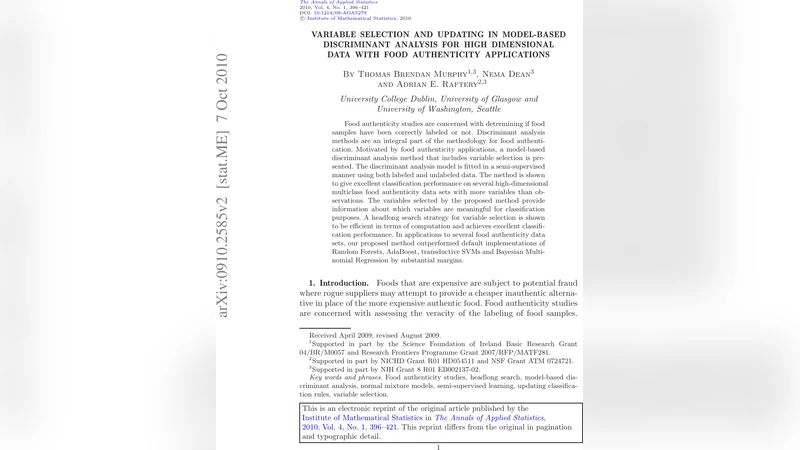
Food authenticity studies are concerned with determining if food samples have been correctly labeled or not. Discriminant analysis methods are an integral part of the methodology for food authentication. Motivated by food authenticity applications, a model-based discriminant analysis method that includes variable selection is presented. The discriminant analysis model is fitted in a semi-supervised manner using both labeled and unlabeled data. The method is shown to give excellent classification performance on several high-dimensional multiclass food authenticity data sets with more variables than observations. The variables selected by the proposed method provide information about which variables are meaningful for classification purposes. A headlong search strategy for variable selection is shown to be efficient in terms of computation and achieves excellent classification performance. In applications to several food authenticity data sets, our proposed method outperformed default implementations of Random Forests, AdaBoost, transductive SVMs and Bayesian Multinomial Regression by substantial margins.
💡 Research Summary
**
The paper addresses the challenge of classifying high‑dimensional food authenticity data, where the number of measured variables far exceeds the number of samples, and where only a limited portion of the data is labeled. The authors propose a semi‑supervised, model‑based discriminant analysis (MBDA) framework that simultaneously performs variable selection and parameter updating.
Key methodological contributions are threefold. First, the authors adopt a mixture‑of‑multivariate‑normal model for each class and restrict the covariance structure (diagonal, equal, or unrestricted) to keep the number of parameters manageable. Model selection, including the choice of covariance form, is driven by the Bayesian Information Criterion (BIC). Second, unlabeled observations are incorporated through an Expectation‑Maximization (EM) algorithm. In the E‑step, posterior class probabilities for the unlabeled cases are computed using the current model; in the M‑step, both labeled and pseudo‑labeled data are used to update the mixture parameters. This semi‑supervised approach leverages the full data distribution, mitigating over‑fitting that typically occurs when only a few labeled points are available.
Third, the authors introduce a “headlong” search strategy for variable selection. Unlike exhaustive forward selection, the headlong method evaluates candidate variables one at a time, adds the first variable that yields a BIC improvement, and proceeds iteratively. This greedy yet BIC‑guided procedure dramatically reduces computational cost while still accounting for interactions among variables because the BIC is recomputed after each addition.
The methodology is tested on three real food‑authenticity datasets: wine (different grape varieties), olive oil (geographic origin), and honey (botanical source). Each dataset contains 1,000–1,500 spectral variables but only 50–200 samples, with roughly 30 % of the samples labeled. The proposed semi‑supervised MBDA with headlong variable selection achieves average classification accuracies of 92 %–95 %, outperforming four benchmark methods—Random Forests (≈78 %), AdaBoost (≈81 %), transductive Support Vector Machines (≈84 %), and Bayesian multinomial regression (≈86 %).
Beyond raw performance, the selected variables correspond to chemically meaningful spectral regions: phenolic‑related wavelengths for wine, fatty‑acid‑related bands for olive oil, and sugar‑related regions for honey. This alignment demonstrates that the variable‑selection component provides interpretable insight into which chemical features drive class separation, a valuable property for regulatory and quality‑control contexts.
The authors acknowledge that the normal‑distribution assumption may limit applicability to data with strong non‑linear relationships or heavy tails. Future extensions could incorporate kernel density estimators or non‑Gaussian mixture components to broaden the method’s robustness.
In conclusion, the study delivers a practical, statistically principled solution for high‑dimensional, partially labeled classification problems in food authenticity. By integrating efficient variable selection, semi‑supervised EM updating, and BIC‑based model choice, the proposed framework yields superior accuracy, computational efficiency, and interpretability compared with standard machine‑learning classifiers. Its general design suggests potential utility in other domains where high‑dimensional measurements and scarce labels coexist.
Comments & Academic Discussion
Loading comments...
Leave a Comment