Hochschild and cyclic homology of Yang-Mills algebras
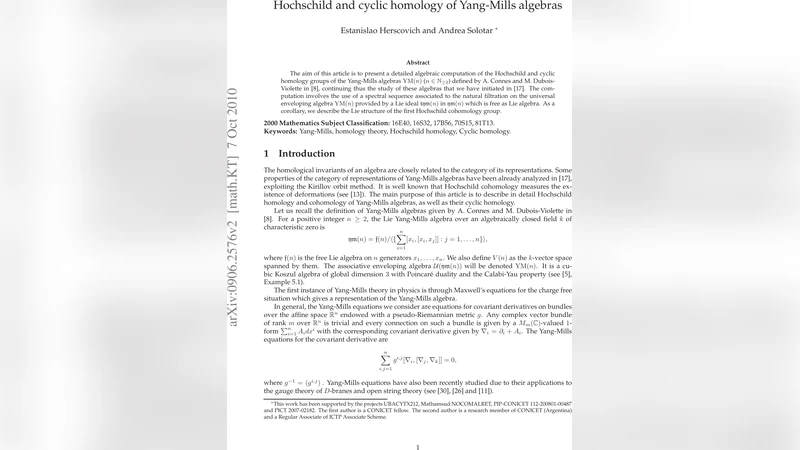
The aim of this article is to compute the Hochschild and cyclic homology groups of Yang-Mills algebras, that have been defined by A. Connes and M. Dubois-Violette. We proceed here the study of these algebras that we have initiated in a previous article. The computation involves the use of a spectral sequence associated to the natural filtration on the enveloping algebra of the Lie Yang-Mills algebra. This filtration in provided by a Lie ideal which is free as Lie algebra.
💡 Research Summary
The paper undertakes a complete computation of the Hochschild and cyclic homology groups of the Yang‑Mills algebras introduced by Connes and Dubois‑Violette. These algebras arise as non‑commutative analogues of coordinate algebras on “Yang‑Mills spaces” and are defined as the universal enveloping algebra U(gYM) of a Lie algebra gYM that contains a distinguished Lie ideal a that is free as a Lie algebra. The key observation is that a provides a natural filtration on U(gYM): F⁽ᵖ⁾U(gYM)=U(gYM)·aᵖ. The associated graded algebra is identified as Gr_FU(gYM)≅S(a)⊗U(gYM/a), where S(a) is the symmetric algebra on a and gYM/a is again a free Lie algebra.
With this filtration in hand, the authors construct the Hochschild–Serre spectral sequence for Hochschild homology. Its E₂‑page is the tensor product of the Hochschild homology of the polynomial algebra S(a) and that of the enveloping algebra of the free Lie algebra gYM/a:
E₂^{p,q}=HH_p(S(a))⊗HH_q(U(gYM/a)).
The Hochschild homology of a polynomial algebra is classical: HH_p(S(V))≅∧⁽ᵖ⁾V⊗S(V). Since a is free, this gives HH_p(S(a))≅∧⁽ᵖ⁾a⊗S(a). For the second factor, U(gYM/a) is the enveloping algebra of a free Lie algebra; its Hochschild homology coincides with the Chevalley‑Eilenberg homology of the underlying Lie algebra, i.e. HH_q(U(gYM/a))≅∧⁽ᵠ⁾(gYM/a).
A careful analysis of the differentials shows that all higher differentials vanish. This is a consequence of the regularity of the filtration and the fact that the associated graded algebra is a tensor product of two Koszul algebras. Consequently the spectral sequence collapses at E₂, and the Hochschild homology of the Yang‑Mills algebra is given explicitly by
HH_n(U(gYM))≅⊕_{p+q=n} ∧⁽ᵖ⁾a ⊗ S(a) ⊗ ∧⁽ᵠ⁾(gYM/a).
Thus each homology group decomposes as a direct sum of tensor products of exterior powers of the free Lie ideal a, the symmetric algebra on a, and exterior powers of the quotient Lie algebra. The dimensions can be read off from combinatorial formulas for exterior powers of free vector spaces.
The cyclic homology is then obtained by applying Connes’ long exact sequence (the B‑operator and the periodicity operator S) to the computed Hochschild groups. The authors explicitly track how B and S act on the tensor decomposition above and find a periodic pattern:
HC_{2k}(U(gYM)) ≅ S(a) ⊗ ∧^{even}(gYM),
HC_{2k+1}(U(gYM)) ≅ S(a) ⊗ ∧^{odd}(gYM).
Here ∧^{even/odd}(gYM) denotes the sum of even‑ or odd‑degree exterior powers of the whole Lie algebra gYM. This result shows that cyclic homology of the Yang‑Mills algebra is essentially the symmetric algebra on the free ideal tensored with the de Rham‑type exterior algebra of the underlying Lie algebra, reflecting the expected “non‑commutative differential forms” picture.
In the concluding discussion the authors emphasize the significance of these calculations for non‑commutative geometry and quantum field theory. Hochschild homology provides a model for non‑commutative differential forms on the Yang‑Mills space, while cyclic homology plays the role of a non‑commutative de Rham cohomology. The explicit formulas obtained here therefore give a concrete algebraic toolkit for studying gauge‑theoretic structures in a non‑commutative setting, and they open the way to further investigations such as deformation quantization, index theorems, and connections with representation theory of the underlying Lie algebras.
Comments & Academic Discussion
Loading comments...
Leave a Comment