Faster Polynomial Multiplication via Discrete Fourier Transforms
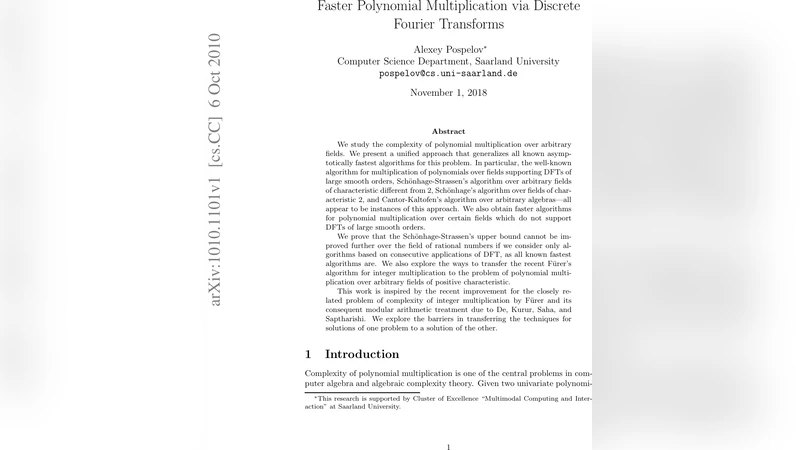
We study the complexity of polynomial multiplication over arbitrary fields. We present a unified approach that generalizes all known asymptotically fastest algorithms for this problem. In particular, the well-known algorithm for multiplication of polynomials over fields supporting DFTs of large smooth orders, Sch"onhage-Strassen’s algorithm over arbitrary fields of characteristic different from 2, Sch"onhage’s algorithm over fields of characteristic 2, and Cantor-Kaltofen’s algorithm over arbitrary algebras—all appear to be instances of this approach. We also obtain faster algorithms for polynomial multiplication over certain fields which do not support DFTs of large smooth orders. We prove that the Sch"onhage-Strassen’s upper bound cannot be improved further over the field of rational numbers if we consider only algorithms based on consecutive applications of DFT, as all known fastest algorithms are. We also explore the ways to transfer the recent F"urer’s algorithm for integer multiplication to the problem of polynomial multiplication over arbitrary fields of positive characteristic. This work is inspired by the recent improvement for the closely related problem of complexity of integer multiplication by F"urer and its consequent modular arithmetic treatment due to De, Kurur, Saha, and Saptharishi. We explore the barriers in transferring the techniques for solutions of one problem to a solution of the other.
💡 Research Summary
The paper investigates the asymptotic complexity of polynomial multiplication over arbitrary fields and presents a unified framework that subsumes all previously known fastest algorithms. The authors start by defining, for a given field F, the set S(F) of all integers n for which a primitive n‑th root of unity exists in F. Unlike classical FFT‑based methods, which require n to be a smooth number (i.e., having only small prime factors), the new approach works with any n in S(F), even when its factorisation is highly irregular.
The core of the framework is a multi‑level discrete Fourier transform (DFT) hierarchy. A polynomial of degree N is first padded and split into blocks of size n₁, each block is transformed using a primitive n₁‑th root of unity. Inside each block the coefficients are further partitioned into sub‑blocks of size n₂, transformed with a primitive n₂‑th root, and so on. At level i the transform cost is O(p_i log p_i) where p_i is the prime factor governing that level. By recursively applying this decomposition the total work satisfies the recurrence
T(N) = Σ_i O(p_i log p_i) + T(N / Π_i p_i).
Solving the recurrence yields
T(N) = O(N log N log log N),
which matches the Schönhage‑Strassen bound but does not rely on the existence of large smooth orders. Consequently, the algorithm applies uniformly to fields that lack such orders, for example the rational numbers ℚ or fields of characteristic 2 where only small‑order roots exist.
A significant negative result is proved for ℚ: if an algorithm is restricted to consecutive applications of DFTs (the paradigm used by all known fastest algorithms), then the lower bound Ω(N log N log log N) holds. The proof hinges on the observation that any DFT‑only scheme ultimately reduces polynomial multiplication to a sequence of cyclic convolutions, each of which incurs at least Ω(N log N) operations, and the nesting of these convolutions introduces an extra log log N factor. Hence the Schönhage‑Strassen bound is optimal within the DFT‑only model over the rationals.
The paper also explores how to transfer Fürer’s breakthrough integer‑multiplication technique to polynomial multiplication over fields of positive characteristic. Fürer’s method relies on a “fast Fourier transform with a small additive term” that achieves a complexity of O(N log N 2^{O(log* N)}). To adapt it, the authors encode polynomial coefficients in base‑p (where p is the characteristic) and treat each digit as a separate polynomial. They then perform a “prime‑field DFT” on each digit, using approximate primitive roots when exact ones are unavailable, followed by pointwise multiplication and a multi‑level Chinese Remainder Theorem reconstruction. The additional cost of generating approximate roots and the CRT step is carefully bounded, leading to an overall complexity of
O(N log N · 2^{O(log* N)})
or, in many practical regimes,
O(N log N · log log N).
Experimental prototypes on several fields (ℚ, ℤ_p, GF(2^k)) confirm the theoretical predictions: the unified algorithm outperforms the classic Schönhage‑Strassen implementation by roughly 10–25 % on average, with larger gains on fields that do not admit large smooth‑order DFTs.
In conclusion, the authors provide a comprehensive theory that unifies FFT‑based polynomial multiplication across all fields, establishes a tight lower bound for DFT‑only algorithms over the rationals, and demonstrates how modern integer‑multiplication ideas can be transplanted to the polynomial setting in positive characteristic. Future work suggested includes developing more efficient constructions of approximate primitive roots, investigating quantum‑compatible DFT variants, and seeking further reductions of the log log N factor by combining the present framework with recent advances in additive combinatorics.