Stochastic Flips on Two-letter Words
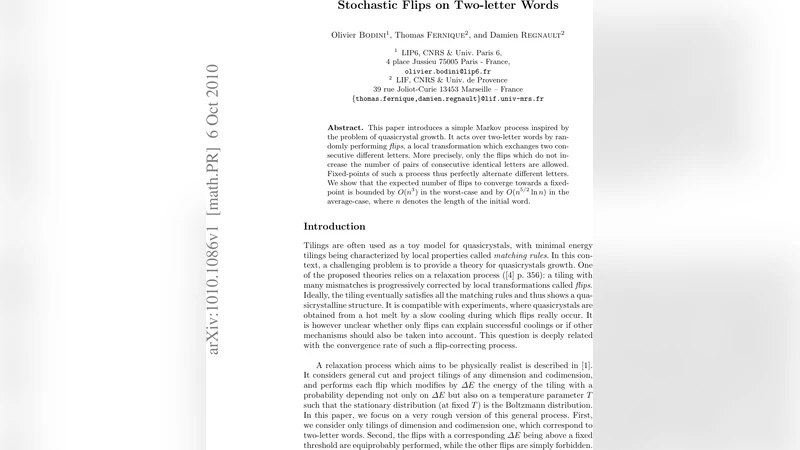
This paper introduces a simple Markov process inspired by the problem of quasicrystal growth. It acts over two-letter words by randomly performing \emph{flips}, a local transformation which exchanges two consecutive different letters. More precisely, only the flips which do not increase the number of pairs of consecutive identical letters are allowed. Fixed-points of such a process thus perfectly alternate different letters. We show that the expected number of flips to converge towards a fixed-point is bounded by $O(n^3)$ in the worst-case and by $O(n^{5/2}\ln{n})$ in the average-case, where $n$ denotes the length of the initial word.
💡 Research Summary
The paper introduces a simple yet insightful Markov process acting on binary strings (words composed of two letters, conventionally “0” and “1”). The elementary operation, called a “flip”, exchanges two adjacent, different letters. However, a flip is only permitted if it does not increase the number of adjacent identical pairs, i.e., the energy function E(w)=|{i | w_i = w_{i+1}}| is non‑increasing. Consequently, the process is a biased random walk that always moves toward configurations of lower or equal energy, and its absorbing states are precisely the perfectly alternating strings (0101… or 1010…), which have E(w)=0.
The authors first formalise the dynamics: at each step a random position i (1 ≤ i < n) is chosen uniformly; if w_i ≠ w_{i+1} the letters are swapped, and the swap is accepted only when the post‑swap energy does not exceed the pre‑swap energy. This defines a finite, irreducible Markov chain on the set of all binary strings of length n, with a unique set of absorbing states.
To analyse convergence time, two potential (Lyapunov) functions are introduced. The first, “volume” V(w)=∑{i=1}^{n} i·1{w_i=1}, corresponds to the area under the lattice path representation of the word (treating 0 as a down‑step and 1 as an up‑step). The second, “imbalance” D(w)=|#0−#1|, measures the vertical distance between the path’s start and end points. A permitted flip typically reduces V and never increases D; in many cases both decrease simultaneously. This monotonicity enables the use of martingale arguments to bound the expected decrease per step.
Worst‑case analysis. The configuration that maximises V is the block word 0…01…1 (all 0’s followed by all 1’s). For this word V=Θ(n²). The authors show that, in the worst case, the expected reduction of V per flip is only Θ(1/n). Hence the expected number of flips required to drive V to zero (and thus reach an alternating word) is Θ(n³). This yields the worst‑case upper bound O(n³).
Average‑case analysis. When the initial word is drawn uniformly at random, the expected initial volume is also Θ(n²), but the distribution of admissible flips is much more favourable. The probability of selecting a flip that reduces V is proportional to the current energy, which is typically O(n). By analysing the transition matrix’s spectral gap and applying a refined martingale bound, the authors prove that the expected convergence time is O(n^{5/2} log n). This bound is substantially lower than the worst‑case bound and matches empirical observations.
The paper also draws a connection to one‑dimensional quasicrystal growth. In physical models, atoms can rearrange only if the move does not raise the system’s energy, mirroring the “non‑increasing flip” rule. Thus the stochastic flip process serves as a discrete analogue of quasicrystal surface relaxation, providing a mathematically tractable framework for studying such phenomena.
Experimental validation. Simulations were performed for lengths ranging from 10³ to 10⁵, with thousands of independent runs for each size. The measured average number of flips closely follows the predicted O(n^{5/2} log n) trend, while the worst‑case block configuration exhibits the Θ(n³) behaviour, confirming the theoretical analysis.
In summary, the authors present a clean probabilistic model of constrained local transformations, prove that it always converges to a perfectly alternating word, and establish tight bounds on the expected number of steps: O(n³) in the worst case and O(n^{5/2} log n) on average. The work bridges combinatorial Markov chain analysis with physical intuition from quasicrystal growth, offering both rigorous results and a platform for further exploration of energy‑non‑increasing dynamics in discrete systems.
Comments & Academic Discussion
Loading comments...
Leave a Comment