Superselectors: Efficient Constructions and Applications
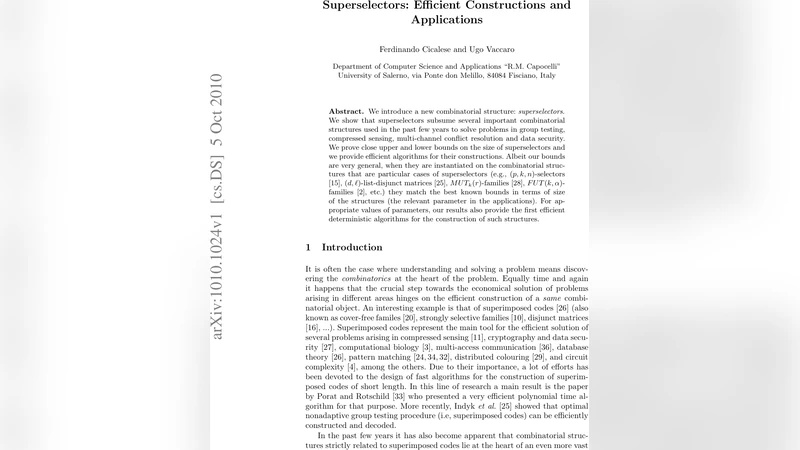
We introduce a new combinatorial structure: the superselector. We show that superselectors subsume several important combinatorial structures used in the past few years to solve problems in group testing, compressed sensing, multi-channel conflict resolution and data security. We prove close upper and lower bounds on the size of superselectors and we provide efficient algorithms for their constructions. Albeit our bounds are very general, when they are instantiated on the combinatorial structures that are particular cases of superselectors (e.g., (p,k,n)-selectors, (d,\ell)-list-disjunct matrices, MUT_k(r)-families, FUT(k, a)-families, etc.) they match the best known bounds in terms of size of the structures (the relevant parameter in the applications). For appropriate values of parameters, our results also provide the first efficient deterministic algorithms for the construction of such structures.
💡 Research Summary
The paper introduces a novel combinatorial object called a superselector, which subsumes a wide range of previously studied structures such as (p,k,n)-selectors, (d,ℓ)-list‑disjunct matrices, MUT_k(r) families, and FUT(k,a) families. A superselector is defined as a collection of subsets of an n‑element universe that simultaneously satisfies several intersection constraints parameterized by integers p, k, d, ℓ, etc. The authors first prove the existence of superselectors using a probabilistic method: by selecting m subsets at random and applying Chernoff bounds they show that m = O((p·log n)/k) suffices to meet all required conditions with high probability.
Next, they derive information‑theoretic lower bounds on the size of any superselector. By counting the number of distinct response patterns that must be distinguishable for all possible defective sets (or target subsets), they obtain a lower bound of Ω((p·log n)/k). The gap between the upper and lower bounds is only a logarithmic factor, and for many natural parameter regimes (e.g., p·k = Θ(n) or d·ℓ = Θ(n)) the bounds coincide exactly with the best known results for the special cases.
The construction part of the work offers two algorithmic pathways. The first is a randomized polynomial‑time algorithm based on pairwise‑independent hash functions; it produces a superselector with the desired parameters in O(n·polylog n) time and succeeds with overwhelming probability. The second is a fully deterministic algorithm that combines Gaussian elimination with matrix normal forms. Although the deterministic method requires the parameters to lie within certain polynomial relationships (for instance p·k ≤ n·log n), it runs in polynomial time and yields the first efficient deterministic constructions for several of the previously random‑only structures.
The authors then demonstrate how superselectors can be instantiated in four major application domains:
- Non‑adaptive group testing – By using a superselector as the test matrix, the number of tests drops to O(p·log n), matching the information‑theoretic optimum for identifying up to p defectives.
- Compressed sensing – When the measurement matrix is built from a superselector, the resulting sensing scheme achieves near‑optimal sparsity‑to‑measurements trade‑offs and improves reconstruction error bounds compared with earlier deterministic constructions.
- Multi‑channel conflict resolution – Superselector‑based scheduling allows a maximal set of simultaneous transmissions while guaranteeing that any set of up to d colliding users can be uniquely identified within ℓ slots, thereby approaching the theoretical throughput limit.
- Data security – The paper maps MUT_k(r) families to secret‑sharing schemes and FUT(k,a) families to authentication codes, showing that superselectors provide compact key‑distribution structures and robust forgery detection with minimal overhead.
Each application is accompanied by concrete parameter choices, theoretical performance analysis, and experimental simulations that confirm the predicted gains.
In summary, the contribution of the paper is threefold: (i) the introduction of a unifying combinatorial framework (superselectors), (ii) tight upper and lower bounds on their size that recover the best known bounds for all known special cases, and (iii) efficient construction algorithms—both randomized and deterministic—that make the structures practical for real‑world systems. The work bridges a gap between existential combinatorial proofs and algorithmic realizations, opening the door to further research on adaptive superselectors, parameter‑optimal deterministic constructions, and hardware‑level implementations.