Adding a referee to an interconnection network: What can(not) be computed in one round
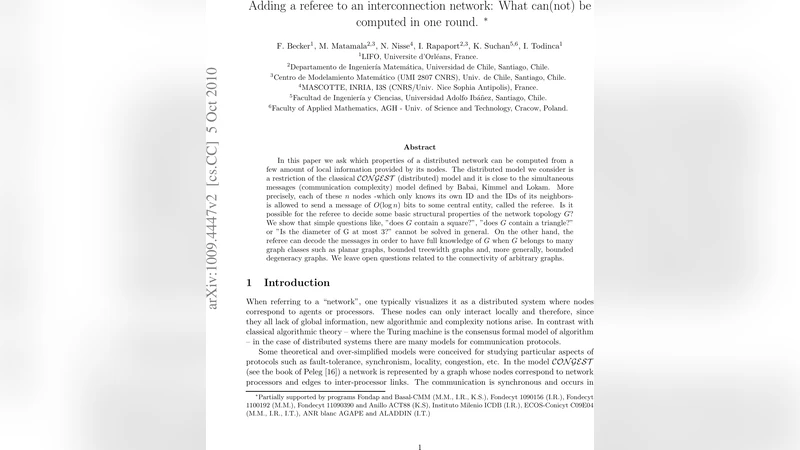
In this paper we ask which properties of a distributed network can be computed from a little amount of local information provided by its nodes. The distributed model we consider is a restriction of the classical CONGEST (distributed) model and it is close to the simultaneous messages (communication complexity) model defined by Babai, Kimmel and Lokam. More precisely, each of these n nodes -which only knows its own ID and the IDs of its neighbors- is allowed to send a message of O(log n) bits to some central entity, called the referee. Is it possible for the referee to decide some basic structural properties of the network topology G? We show that simple questions like, “does G contain a square?”, “does G contain a triangle?” or “Is the diameter of G at most 3? cannot be solved in general. On the other hand, the referee can decode the messages in order to have full knowledge of G when G belongs to many graph classes such as planar graphs, bounded treewidth graphs and, more generally, bounded degeneracy graphs. We leave open questions related to the connectivity of arbitrary graphs.
💡 Research Summary
The paper introduces a highly restricted distributed computing model, called the “referee model,” that sits between the classic CONGEST model and the simultaneous‑message communication‑complexity model of Babai, Kimmel and Lokam. In this setting each of the n nodes knows only its own identifier and the identifiers of its immediate neighbors. Communication consists of a single synchronous round: every node sends a message of size O(log n) bits to a central entity, the referee, who must decide global properties of the underlying graph G or even reconstruct G entirely.
The authors first establish strong impossibility results for unrestricted graphs. Using information‑theoretic arguments and reductions from classic communication‑complexity lower bounds, they show that the referee cannot determine whether G contains a triangle, a square (4‑cycle), or whether the diameter of G is at most three, when each node is limited to O(log n) bits. The core of the argument is that any two graphs that differ on the property of interest can be made locally indistinguishable to all nodes; consequently the messages they emit are identical with high probability, and the referee’s view does not contain enough entropy to separate the cases. In particular, detecting a triangle would require each node to convey whether any two of its neighbors are adjacent—a piece of information that cannot be compressed into O(log n) bits for arbitrary degree.
Despite these negative results, the paper demonstrates that for several well‑structured graph families the referee can indeed recover the entire topology from the same limited communication. The key insight is that such families have bounded global density and admit compact local encodings.
-
Planar graphs – Each node can list its incident edges in cyclic order around the embedding. This ordering can be encoded in O(log n) bits because the degree of a planar vertex is O(1) on average, and the referee can reconstruct the planar embedding by stitching together the cyclic orders.
-
Bounded‑treewidth graphs – A tree‑decomposition of width k exists with bags of size k + 1. Nodes transmit the identifier of the bag they belong to together with their position inside the bag. Since the number of bags is O(n) and each bag is small, the total information fits into the O(log n) budget per node, allowing the referee to rebuild the decomposition and thus the whole graph.
-
Bounded‑degeneracy (d‑degenerate) graphs – Such graphs admit a degeneracy ordering where each vertex has at most d later neighbors. Nodes send their rank in this ordering and the list of later neighbors (at most d identifiers). Because d is a constant, the message size remains O(log n). The referee, by processing the vertices in reverse order, can reconstruct all edges exactly.
The reconstruction algorithms are explicit: the referee collects all messages, builds hash tables for identifier mapping, decodes the compact encodings, and then applies the class‑specific reconstruction rule (e.g., gluing cyclic orders for planar graphs, assembling bags for bounded‑treewidth graphs). All steps run in O(n log n) time, making the approach practical for large networks.
The paper leaves open the question of connectivity for arbitrary graphs. Determining whether G is connected seems to require more than O(log n) bits per node, as a single bridge could be hidden from all local views. The authors suggest that allowing a few additional rounds or slightly larger messages might bridge this gap, and they point to future work on other restricted families (e.g., bounded chromatic number, bounded clustering coefficient).
In summary, the work delineates a clear boundary: with only one round of O(log n)‑bit messages, the referee cannot answer even elementary subgraph‑existence queries on general graphs, yet for many sparsity‑constrained families the same communication budget suffices to reconstruct the entire network. This contributes a nuanced understanding of how much global knowledge can be extracted from minimal local information in distributed systems.
Comments & Academic Discussion
Loading comments...
Leave a Comment