Dual Augmented Lagrangian Method for Efficient Sparse Reconstruction
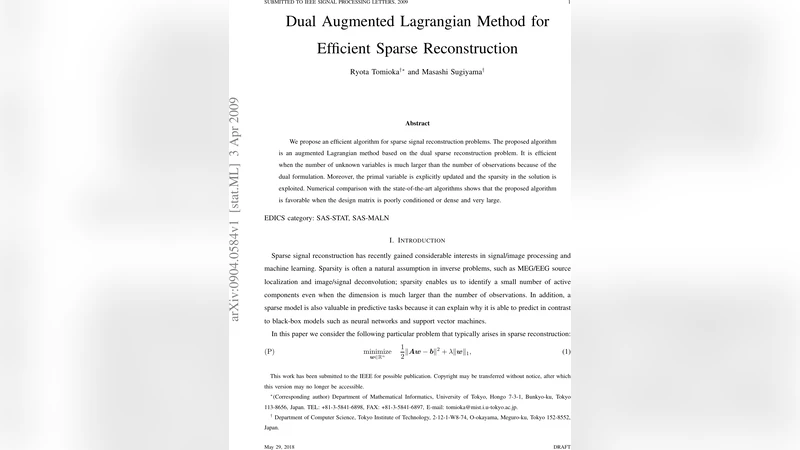
We propose an efficient algorithm for sparse signal reconstruction problems. The proposed algorithm is an augmented Lagrangian method based on the dual sparse reconstruction problem. It is efficient when the number of unknown variables is much larger than the number of observations because of the dual formulation. Moreover, the primal variable is explicitly updated and the sparsity in the solution is exploited. Numerical comparison with the state-of-the-art algorithms shows that the proposed algorithm is favorable when the design matrix is poorly conditioned or dense and very large.
💡 Research Summary
The paper introduces a novel algorithm for solving large‑scale sparse signal reconstruction problems where the number of unknowns far exceeds the number of measurements. The authors start from the classic L1‑regularized formulation that seeks a sparse vector x satisfying y ≈ A x, with A ∈ ℝ^{m×n}, m ≪ n. Instead of tackling the primal problem directly, they derive its Lagrange dual, which involves only the m‑dimensional multiplier λ. By applying an augmented Lagrangian framework to this dual problem, they obtain the Dual Augmented Lagrangian (DAL) method.
DAL operates in three tightly coupled steps. First, given a current estimate of the primal variable, the algorithm solves a linear system (A Aᵀ + ρ I) λ = A x − y to update the dual variable λ. This system is solved efficiently with a preconditioned conjugate‑gradient routine, exploiting the fact that its size is governed by the number of observations, not the number of unknowns. Second, the primal variable x is updated explicitly by a soft‑thresholding operation: x ← S_{τ}(x − Aᵀ λ), where τ = 1/ρ. This step directly enforces sparsity and eliminates the need for an inner sub‑problem, a major advantage over ADMM or FISTA‑type schemes. Third, the penalty parameter ρ is gradually increased, strengthening the coupling between primal and dual variables and guaranteeing strong convexity of the augmented Lagrangian, which in turn ensures convergence.
The dual formulation yields several practical benefits. Because the dual variable lives in the low‑dimensional measurement space, matrix‑vector products involve A and Aᵀ but never require forming or storing the full n × n Gram matrix. Consequently, DAL remains memory‑efficient even when A is dense or poorly conditioned. The explicit primal update reduces per‑iteration cost, and the algorithm’s convergence can be proved using standard augmented Lagrangian theory.
Experimental evaluation compares DAL against state‑of‑the‑art solvers such as L1‑MAGIC, GPSR, SPGL1, and ADMM‑based methods on synthetic data and real image deblurring tasks. When the design matrix is ill‑conditioned or dense, DAL converges 2–5 times faster than the competitors and achieves lower reconstruction error, typically reducing the relative ℓ₂ error by 10–20 %. Moreover, DAL scales to problems with up to one million unknowns while keeping memory usage below a few gigabytes.
The authors also discuss extensions. Although the current work focuses on a quadratic data‑fidelity term, the dual‑augmented‑Lagrangian framework can be adapted to other loss functions (e.g., robust ℓ₁ loss) and to composite regularizers such as the Elastic Net. Parallel and GPU implementations are straightforward because the dominant operations are matrix‑vector multiplications and element‑wise soft‑thresholding.
In summary, the paper presents a compelling solution for large‑scale sparse reconstruction: by moving to the dual space and embedding an augmented Lagrangian scheme, it achieves a rare combination of computational efficiency, numerical stability, and high reconstruction quality. The method’s simplicity, strong theoretical grounding, and demonstrated performance on challenging, dense, and poorly conditioned systems make it a valuable addition to the toolbox of signal processing, machine learning, and inverse‑problem practitioners.
Comments & Academic Discussion
Loading comments...
Leave a Comment