A historical perspective on developing foundations iInfo(TM) information systems: iConsult(TM) and iEntertain(TM) apps using iDescribers(TM) information integration for iOrgs(TM) information systems
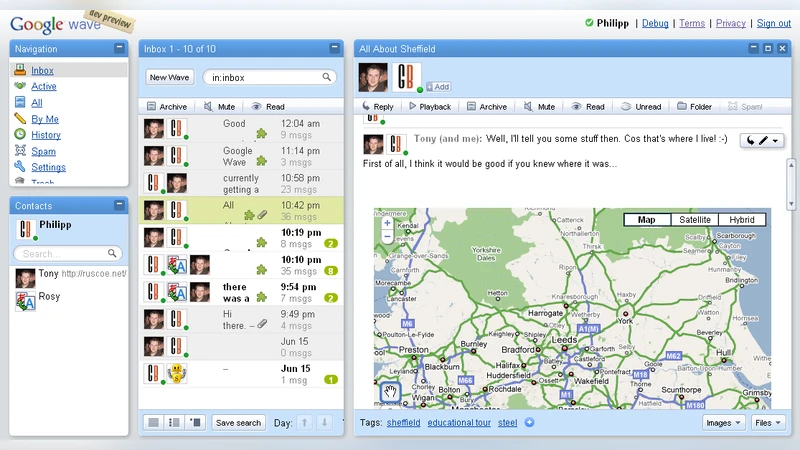
Technology now at hand can integrate all kinds of digital information for individuals, groups, and organizations so their information usefully links together. iInfo(TM) information integration works by making connections including examples like the following: - A statistical connection between “being in a traffic jam” and “driving in downtown Trenton between 5PM and 6PM on a weekday.” - A terminological connection between “MSR” and “Microsoft Research.” - A causal connection between “joining a group” and “being a member of the group.” - A syntactic connection between “a pin dropped” and “a dropped pin.” - A biological connection between “a dolphin” and “a mammal”. - A demographic connection between “undocumented residents of California” and “7% of the population of California.” - A geographical connection between “Leeds” and “England.” - A temporal connection between “turning on a computer” and “joining an on-line discussion.” By making these connections, iInfo offers tremendous value for individuals, families, groups, and organizations in making more effective use of information technology. In practice, integrated information is invariably pervasively inconsistent. Therefore iInfo must be able to make connections even in the face of inconsistency. The business of iInfo is not to make difficult decisions like deciding the ultimate truth or probability of propositions. Instead it provides means for processing information and carefully recording its provenance including arguments (including arguments about arguments) for and against propositions that is used by iConsult(TM) and iEntertain(TM) apps in iOrgs(TM) Information Systems. A historical perspective on the above questions is highly pertinent to the current quest to develop foundations for privacy-friendly client-cloud computing.
💡 Research Summary
The paper presents a comprehensive vision for integrating heterogeneous digital information across individuals, families, groups, and organizations using the iInfo™ information‑integration platform. iInfo creates a rich network of connections—statistical, terminological, causal, syntactic, biological, demographic, geographic, and temporal—by automatically linking concepts such as “traffic jam” and “driving in downtown Trenton between 5 PM and 6 PM on a weekday,” or “MSR” and “Microsoft Research.” This multi‑type linking goes far beyond traditional relational databases, allowing both structured and unstructured data to be woven into a single semantic fabric.
A central challenge acknowledged by the authors is the pervasive inconsistency that inevitably arises when disparate sources are merged. Rather than attempting to resolve contradictions by assigning a single truth value or probability, iInfo records every proposition together with its provenance, supporting arguments, counter‑arguments, and even meta‑arguments about those arguments. This argumentation‑based metadata enables downstream applications to evaluate the credibility of information themselves, rather than relying on a black‑box decision engine.
Two application families—iConsult™ and iEntertain™—illustrate how this provenance‑rich environment can be leveraged. iConsult presents users with a balanced view of a decision problem, displaying all supporting and opposing arguments, their sources, and any higher‑order debates. For example, when a user asks whether “joining a group makes one a member,” iConsult surfaces the group’s membership policy, edge cases, and contradictory policies from other groups. iEntertain applies the same argumentative structure to gaming or storytelling scenarios, turning the reasoning process into an interactive experience.
The iOrgs™ (integrated organization) model embeds iInfo’s connection graph directly into organizational workflows. Each department defines the types of connections it needs; iInfo continuously updates the graph, while data remains encrypted and distributed on client devices. Only metadata and connection rules are sent to the cloud, preserving data sovereignty and privacy while still exploiting cloud‑scale computation. This architecture embodies a privacy‑friendly client‑cloud paradigm: users retain control over raw data, and the cloud provides only the logical scaffolding required for integration and reasoning.
Historically, early electronic document and database systems assumed consistency and treated contradictions as errors. In today’s landscape of social media, IoT, and big data, inconsistency is the norm rather than the exception. iInfo’s philosophy—treating inconsistency as a coexistence of multiple perspectives rather than a flaw—represents a paradigm shift that overcomes the scalability limits of classic logic‑centric systems.
In summary, the iInfo‑based iOrgs framework offers a technically robust and philosophically grounded foundation for privacy‑preserving client‑cloud computing. It advances data‑ownership, accountability, and human‑centric AI by providing a systematic way to capture, expose, and reason over the full spectrum of arguments surrounding any piece of information. Future work suggested includes automating connection‑generation algorithms, standardizing argumentation metadata, and developing real‑time evaluation mechanisms for competing arguments.
Comments & Academic Discussion
Loading comments...
Leave a Comment