Hochschild cohomology and Atiyah classes
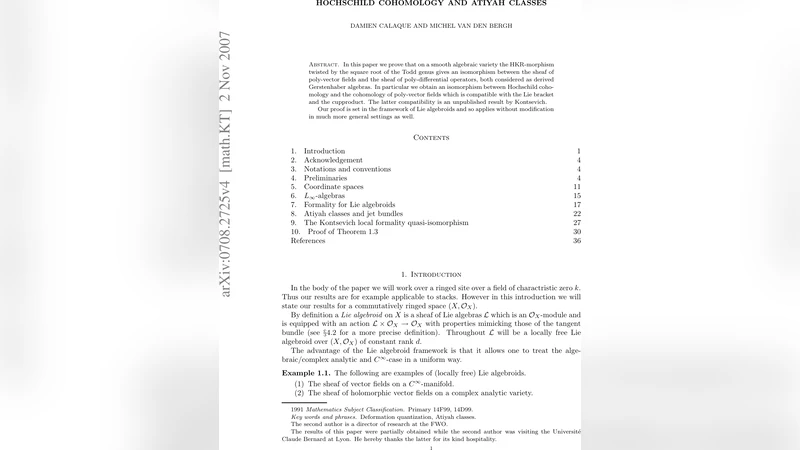
In this paper we prove that on a smooth algebraic variety the HKR-morphism twisted by the square root of the Todd genus gives an isomorphism between the sheaf of poly-vector fields and the sheaf of poly-differential operators, both considered as derived Gerstenhaber algebras. In particular we obtain an isomorphism between Hochschild cohomology and the cohomology of poly-vector fields which is compatible with the Lie bracket and the cupproduct. The latter compatibility is an unpublished result by Kontsevich. Our proof is set in the framework of Lie algebroids and so applies without modification in much more general settings as well.
💡 Research Summary
The paper establishes a precise and structure‑preserving isomorphism between the sheaf of poly‑vector fields and the sheaf of poly‑differential operators on a smooth algebraic variety, thereby identifying Hochschild cohomology with the cohomology of poly‑vector fields. The classical Hochschild–Kostant–Rosenberg (HKR) map sends a poly‑vector field to a Hochschild cochain, but it fails to be an isomorphism on the level of Gerstenhaber algebras: it does not respect either the Lie bracket (the Schouten–Nijenhuis bracket on poly‑vectors versus the Gerstenhaber bracket on Hochschild cochains) or the cup product.
The authors remedy this defect by twisting the HKR map with the square root of the Todd class, √td_X. The Todd class td_X ∈ H^{2*}(X,ℚ) is the characteristic class appearing in the Grothendieck–Riemann–Roch theorem; its square root can be defined in rational cohomology and encodes precisely the curvature corrections needed to align the two algebraic structures.
The construction is carried out in the language of Lie algebroids. Let 𝔞 = (T_X, 𝒪_X) be the tangent Lie algebroid of the variety X. The Atiyah class a_X ∈ Ext¹(T_X, T_X ⊗ Ω¹_X) is the obstruction to the existence of a global holomorphic connection on T_X and can be interpreted as the curvature of the universal 𝔞‑connection. By taking successive powers of a_X and forming the appropriate exponential, one recovers √td_X.
Using this data, the authors define a global 𝔞‑connection ∇ on the sheaf of poly‑vector fields. Applying ∇ to a poly‑vector field produces a differential operator; inserting this operator into the HKR formula yields a map
Φ_{√td} : ∧⁎T_X → ⊕_{n} Diffⁿ_X
which is a quasi‑isomorphism of complexes. Moreover, because the curvature terms are exactly compensated by √td_X, Φ_{√td} respects both the Gerstenhaber bracket and the cup product. Consequently, the induced map on cohomology
HH⁎(X) ≅ H⁎(X, ∧⁎T_X)
is an isomorphism of graded Gerstenhaber algebras. This confirms an unpublished claim of Kontsevich that the HKR map, after appropriate Todd‑class correction, is compatible with the full Gerstenhaber structure.
The proof avoids local coordinate calculations; instead it relies on functorial properties of Lie algebroid modules and the universal Atiyah class. This makes the argument robust and readily adaptable to more general contexts: derived schemes, complex analytic spaces, and even certain non‑commutative settings where a suitable Lie algebroid and Atiyah class exist.
Beyond the main theorem, the authors discuss several implications. In deformation quantization, Hochschild cohomology controls formal deformations of the structure sheaf, while poly‑vector fields encode Poisson structures; the isomorphism therefore provides a canonical bridge between Poisson geometry and deformation theory. In cyclic homology and index theory, the Todd‑class twist mirrors the appearance of the Todd class in the Riemann–Roch formula, suggesting deeper links between algebraic K‑theory and Hochschild invariants. Finally, the method offers a template for transferring higher algebraic structures (A∞, L∞) across the HKR correspondence, potentially simplifying the construction of formality morphisms in broader geometric settings.
In summary, by integrating the Atiyah class and the square root of the Todd genus into the HKR framework, the authors achieve a fully compatible Gerstenhaber‑algebra isomorphism between Hochschild cohomology and poly‑vector field cohomology. This result not only resolves a subtle compatibility issue left open in earlier work but also opens new avenues for applications in deformation theory, index theorems, and higher‑categorical algebraic geometry.
Comments & Academic Discussion
Loading comments...
Leave a Comment