Cliquishness and Quasicontinuity of Two Variables Maps
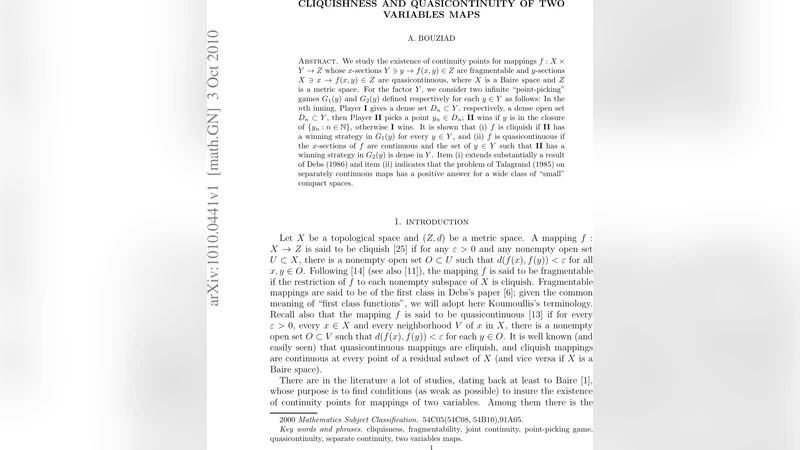
We study the existence of continuity points for mappings $f: X\times Y\to Z$ whose $x$-sections $Y\ni y\to f(x,y)\in Z$ are fragmentable and $y$-sections $X\ni x\to f(x,y)\in Z$ are quasicontinuous, where $X$ is a Baire space and $Z$ is a metric space. For the factor $Y$, we consider two infinite “point-picking” games $G_1(y)$ and $G_2(y)$ defined respectively for each $y\in Y$ as follows: In the $n$th inning, Player I gives a dense set $D_n\subset Y$, respectively, a dense open set $D_n\subset Y$, then Player II picks a point $y_n\inD_n$; II wins if $y$ is in the closure of ${y_n:n\in\mathbb N}$, otherwise I wins. It is shown that (i) $f$ is cliquish if II has a winning strategy in $G_1(y)$ for every $y\in Y$, and (ii) $f$ is quasicontinuous if the $x$-sections of $f$ are continuous and the set of $y\in Y$ such that II has a winning strategy in $G_2(y)$ is dense in $Y$. Item (i) extends substantially a result of Debs (1986) and item (ii) indicates that the problem of Talagrand (1985) on separately continuous maps has a positive answer for a wide class of “small” compact spaces.
💡 Research Summary
The paper investigates the existence of continuity points for two‑variable mappings
(f\colon X\times Y\to Z) under a mixed regularity hypothesis: every (x)‑section
(y\mapsto f(x,y)) is fragmentable, while every (y)‑section (x\mapsto f(x,y)) is quasicontinuous.
The domain (X) is assumed to be a Baire space, the codomain (Z) a metric space, and the
second factor (Y) is left completely general.
To capture the “size’’ of (Y) in a game‑theoretic way the authors introduce two point‑picking games, denoted (G_{1}(y)) and (G_{2}(y)), each defined for a fixed target point (y\in Y). In the (n)‑th round of (G_{1}(y)) Player I chooses a dense set (D_{n}\subset Y); Player II then selects a point (y_{n}\in D_{n}). Player II wins iff the closure of ({y_{n}:n\in\mathbb N}) contains the target (y). The game (G_{2}(y)) is identical except that the sets offered by Player I must be dense open subsets of (Y). Thus a winning strategy for Player II in (G_{2}(y)) is a stronger form of “point‑selection ability’’ than in (G_{1}(y)).
The main results are two theorems linking the existence of winning strategies to regularity properties of (f).
Theorem (i). If for every (y\in Y) Player II has a winning strategy in (G_{1}(y)), then (f) is cliquish: for every non‑empty open rectangle (U\times V\subset X\times Y) and every (\varepsilon>0) there exists a non‑empty open sub‑rectangle (U’\times V’\subset U\times V) such that the image (f(U’\times V’)) has diameter smaller than (\varepsilon). The proof combines the fragmentability of the (x)‑sections (which supplies small‑diameter pieces in the (X) direction) with the quasicontinuity of the (y)‑sections (which guarantees that dense selections in (Y) do not cause large jumps). The game‑theoretic hypothesis supplies a systematic way to choose points (y_{n}) that converge to any prescribed target, thereby producing the required small sub‑rectangles. This theorem extends a classical result of Debs (1986), who proved cliquishness under the stronger assumption that (X) and (Y) are metric spaces and the (x)‑sections are actually continuous. Here the authors replace metric completeness by the Baire property, allow arbitrary topologies on (Y), and only require fragmentability rather than full continuity.
Theorem (ii). Suppose each (x)‑section is continuous. If the set
({y\in Y :) Player II has a winning strategy in (G_{2}(y)}) is dense in (Y),
then the whole map (f) is quasicontinuous: for any ((x_{0},y_{0})\in X\times Y)
and any (\varepsilon>0) there exist neighbourhoods (U) of (x_{0}) and (V) of
(y_{0}) such that (f(U\times V)\subset B_{Z}(f(x_{0},y_{0}),\varepsilon)).
The open‑set requirement in (G_{2}(y)) yields a stronger control over the
chosen points: each round forces Player II to pick a point inside a dense open set,
so the resulting sequence can be made to converge inside any prescribed open
neighbourhood of the target. Combined with the continuity of the (x)‑sections,
this produces the usual quasicontinuity estimate.
The significance of (ii) lies in its connection to a problem raised by Talagrand (1985): whether a separately continuous function on a product of a Baire space and a compact space must be jointly continuous on a dense set. The authors show that for a wide class of “small’’ compact spaces—those for which II has a winning strategy in (G_{2}(y)) for a dense set of points (e.g. Corson compacta, Eberlein compacta)—the answer is affirmative. Thus the paper not only generalises Debs’ theorem but also provides a positive solution to Talagrand’s question for many compact factors that are topologically small in the sense of the point‑picking games.
Beyond the main theorems, the paper discusses several corollaries and possible extensions. It notes that the game‑theoretic framework can be adapted to other regularity notions such as Baire‑1 functions, and that fragmentability may be replaced by weaker notions like “σ‑fragmentability’’ without breaking the arguments. The authors also propose studying variants of the games (e.g. allowing Player I to present families of dense sets) to capture other topological properties such as Lindelöfness or σ‑compactness. Finally, they outline a research program aimed at characterising precisely which compact spaces admit a dense set of points with a winning strategy in (G_{2}), thereby delineating the exact boundary of Talagrand’s problem.
In summary, the paper introduces a novel game‑theoretic approach to analyse the joint regularity of two‑variable maps. By linking the existence of winning strategies in the point‑picking games (G_{1}) and (G_{2}) to cliquishness and quasicontinuity, it substantially broadens the scope of earlier results, provides new insight into the structure of fragmentable and quasicontinuous sections, and offers a positive answer to Talagrand’s longstanding question for a large family of compact spaces. The work stands at the intersection of general topology, functional analysis, and infinite‑game theory, and opens several promising avenues for further investigation.
Comments & Academic Discussion
Loading comments...
Leave a Comment