Some results on separate and joint continuity
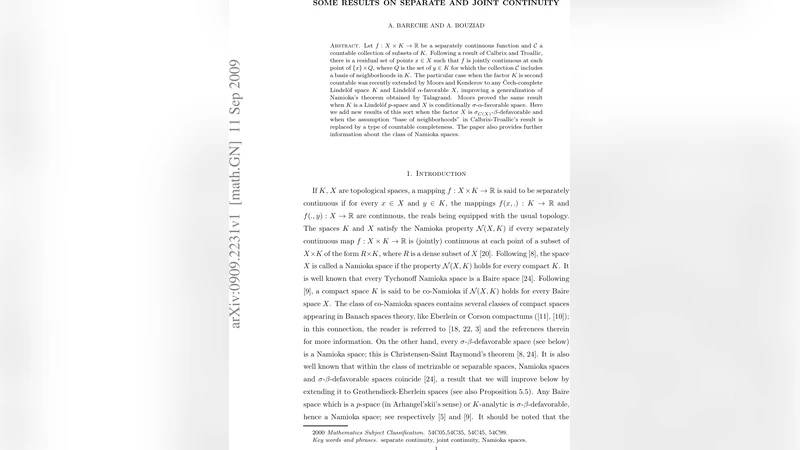
Let $f: X\times K\to \mathbb R$ be a separately continuous function and $\mathcal C$ a countable collection of subsets of $K$. Following a result of Calbrix and Troallic, there is a residual set of points $x\in X$ such that $f$ is jointly continuous at each point of ${x}\times Q$, where $Q$ is the set of $y\in K$ for which the collection $\mathcal C$ includes a basis of neighborhoods in $K$. The particular case when the factor $K$ is second countable was recently extended by Moors and Kenderov to any \v{C}ech-complete Lindel"of space $K$ and Lindel"of $\alpha$-favorable $X$, improving a generalization of Namioka’s theorem obtained by Talagrand. Moors proved the same result when $K$ is a Lindel"of $p$-space and $X$ is conditionally $\sigma$-$\alpha$-favorable space. Here we add new results of this sort when the factor $X$ is $\sigma_{C(X)}$-$\beta$-defavorable and when the assumption “base of neighborhoods” in Calbrix-Troallic’s result is replaced by a type of countable completeness. The paper also provides further information about the class of Namioka spaces.
💡 Research Summary
The paper investigates joint continuity of separately continuous functions (f:X\times K\to\mathbb R) under weakened hypotheses on the factor spaces and on the auxiliary family of subsets (\mathcal C\subseteq\mathcal P(K)). The classical Namioka theorem asserts that if (X) is a Baire space and (K) is compact, then any separately continuous function is jointly continuous on a dense (G_\delta) subset of (X). Calbrix and Troallic later generalized this by replacing compactness of (K) with a countable family (\mathcal C) that supplies a neighbourhood basis at each point of a set (Q\subseteq K); they proved that there exists a residual set (R\subseteq X) such that for every (x\in R) the function (f) is jointly continuous on ({x}\times Q).
The present work pushes this line of research in two directions. First, the “basis of neighbourhoods’’ requirement on (\mathcal C) is replaced by a much weaker “countable completeness’’ condition: for each (y\in K) the family (\mathcal C_y={C\in\mathcal C:y\in C}) is required to be countable and any decreasing chain in (\mathcal C_y) has a non‑empty intersection. This condition is satisfied in many natural situations where (\mathcal C) does not form a genuine base, thereby enlarging the class of admissible target spaces.
Second, the authors introduce a new game‑theoretic property of the domain space (X). A space is called (\sigma_{C(X)})-(\beta)-defavorable if the player (\beta) cannot win a certain Banach–Mazur type game using (\sigma)-strategies that are defined on the collection (C(X)) of continuous real‑valued functions. This property is strictly weaker than the classical (\alpha)-favourability (or (\sigma)-(\alpha)-favourability) used in earlier extensions by Moors, Kenderov and Talagrand, yet it is still strong enough to guarantee the existence of a residual set of points where joint continuity holds.
The main theorem states: let (f:X\times K\to\mathbb R) be separately continuous, let (\mathcal C) be a countable family of subsets of (K) satisfying the countable completeness condition, and assume that (X) is (\sigma_{C(X)})-(\beta)-defavorable. Then there exists a residual set (R\subseteq X) such that for every (x\in R) the function (f) is jointly continuous at every point of ({x}\times K). In particular, if we define (Q) as the set of points of (K) for which (\mathcal C) contains a neighbourhood basis, the conclusion recovers the Calbrix‑Troallic result as a special case.
The paper also revisits two previously known extensions. Moors and Kenderov proved that when (K) is a Čech‑complete Lindelöf space and (X) is Lindelöf (\alpha)-favourable, the same residual joint continuity holds. Moors later showed that the same conclusion is valid when (K) is a Lindelöf (p)-space and (X) is conditionally (\sigma)-(\alpha)-favourable. By employing the new (\sigma_{C(X)})-(\beta)-defavourability condition and the countable completeness of (\mathcal C), the authors unify and generalize these results: the assumptions on (K) can be relaxed to mere Lindelöfness (with either Čech‑completeness or the (p)-space property) and the requirements on (X) can be weakened to the new game‑theoretic property.
Finally, the authors turn to the class of Namioka spaces. They prove several equivalent characterisations: a space (X) is Namioka if and only if it is a Baire space, (\sigma)-complete, and (\sigma_{C(X)})-(\beta)-defavourable. This bridges the gap between classical descriptive‑set‑theoretic conditions and modern topological game theory. The paper supplies new examples of Namioka spaces that are not metrizable, as well as counter‑examples showing that the converse implications fail without the Baire assumption.
Overall, the article significantly broadens the scope of Namioka‑type theorems by weakening both the structural requirements on the factor space (K) and the topological game conditions on the domain (X). The results open the way for further investigations into joint continuity phenomena in non‑metrizable, non‑compact settings, and they highlight the power of game‑theoretic methods in modern topology.
Comments & Academic Discussion
Loading comments...
Leave a Comment