Trek separation for Gaussian graphical models
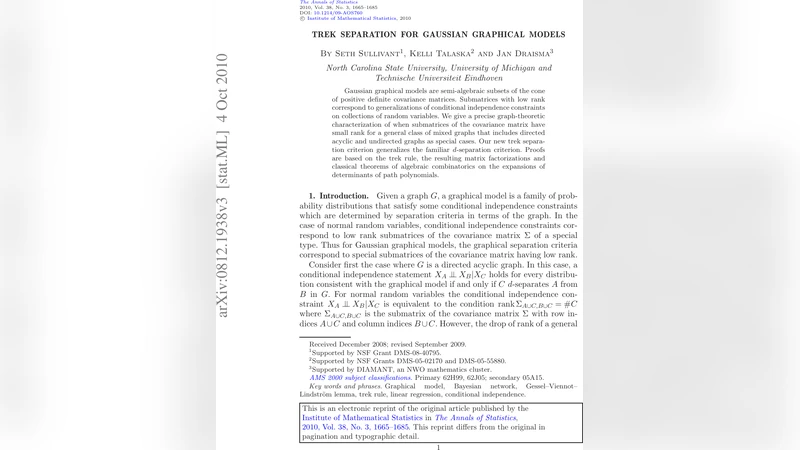
Gaussian graphical models are semi-algebraic subsets of the cone of positive definite covariance matrices. Submatrices with low rank correspond to generalizations of conditional independence constraints on collections of random variables. We give a precise graph-theoretic characterization of when submatrices of the covariance matrix have small rank for a general class of mixed graphs that includes directed acyclic and undirected graphs as special cases. Our new trek separation criterion generalizes the familiar $d$-separation criterion. Proofs are based on the trek rule, the resulting matrix factorizations and classical theorems of algebraic combinatorics on the expansions of determinants of path polynomials.
💡 Research Summary
The paper addresses the problem of characterizing when submatrices of a Gaussian covariance matrix have low rank in the context of mixed graphical models, which may contain both directed and undirected edges. Classical Gaussian graphical models are defined as semi‑algebraic subsets of the cone of positive‑definite matrices, and conditional independence constraints correspond to zero submatrices. However, low‑rank submatrices represent a more subtle form of dependence that cannot be captured by ordinary independence alone.
The authors introduce the notion of a trek: a pair of directed (or undirected) paths that start at two distinct vertices and meet at a common ancestor (or descendant). The trek rule states that each entry σ_{ij} of the covariance matrix Σ can be expressed as a sum over all treks t connecting i and j of the product of edge weights along t. Symbolically,
σ_{ij}=∑{t∈𝒯(i,j)}∏{e∈t}λ_e,
where λ_e denotes the structural parameter associated with edge e. This representation yields a factorization Σ = L R, where L collects the contributions of the “left” side of each trek (from a vertex to the meeting point) and R collects the “right” side contributions.
With this factorization, any submatrix Σ_{A,B} (rows indexed by a set A, columns by a set B) can be written as L_{A,S} R_{S,B} for some intermediate vertex set S that all treks from A to B must pass through. The authors define trek separation: a set S trek‑separates A from B if every trek linking a vertex in A to a vertex in B contains at least one vertex from S. The central theorem proves that the rank of Σ_{A,B} equals the size of the smallest trek‑separating set. Consequently, if a trek‑separator of size k exists, the rank of the submatrix cannot exceed k, and this bound is tight.
To establish tightness, the paper leverages classical combinatorial results, notably the Lindström–Gessel–Viennot theorem, which relates determinants of path matrices to families of non‑intersecting paths. By adapting this theorem to the weighted trek setting, the authors show that the determinant of any (k+1)×(k+1) submatrix of Σ_{A,B} vanishes precisely when a trek‑separator of size ≤k exists, thereby confirming the rank bound.
The trek‑separation criterion generalizes the familiar d‑separation used in directed acyclic graphs (DAGs). In a DAG, d‑separation corresponds to the special case where the separating set consists of colliders and non‑colliders that block all active trails; this is exactly a trek‑separator that respects the directionality of edges. In undirected graphs, ordinary graph separation coincides with trek‑separation as well. Hence, trek‑separation subsumes both previous notions and applies uniformly to any mixed graph.
From an algorithmic perspective, finding a minimum trek‑separator reduces to a minimum‑cut problem in an appropriately constructed auxiliary network. Standard max‑flow/min‑cut algorithms (e.g., Ford–Fulkerson, push‑relabel) can compute the smallest separating set in polynomial time, making the criterion computationally tractable for moderate‑size models.
The paper also discusses practical implications. Low‑rank submatrices often signal the presence of latent variables that act as common causes for the variables in A and B. Trek‑separation thus provides a graph‑theoretic diagnostic for hidden confounding and can guide model identification strategies. The authors illustrate the method on synthetic examples and on a real‑world gene‑expression network that contains both regulatory (directed) and co‑expression (undirected) relationships. In this setting, trek‑separation correctly identifies clusters of genes whose joint covariance lives in a low‑dimensional subspace, suggesting underlying biological pathways.
In conclusion, the authors deliver a rigorous, graph‑theoretic characterization of low‑rank covariance substructures in Gaussian mixed graphical models. By unifying the trek rule, matrix factorization, and combinatorial determinant expansions, they formulate the trek‑separation criterion, which extends d‑separation to the most general mixed graph setting. The work opens avenues for further research, including extensions to non‑Gaussian distributions, dynamic (time‑varying) graphs, and integration of trek‑separation into structure‑learning algorithms for high‑dimensional data.
Comments & Academic Discussion
Loading comments...
Leave a Comment