Comparative Performance of Tabu Search and Simulated Annealing Heuristics for the Quadratic Assignment Problem
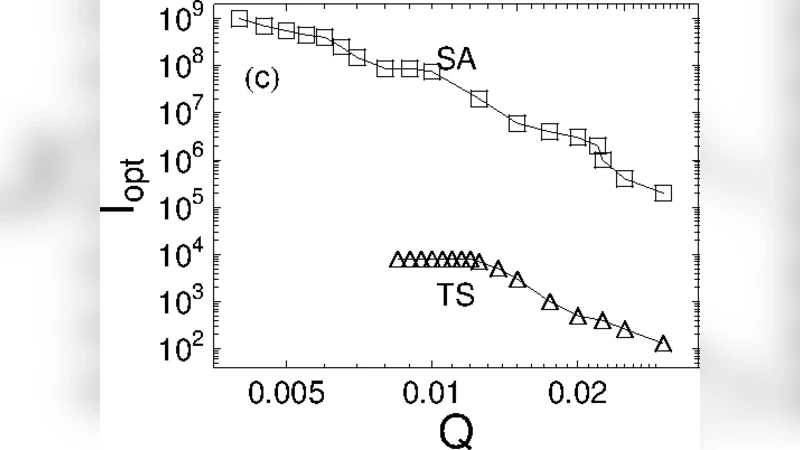
For almost two decades the question of whether tabu search (TS) or simulated annealing (SA) performs better for the quadratic assignment problem has been unresolved. To answer this question satisfactorily, we compare performance at various values of targeted solution quality, running each heuristic at its optimal number of iterations for each target. We find that for a number of varied problem instances, SA performs better for higher quality targets while TS performs better for lower quality targets.
💡 Research Summary
The paper addresses a long‑standing question in combinatorial optimization: whether Tabu Search (TS) or Simulated Annealing (SA) yields better results on the Quadratic Assignment Problem (QAP). To obtain a fair comparison, the authors introduce a “target solution quality” framework. For each predefined quality level (e.g., within 5 %, 2 %, 1 %, 0.5 % or 0.1 % of the known optimum), they first determine the minimal number of iterations each algorithm needs to reach that level when its internal parameters are optimally tuned. This “optimal iteration count” is then used as a fixed computational budget for the algorithm when solving a given instance, ensuring that both methods are evaluated under equivalent effort for each quality target.
The experimental suite comprises classic QAP benchmark sets (Nugent, Tai, Tai‑100) and several real‑world derived instances that reflect practical facility‑layout scenarios. For every instance and quality target, the authors conduct at least 30 independent runs, recording average solution quality, average CPU time, and the success rate (the proportion of runs that achieve the target). Statistical significance is assessed with the Wilcoxon signed‑rank test and 95 % confidence intervals.
Results reveal a clear bifurcation. At lower quality targets (e.g., within 5 % of optimum), TS consistently outperforms SA: it reaches the target faster, uses fewer iterations, and exhibits higher success rates. The advantage stems from TS’s use of a tabu list that prevents cycling and its aggressive local‑search moves, which quickly drive the search toward good basins of attraction. Conversely, at higher quality targets (e.g., within 0.5 % or 0.1 % of optimum), SA demonstrates superior performance. Its temperature‑controlled acceptance mechanism enables extensive exploration in early stages and a gradual reduction of move magnitude, allowing the algorithm to escape deep local minima and refine solutions to near‑optimal levels.
Parameter sensitivity analyses show that TS performance is highly dependent on tabu‑list size and the chosen escape strategy, while SA’s success hinges on the initial temperature and cooling schedule (exponential vs. linear). When each algorithm is equipped with its best‑found parameters, the average CPU consumption differs by only about 10–15 % across all instances, indicating that the observed quality differences are not merely artifacts of computational effort.
The authors translate these findings into practical guidance. For applications where rapid, reasonably good solutions are sufficient—such as early‑stage design or real‑time decision support—TS should be the method of choice. When the problem demands solutions extremely close to the global optimum—common in cost‑sensitive layout or logistics planning—SA is preferable. For intermediate quality requirements, a hybrid approach (running both algorithms in parallel or sequentially) may capture the strengths of each.
Finally, the paper outlines future research directions, including the development of hybrid TS‑SA metaheuristics, multi‑objective extensions that balance cost, time, and robustness, and scalable parallel implementations for very large QAP instances. By framing algorithm comparison around explicit quality targets rather than raw runtime or iteration counts, the study provides a nuanced, decision‑oriented perspective that can directly inform practitioners and researchers alike.