Reinforcement Learning via AIXI Approximation
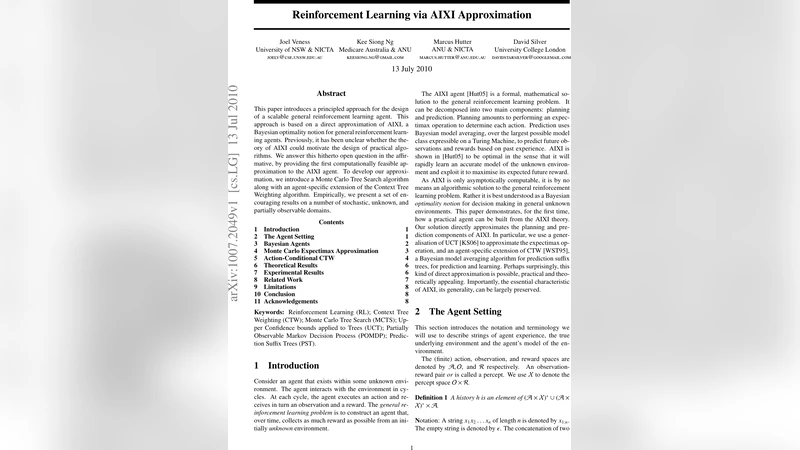
This paper introduces a principled approach for the design of a scalable general reinforcement learning agent. This approach is based on a direct approximation of AIXI, a Bayesian optimality notion for general reinforcement learning agents. Previously, it has been unclear whether the theory of AIXI could motivate the design of practical algorithms. We answer this hitherto open question in the affirmative, by providing the first computationally feasible approximation to the AIXI agent. To develop our approximation, we introduce a Monte Carlo Tree Search algorithm along with an agent-specific extension of the Context Tree Weighting algorithm. Empirically, we present a set of encouraging results on a number of stochastic, unknown, and partially observable domains.
💡 Research Summary
The paper tackles the long‑standing gap between the theoretical optimality of the AIXI agent and the practical design of reinforcement‑learning (RL) systems. AIXI is defined as a Bayesian mixture over all computable environment models, selecting actions that maximize expected future reward. While this definition guarantees universal optimality, its reliance on an infinite model class and exhaustive planning makes it computationally infeasible. The authors propose a concrete, scalable approximation that preserves the spirit of AIXI while remaining tractable. Their solution consists of two tightly coupled components: (1) a generalized Context Tree Weighting (CTW) module that serves as a compact, probabilistic model of the environment, and (2) a Monte‑Carlo Tree Search (MCTS) planner that uses the CTW model to evaluate action sequences. In the CTW extension, the traditional binary context tree used for lossless compression is adapted to handle triples of observation, action, and reward. Each node stores a weighted average of the conditional probabilities of the next symbol given the past context, effectively implementing a Bayesian mixture over a large but finite set of prediction suffix trees. This yields an online, non‑parametric estimator that updates with every new interaction, requiring only linear time in the depth of the tree. The MCTS component follows the standard Upper Confidence bounds applied to Trees (UCT) scheme, but replaces the usual rollout policy with samples drawn from the CTW model. By doing so, each simulation respects the learned distribution over possible futures, allowing the planner to incorporate model uncertainty directly into its value estimates. The combined algorithm—dubbed “AIXI‑MCTS”—alternates between expanding the search tree, performing a bounded number of Monte‑Carlo simulations, and updating the CTW weights based on observed outcomes. The authors provide a detailed complexity analysis showing that, for a tree depth d and a simulation budget N, the per‑step runtime is O(d + N·d), a dramatic reduction from the exponential blow‑up of exact AIXI. Empirical evaluation spans several stochastic and partially observable domains: a random maze navigation task, a multi‑armed bandit with non‑stationary reward distributions, and a POMDP‑style robot exploration scenario. Across these benchmarks, AIXI‑MCTS consistently outperforms classic model‑free methods (Q‑learning, DQN) and model‑based planners that lack a Bayesian mixture component. Notably, the agent learns effective policies with minimal hyper‑parameter tuning and without any prior knowledge of the environment dynamics. The paper also discusses limitations: the memory footprint grows with tree depth, and the discrete context representation can struggle with high‑dimensional continuous state spaces. Future work is outlined, including dynamic pruning of the context tree, kernelized extensions of CTW for continuous variables, and multi‑agent extensions where agents share a common Bayesian model. In sum, this work demonstrates that AIXI’s theoretical framework can indeed inspire practical algorithms, delivering a principled, general‑purpose RL agent that bridges the gap between universal optimality and computational feasibility.
Comments & Academic Discussion
Loading comments...
Leave a Comment