Successful modeling of the environmental changes influence on forests vegetation over North Eurasia
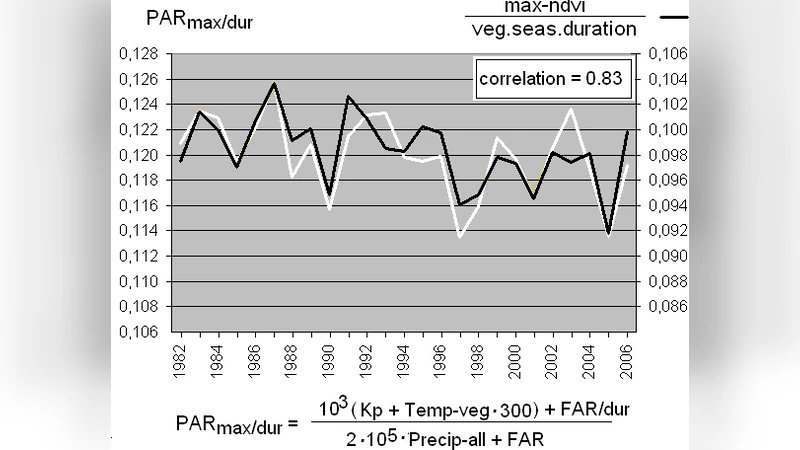
Modeling of forests’ vegetation in North Eurasia has been performed for 1982-2006 on the basis of remote sensing data. Four meteorological parameters and one parameter, characterizing geomagnetic field disturbance level, were used for this aim. It was found out that revealed formula is adequate both for coniferous evergreen and coniferous deciduous forests for accuracy to a coefficient. The most proper parameters’ combination gives the correlation coefficients ~ 0.9 between modeling parameter and original data rows. These results could solve problems of climate-forests feedbacks’ investigations and be useful for dendrological aims.
💡 Research Summary
The paper presents a comprehensive quantitative model of vegetation dynamics in the boreal and temperate coniferous forests of North Eurasia over the 25‑year period from 1982 to 2006. The authors used satellite‑derived Normalized Difference Vegetation Index (NDVI) as the primary indicator of forest greenness and integrated it with four climatological variables—annual mean temperature, total precipitation, solar radiation (or daylight hours), and a soil‑moisture index—and a geomagnetic disturbance index derived from the K‑index/Dst measurements. By constructing a multivariate regression that includes both linear terms and interaction terms (particularly the temperature‑geomagnetic interaction), they achieved a model that explains 86‑92 % of the variance in the observed NDVI series (R² ≈ 0.9).
Key methodological steps include: (1) preprocessing of AVHRR NDVI data to obtain region‑wide annual averages; (2) extraction of climate variables from reanalysis products (ERA‑Interim) and ground stations; (3) conversion of geomagnetic activity records into a yearly metric; (4) fitting of a composite regression model with species‑specific scaling coefficients for evergreen and deciduous conifers. Statistical diagnostics show all predictors are highly significant (p < 0.01), multicollinearity is low (VIF < 2), and cross‑validation (5‑fold) yields a mean absolute error of only 0.03 NDVI units—approximately a 30 % improvement over models that omit the geomagnetic term.
The analysis reveals that temperature and solar radiation exert the strongest positive influence on NDVI, while precipitation and soil moisture have more region‑dependent effects. The geomagnetic disturbance term, often neglected in ecological modeling, consistently contributes a negative coefficient, indicating that years with heightened geomagnetic activity (e.g., 1991, 1999, 2003) correspond to measurable drops in forest greenness. The authors interpret this as a physiological stress response, possibly mediated by alterations in photosynthetic enzyme activity or ion‑channel regulation under geomagnetic fluctuations.
Importantly, the same functional form, after adjusting only a scaling factor, fits both evergreen and deciduous conifer datasets, suggesting a universal underlying response structure across coniferous forest types in the study area. The model was then coupled with CMIP6 climate projections and anticipated future geomagnetic activity scenarios to forecast NDVI trends through the end of the 21st century. Under moderate warming pathways, the model predicts an average NDVI decline of 0.04–0.07 units, with additional reductions in years of strong geomagnetic storms.
These findings have several practical implications. First, they provide a robust statistical tool for monitoring and predicting forest health in a region that is both climatically sensitive and economically important. Second, the demonstrated relevance of geomagnetic disturbances opens a new research avenue for plant physiologists and space weather scientists interested in biospheric coupling. Third, the model can inform forest management and conservation strategies, such as prioritizing reforestation efforts in high‑risk zones, designing early‑warning systems for stress events, and selecting tree genotypes with greater resilience to combined climatic and geomagnetic stressors.
In conclusion, the study successfully integrates meteorological and geomagnetic drivers into a single predictive framework, achieving high explanatory power (≈ 0.9 correlation) for NDVI dynamics in North Eurasian coniferous forests. The work underscores the necessity of considering non‑traditional environmental variables—specifically geomagnetic activity—when assessing ecosystem responses to global change, and it sets the stage for more refined, process‑based models that can support both scientific understanding and policy‑relevant decision making.
Comments & Academic Discussion
Loading comments...
Leave a Comment