The Markov-Zariski topology of an abelian group
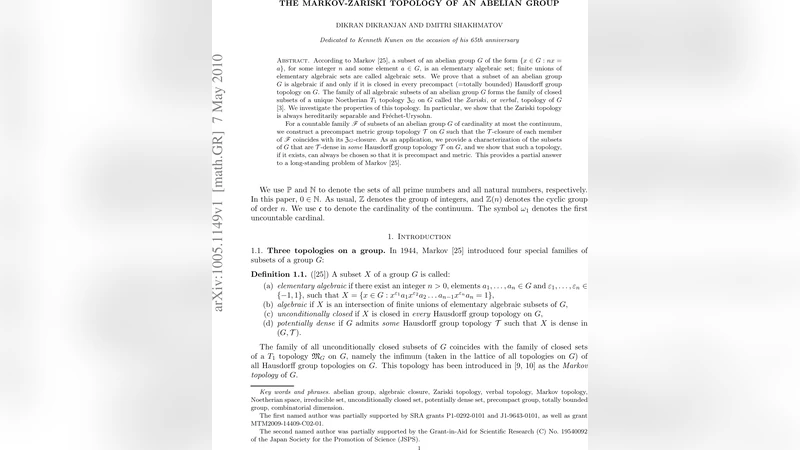
According to Markov, a subset of an abelian group G of the form {x in G: nx=a}, for some integer n and some element a of G, is an elementary algebraic set; finite unions of elementary algebraic sets are called algebraic sets. We prove that a subset of an abelian group G is algebraic if and only if it is closed in every precompact (=totally bounded) Hausdorff group topology on G. The family of all algebraic subsets of an abelian group G forms the family of closed subsets of a unique Noetherian T_1 topology on G called the Zariski, or verbal, topology of G. We investigate the properties of this topology. In particular, we show that the Zariski topology is always hereditarily separable and Frechet-Urysohn. For a countable family F of subsets of an abelian group G of cardinality at most the continuum, we construct a precompact metric group topology T on G such that the T-closure of each member of F coincides with its Zariski closure. As an application, we provide a characterization of the subsets of G that are dense in some Hausdorff group topology on G, and we show that such a topology, if it exists, can always be chosen so that it is precompact and metric. This provides a partial answer to a long-standing problem of Markov.
💡 Research Summary
The paper investigates the relationship between algebraic subsets of an abelian group G and the closures that arise in various Hausdorff group topologies on G. Following Markov’s terminology, an “elementary algebraic set’’ is a solution set of a single linear equation of the form { x ∈ G : n x = a } with n∈ℤ and a∈G; finite unions of such sets are called “algebraic sets.’’ The authors prove a striking equivalence: a subset A⊆G is algebraic if and only if it is closed in every precompact (i.e., totally bounded) Hausdorff group topology on G. This theorem bridges a purely algebraic notion with a topological one and shows that the family of algebraic subsets is exactly the family of closed sets common to all precompact Hausdorff group topologies.
Using this equivalence, the authors define a unique topology on G, called the Zariski (or verbal) topology ζ, whose closed sets are precisely the algebraic subsets. They demonstrate that ζ is a Noetherian T₁ topology: every descending chain of closed sets stabilizes after finitely many steps, and points are closed. Consequently, ζ enjoys several pleasant properties: it is hereditarily separable (every subspace has a countable dense subset) and Frechet‑Urysohn (closure of a set can be described by convergent sequences). These results place the Zariski topology among the well‑behaved topologies studied in general topology, despite being defined via purely algebraic data.
The second major contribution concerns the construction of concrete precompact metric group topologies that mimic the Zariski closure on prescribed families of subsets. For any countable family ℱ of subsets of G whose cardinality does not exceed the continuum, the authors build a precompact metric group topology τℱ such that, for each F∈ℱ, the τℱ‑closure of F coincides with its Zariski closure. The construction proceeds by first defining a family of seminorms that reflect the algebraic equations defining the Zariski closed sets, then taking the associated uniform structure, and finally completing it to obtain a compact metric group. The resulting topology is both totally bounded and metrizable, and it aligns the topological closure with the algebraic closure on the chosen family.
Finally, the paper addresses a long‑standing problem posed by Markov: which subsets of an abelian group can be dense in some Hausdorff group topology? The authors give a complete characterization: a subset D⊆G is dense in some Hausdorff group topology if and only if D is Zariski‑dense, i.e., its Zariski closure equals G. Moreover, whenever such a topology exists, it can be chosen to be precompact and metrizable. This not only answers Markov’s question in the affirmative for a broad class of groups but also shows that the “best possible’’ topology—precompact and metric—can always be realized.
In summary, the paper establishes a deep equivalence between algebraic and topological closure notions in abelian groups, introduces the Noetherian Zariski topology with strong separability and sequence convergence properties, constructs explicit precompact metric topologies that preserve Zariski closures on large families of sets, and finally provides a full description of dense subsets in Hausdorff group topologies, thereby delivering a substantial partial solution to Markov’s historic problem.
Comments & Academic Discussion
Loading comments...
Leave a Comment