The communication complexity of non-signaling distributions
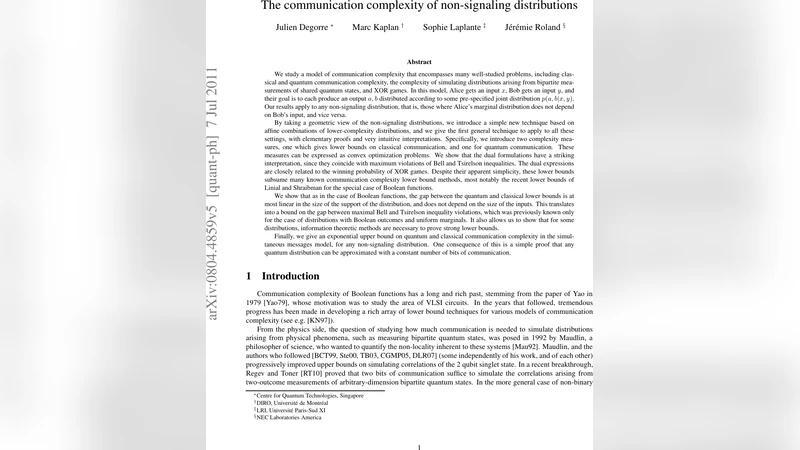
We study a model of communication complexity that encompasses many well-studied problems, including classical and quantum communication complexity, the complexity of simulating distributions arising from bipartite measurements of shared quantum states, and XOR games. In this model, Alice gets an input x, Bob gets an input y, and their goal is to each produce an output a,b distributed according to some pre-specified joint distribution p(a,b|x,y). We introduce a new technique based on affine combinations of lower-complexity distributions. Specifically, we introduce two complexity measures, one which gives lower bounds on classical communication, and one for quantum communication. These measures can be expressed as convex optimization problems. We show that the dual formulations have a striking interpretation, since they coincide with maximum violations of Bell and Tsirelson inequalities. The dual expressions are closely related to the winning probability of XOR games. These lower bounds subsume many known communication complexity lower bound methods, most notably the recent lower bounds of Linial and Shraibman for the special case of Boolean functions. We show that the gap between the quantum and classical lower bounds is at most linear in the size of the support of the distribution, and does not depend on the size of the inputs. This translates into a bound on the gap between maximal Bell and Tsirelson inequality violations, which was previously known only for the case of distributions with Boolean outcomes and uniform marginals. Finally, we give an exponential upper bound on quantum and classical communication complexity in the simultaneous messages model, for any non-signaling distribution. One consequence is a simple proof that any quantum distribution can be approximated with a constant number of bits of communication.
💡 Research Summary
The paper introduces a unified communication‑complexity framework that captures a broad class of problems, namely the simulation of non‑signaling joint distributions p(a,b|x,y). In this setting Alice receives an input x, Bob receives y, and they must each output a and b such that the pair (a,b) follows the prescribed distribution. The non‑signaling condition guarantees that the marginal distribution of one party’s output does not depend on the other party’s input, mirroring the no‑signaling principle of quantum mechanics.
The authors’ central technical contribution is a novel “affine‑combination” technique. They define two complexity measures: the classical affine‑rank C(p) and the quantum affine‑rank Q(p). Both are the optimal values of convex‑optimization problems that ask how cheaply (in terms of communication) the target distribution can be expressed as an affine combination of distributions that are trivial to generate (zero‑communication classical or quantum distributions, respectively). The primal formulations involve linear constraints on the coefficients of the combination and on the underlying low‑complexity distributions; the objective is the ℓ₁‑norm (or a related norm) of the coefficient vector.
A striking insight is that the dual of each convex program coincides with a well‑known family of Bell‑type inequalities. The dual variables for the classical program are precisely the coefficients of a Bell inequality, and the optimal dual value equals the maximal violation of that inequality by the distribution p. Analogously, the dual of the quantum program yields the maximal Tsirelson‑type violation. Consequently, lower bounds on classical (resp. quantum) communication are exactly the maximal Bell (resp. Tsirelson) inequality violations achievable by p. This establishes a deep bridge between communication‑complexity lower‑bound methods and foundational quantum‑nonlocality concepts.
The paper further shows that these dual expressions are closely related to the winning probability of XOR games. In an XOR game the players output bits a and b and win if a⊕b equals a prescribed function of (x,y). The optimal classical (quantum) value of an XOR game can be written as a linear functional of p, and the authors prove that the affine‑rank lower bounds subsume the XOR‑game method. As a special case, the Linial‑Shraibman γ₂‑norm lower bound for Boolean functions appears as the classical affine‑rank of the associated distribution, while the quantum analogue corresponds to a θ₂‑type norm. Thus the new framework unifies and extends many previously known lower‑bound techniques.
A second major result concerns the gap between the quantum and classical bounds. The authors prove that for any non‑signaling distribution p, the difference Q(p)−C(p) is at most linear in the size of the support of p (the number of (a,b) pairs with non‑zero probability), and crucially does not depend on the input lengths |x| or |y|. This yields a universal bound on the possible separation between maximal Bell‑inequality violations and maximal Tsirelson‑inequality violations, extending earlier results that were limited to Boolean outcomes with uniform marginals.
Finally, the paper addresses the simultaneous‑messages model (SMP). It shows that any non‑signaling distribution can be simulated with O(log|A|+log|B|) bits of communication, where |A| and |B| are the output alphabet sizes. The construction uses shared randomness and the affine‑combination representation to encode the necessary coefficients efficiently. As a corollary, any quantum‑generated distribution can be approximated arbitrarily well using only a constant number of classical bits, independent of the input size. This provides a simple and powerful proof that quantum correlations do not require large amounts of classical communication to be reproduced.
In summary, the paper (1) formalizes a general non‑signaling communication‑complexity model, (2) introduces affine‑combination based classical and quantum complexity measures expressible as convex programs, (3) reveals that the duals of these programs are exactly Bell and Tsirelson inequality violations, (4) subsumes prior lower‑bound methods such as the Linial‑Shraibman γ₂‑norm and XOR‑game techniques, (5) establishes a support‑size‑dependent bound on the quantum‑classical gap, and (6) provides exponential‑type upper bounds in the SMP setting, leading to constant‑bit approximations of quantum distributions. These contributions deepen the connection between communication complexity, convex optimization, and the foundations of quantum non‑locality, and they furnish new tools for both theoretical analysis and practical protocol design.
Comments & Academic Discussion
Loading comments...
Leave a Comment