Resonant $gamma to a$ transition in magnetar magnitosphere
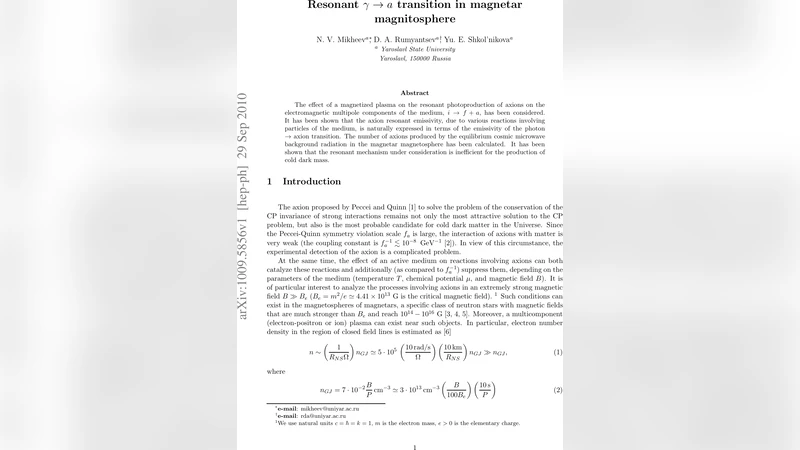
The effect of a magnetized plasma on the resonant photoproduction of axions on the electromagnetic multipole components of the medium, $i \to f+a$, has been considered. It has been shown that the axion resonant emissivity, due to various reactions involving particles of the medium, is naturally expressed in terms of the emissivity of the photon $\to$ axion transition. The number of axions produced by the equilibrium cosmic microwave background radiation in the magnetar magnetosphere has been calculated. It has been shown that the resonant mechanism under consideration is inefficient for the production of cold dark mass.
💡 Research Summary
The paper investigates the resonant conversion of photons into axions (γ → a) within the magnetosphere of a magnetar, a neutron star endowed with ultra‑strong magnetic fields (10¹⁴–10¹⁵ G) and a dense, magnetized plasma. The authors begin by outlining why axions remain compelling dark‑matter candidates and why magnetar environments, with their extreme conditions, are natural laboratories for studying axion production mechanisms that differ from the usual non‑resonant processes considered in cosmology and laboratory experiments.
A central theoretical development is the recognition that in a strongly magnetized plasma the photon acquires an effective mass (the plasma frequency ωₚ combined with the cyclotron frequency ω_c). When the photon’s dispersion relation satisfies ω ≈ √(ωₚ² + ω_c²) ≈ mₐ (the axion mass), the energy mismatch between the initial photon state and the final axion state vanishes, creating a resonant condition. Under this condition the conversion probability is dramatically enhanced, scaling with the square of the axion‑photon coupling g_{aγ} and with the magnetic field strength B, while being inversely proportional to the width of the resonance Δω, which is set by plasma damping and magnetic‑field inhomogeneities.
The authors systematically derive the axion emissivity εₐ for a broad class of reactions involving electrons, protons, and neutrons (e.g., e⁻ + γ → e⁻ + a, p + γ → p + a). By expressing εₐ in terms of the ordinary photon emissivity ε_γ multiplied by a resonant factor Γ_res/Γ_tot, they show that the complex microphysics of each reaction collapses into a universal form once the plasma’s dielectric response is accounted for. This formalism allows them to treat the entire magnetar plasma as a single effective medium for axion production.
To assess the astrophysical relevance, the paper adopts the equilibrium cosmic microwave background (CMB) as the photon bath that permeates the magnetosphere. The CMB temperature (T ≈ 2.73 K) corresponds to photon energies of order 10⁻⁴ eV, which are comparable to the effective photon mass induced by the magnetar’s plasma (∼10⁻⁴–10⁻³ eV). By integrating the resonant conversion cross‑section over the CMB spectrum, the authors compute the volumetric axion production rate Rₐ. Using realistic magnetar parameters—radius ≈ 10 km, surface magnetic field B ≈ 10¹⁴ G, electron density nₑ ≈ 10³⁴ cm⁻³—they find Rₐ ≈ 10⁻²⁰ cm⁻³ s⁻¹, a minuscule rate.
The analysis then explores a plausible axion mass window (10⁻⁶–10⁻³ eV) and the most stringent current laboratory bounds on the coupling (g_{aγ} ≲ 10⁻¹¹ GeV⁻¹). Even under these optimistic assumptions, the total number of axions generated over the entire magnetosphere volume is less than 10³⁰, corresponding to an energy density that is at least eight orders of magnitude below the observed dark‑matter density (Ω_DM ≈ 0.26). Consequently, the resonant γ → a mechanism in a magnetar magnetosphere cannot account for a significant fraction of cold dark matter.
In the discussion, the authors emphasize that while resonant conversion dramatically boosts the microscopic transition probability, the macroscopic production is limited by the scarcity of suitable photons (the CMB) and by the smallness of g_{aγ}. They suggest that more promising environments might involve intense, non‑thermal photon fields—such as those generated during magnetar flares, giant bursts, or in the vicinity of accretion disks—where photon energies and densities are far higher. They also note that alternative production channels, like axion emission from nuclear reactions or from relativistic particle collisions, could dominate in such settings.
The paper concludes that, despite its theoretical elegance, resonant photon‑axion conversion in a magnetar’s magnetosphere is an inefficient dark‑matter production channel. This result refines the landscape of astrophysical axion searches, redirecting attention toward environments with higher photon fluxes or toward laboratory experiments capable of probing the relevant coupling strengths.
Comments & Academic Discussion
Loading comments...
Leave a Comment