Functional data analytic approach of modeling ECG T-wave shape to measure cardiovascular behavior
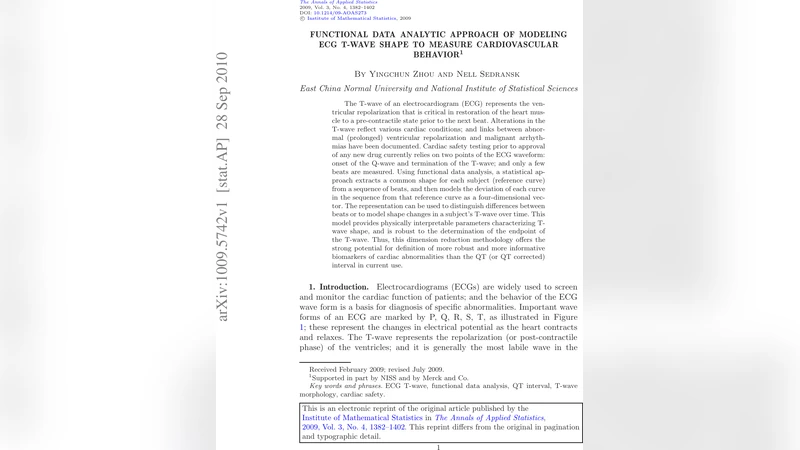
The T-wave of an electrocardiogram (ECG) represents the ventricular repolarization that is critical in restoration of the heart muscle to a pre-contractile state prior to the next beat. Alterations in the T-wave reflect various cardiac conditions; and links between abnormal (prolonged) ventricular repolarization and malignant arrhythmias have been documented. Cardiac safety testing prior to approval of any new drug currently relies on two points of the ECG waveform: onset of the Q-wave and termination of the T-wave; and only a few beats are measured. Using functional data analysis, a statistical approach extracts a common shape for each subject (reference curve) from a sequence of beats, and then models the deviation of each curve in the sequence from that reference curve as a four-dimensional vector. The representation can be used to distinguish differences between beats or to model shape changes in a subject’s T-wave over time. This model provides physically interpretable parameters characterizing T-wave shape, and is robust to the determination of the endpoint of the T-wave. Thus, this dimension reduction methodology offers the strong potential for definition of more robust and more informative biomarkers of cardiac abnormalities than the QT (or QT corrected) interval in current use.
💡 Research Summary
The paper introduces a novel statistical framework based on Functional Data Analysis (FDA) to model the shape of the electrocardiogram (ECG) T‑wave, a key indicator of ventricular repolarization. Traditional cardiac safety assessments rely on the QT interval, which measures only two points—the onset of the Q‑wave and the termination of the T‑wave—and therefore ignores the rich morphological information contained in the entire T‑wave. To overcome this limitation, the authors first extract a sequence of T‑waves from continuous ECG recordings for each subject, align them temporally, and smooth each beat using spline interpolation to obtain functional representations. From this collection they estimate a subject‑specific reference curve (the mean function) that captures the common underlying shape.
Each individual T‑wave is then expressed as a deviation from the reference curve. By projecting this deviation onto a set of four pre‑defined basis functions—representing overall amplitude, ascent slope, descent slope, and asymmetry—the authors obtain a four‑dimensional vector that succinctly characterizes the beat’s shape. These four components have clear physiological interpretations, making the model both parsimonious and clinically meaningful.
The methodology is evaluated in three contexts: (1) discrimination between healthy volunteers and patients with known cardiac pathology, (2) detection of drug‑induced repolarization changes before and after administration, and (3) assessment of robustness to variations in the T‑wave endpoint definition. In the first scenario, the four‑dimensional vectors form distinct clusters, with the asymmetry component providing the strongest separation. In the second, even when the QT interval remains unchanged, the amplitude and asymmetry dimensions shift significantly after drug exposure, revealing subtle repolarization effects that conventional QT analysis would miss. In the third, perturbing the T‑wave termination point by ±5 ms produces negligible changes in the vector, demonstrating the approach’s insensitivity to endpoint detection errors.
These findings suggest that FDA‑based T‑wave modeling captures clinically relevant shape information that is invisible to QT‑based metrics. The reduced‑dimensional representation can be directly incorporated into risk‑prediction algorithms, offering a more robust and informative biomarker for cardiac safety testing and disease diagnosis. The authors acknowledge limitations, including reliance on manually selected basis functions and the need for high‑quality, single‑lead ECG data. They propose future extensions such as data‑driven basis learning (e.g., variational autoencoders) and multi‑lead, large‑cohort validation.
In conclusion, by extracting a common reference curve and summarizing deviations with a physically interpretable four‑dimensional vector, the proposed FDA approach provides a powerful, endpoint‑robust alternative to the QT interval. It holds promise for improving the detection of abnormal ventricular repolarization, enhancing drug safety assessments, and potentially establishing a new standard for ECG‑based cardiovascular biomarkers.
Comments & Academic Discussion
Loading comments...
Leave a Comment