Partial monoids: associativity and confluence
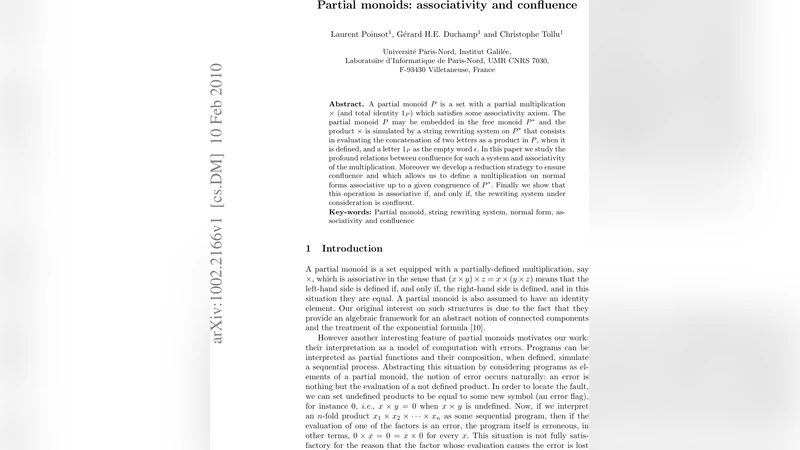
A partial monoid $P$ is a set with a partial multiplication $\times$ (and total identity $1_P$) which satisfies some associativity axiom. The partial monoid $P$ may be embedded in a free monoid $P^$ and the product $\star$ is simulated by a string rewriting system on $P^$ that consists in evaluating the concatenation of two letters as a product in $P$, when it is defined, and a letter $1_P$ as the empty word $\epsilon$. In this paper we study the profound relations between confluence for such a system and associativity of the multiplication. Moreover we develop a reduction strategy to ensure confluence and which allows us to define a multiplication on normal forms associative up to a given congruence of $P^*$. Finally we show that this operation is associative if, and only if, the rewriting system under consideration is confluent.
💡 Research Summary
The paper investigates the deep relationship between partial monoids and string rewriting systems, focusing on how associativity of the partial multiplication interacts with confluence of the induced rewriting system. A partial monoid P is a set equipped with a partially defined binary operation × and a total identity 1_P, satisfying a weak associativity condition: (x × y) × z and x × (y × z) are defined simultaneously and then equal. By embedding P into the free monoid P* via the canonical injection i_P, the authors construct a semi‑Thue system R_P consisting of rules i_P(x)i_P(y) → i_P(x × y) for every defined product (x,y) and i_P(1_P) → ε. This system is always terminating, guaranteeing that every word reduces to at least one normal form, but it is not generally confluent, i.e., normal forms need not be unique.
Confluence is examined through the classical notion of critical pairs. The authors restrict attention to “essential” critical pairs, those that arise from overlapping applications of the multiplication rules. Essential pairs fall into two broad categories: type (A) and type (B). Type (B) pairs are automatically convergent because both sides correspond to fully defined triple products. Type (A) pairs are further split into A₀ and A₁. A₁ pairs are trivial (the two words are identical) and thus convergent; A₀ pairs involve distinct words where neither side can be further reduced, leading to non‑convergence. Consequently, R_P is confluent iff no A₀‑type essential critical pair exists.
To guarantee the absence of A₀ pairs, the paper introduces the notion of catenary associativity: for any y ≠ 1_P, if (x,y) and (y,z) are defined then (x × y, z) must also be defined (and symmetrically for (x, y × z)). Any total monoid trivially satisfies this condition, as do the arrow categories of small categories with an adjoined total identity. The authors prove that if P is catenary associative then R_P is confluent. However, catenary associativity is sufficient but not necessary; they provide examples of non‑catenary partial monoids whose associated semi‑Thue systems are still confluent.
Because many partial monoids are not confluent, the authors devise a left‑standard reduction strategy that enforces a deterministic reduction order. The algorithm proceeds as follows: (1) delete all occurrences of i_P(1_P); (2) scan the word from left to right, locate the first adjacent pair i_P(x)i_P(y) with (x,y) defined; (3) if x × y = 1_P, delete the pair, otherwise replace it by i_P(x × y); repeat until no reducible pair remains. This process always terminates and yields a unique normal form that is also a normal form for the original system R_P.
Using these unique normal forms, the authors define a new binary operation ⊙ on the set N of normal forms: for u, v ∈ N, let u ⊙ v be the left‑standard reduction of the concatenation uv. They prove that ⊙ is associative up to the congruence generated by R_P; that is, (u ⊙ v) ⊙ w and u ⊙ (v ⊙ w) belong to the same equivalence class. The central theorem states that ⊙ is genuinely associative (i.e., the two sides are equal as normal forms) if and only if the original semi‑Thue system R_P is confluent. Thus, associativity of the multiplication on normal forms and confluence of the rewriting system are equivalent properties.
In summary, the paper establishes a precise correspondence between algebraic associativity in partial monoids and syntactic confluence in their associated string rewriting systems. It provides a sufficient condition (catenary associativity) for confluence, a deterministic reduction strategy that yields unique normal forms even when confluence fails, and a construction of an associative product on those normal forms exactly when confluence holds. These results give a solid theoretical foundation for modeling computations with partial operations, error handling, and normal‑form evaluation in a coherent algebraic framework.
Comments & Academic Discussion
Loading comments...
Leave a Comment