The third cohomology group classifies crossed module extensions
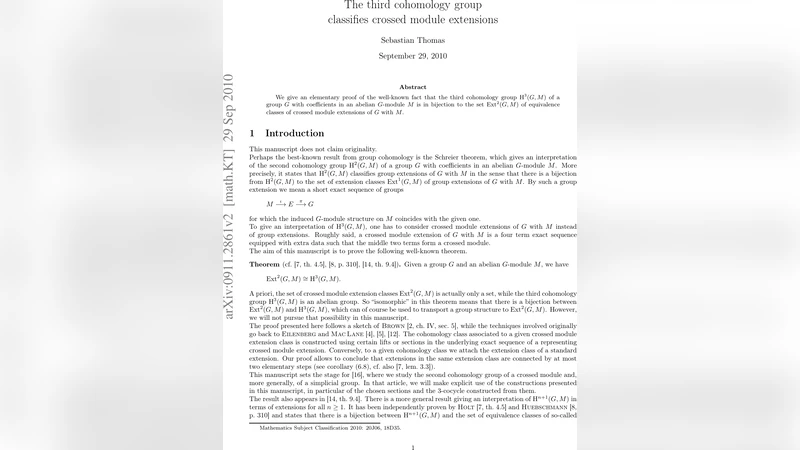
We give an elementary proof of the well-known fact that the third cohomology group H^3(G, M) of a group G with coefficients in an abelian G-module M is in bijection to the set Ext^2(G, M) of equivalence classes of crossed module extensions of G with M.
💡 Research Summary
The paper provides a self‑contained, elementary proof of the classical correspondence between the third cohomology group (H^{3}(G,M)) of a group (G) with coefficients in an abelian (G)-module (M) and the set (\operatorname{Ext}^{2}(G,M)) of equivalence classes of crossed‑module extensions of (G) by (M). After a brief historical motivation, the author recalls the definition of a crossed module ((E \xrightarrow{\partial} G,\cdot)): two groups (E) and (G), a homomorphism (\partial) and a left action of (G) on (E) satisfying (\partial(g\cdot e)=g\partial(e)g^{-1}) and (\partial(e)\cdot e’ = ee’e^{-1}). These axioms encode a 2‑dimensional algebraic structure (a 2‑group) and are precisely the data needed to model a “higher” extension.
The first direction constructs a crossed module from a given 3‑cocycle (f\colon G^{3}\to M). By fixing a normalized representative (i.e., (f) vanishes whenever one argument is the identity), the author defines a set (E = G\times M) with multiplication \
Comments & Academic Discussion
Loading comments...
Leave a Comment