Group Actions and Covering Maps in the Uniform Category
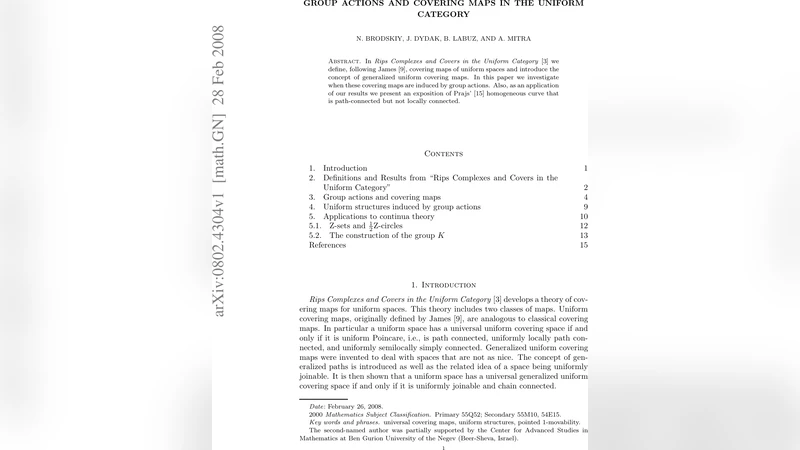
In Rips Complexes and Covers in the Uniform Category (arXiv:0706.3937) we define, following James, covering maps of uniform spaces and introduce the concept of generalized uniform covering maps. In this paper we investigate when these covering maps are induced by group actions. Also, as an application of our results we present an exposition of Prajs’ homogeneous curve that is path-connected but not locally connected.
💡 Research Summary
The paper investigates covering maps in the category of uniform spaces, focusing on when such maps arise from group actions. It begins by revisiting James’s definition of a uniform covering map, which requires not only continuity but also the preservation of the uniform structure: the pre‑image of any entourage must be uniformly “thin.” Recognizing that this condition can be too restrictive for many natural examples, the authors introduce the notion of a generalized uniform covering. This broader class relaxes the thinness requirement while retaining three essential properties: (i) uniform continuity of the projection, (ii) the ability to lift uniform paths (uniform path‑lifting), and (iii) a form of uniform density of the fibers that replaces the classical thinness condition.
The central technical contribution is a set of necessary and sufficient conditions for a quotient map π : X → X/G, induced by a continuous free action of a group G on a uniform space X, to be a (generalized) uniform covering. Two key hypotheses emerge. First, the action must be uniformly continuous: for every entourage ε in X there exists δ such that d_X(x, y) < δ implies d_{X/G}(π(x), π(y)) < ε. Second, the action must be uniformly properly discontinuous: for each ε there is a δ > 0 such that no non‑trivial group element fixes a δ‑ball. These conditions are the uniform analogues of the classical requirements of normality and freeness for topological covering maps, but they are stronger because they must hold at every scale of the uniform structure.
To handle spaces that are not simply connected in the usual topological sense, the authors develop uniform analogues of path‑connectedness and simple‑connectedness. A uniform path is a map whose image stays within a prescribed entourage at each stage, and a space is uniformly simply connected if every uniform loop can be contracted by a uniform homotopy. With these tools they prove that if the action preserves uniform path‑connectedness and the orbit space X/G is uniformly simply connected, then π is a generalized uniform covering. This result extends classical covering theory to a much wider class of spaces, including non‑metrizable uniform spaces where traditional topological methods fail.
The theoretical framework is illustrated by re‑examining Prajs’s homogeneous curve—a continuum that is globally path‑connected but fails to be locally connected. The original construction of this curve is intricate, involving inverse limits of graphs with carefully designed bonding maps. In the present work the curve is modeled as a uniform space equipped with a suitable group action. By selecting a group G that acts freely and uniformly properly discontinuously on a uniformly path‑connected covering space, the authors obtain the homogeneous curve as the orbit space. The construction automatically guarantees the generalized uniform covering property, while the uniform path‑lifting ensures that the global connectivity of the covering space descends to the curve, and the failure of uniform local connectedness is reflected in the deliberate violation of the uniform thinness condition in the fibers. This reinterpretation not only simplifies the original argument but also demonstrates the power of the uniform covering perspective.
In summary, the paper achieves three major goals: (1) it clarifies the relationship between group actions and uniform covering maps by providing precise uniform‑continuity and proper‑discontinuity criteria; (2) it introduces generalized uniform coverings and the associated notions of uniform path‑connectedness and uniform simple‑connectedness, thereby extending covering theory to a broader uniform setting; and (3) it applies this machinery to give a streamlined exposition of Prajs’s homogeneous curve, showcasing how a complex topological example can be understood through uniform group actions. The results open avenues for further research on uniform coverings of non‑metrizable spaces, the classification of uniform fundamental groups, and potential applications in coarse geometry and analysis on uniform spaces.
Comments & Academic Discussion
Loading comments...
Leave a Comment