The approach mapping from a matching of bipartite graphs to digraphs has been successfully used for forcing set problem, in this paper, it is extended to uniquely restricted matching problem. We show to determine a uniquely restricted matching in a bipartite graph is equivalent to recognition a acyclic digraph. Based on these results, it proves that determine the bipartite graphs with all maximum matching are uniquely restricted is polynomial time. This answers an open question of Levit and Mandrescu(Discrete Applied Mathematics 132(2004) 163-164).
Deep Dive into Determining All Maximum Uniquely Restricted Matching in Bipartite Graphs.
The approach mapping from a matching of bipartite graphs to digraphs has been successfully used for forcing set problem, in this paper, it is extended to uniquely restricted matching problem. We show to determine a uniquely restricted matching in a bipartite graph is equivalent to recognition a acyclic digraph. Based on these results, it proves that determine the bipartite graphs with all maximum matching are uniquely restricted is polynomial time. This answers an open question of Levit and Mandrescu(Discrete Applied Mathematics 132(2004) 163-164).
Let G = (X, Y ; E) be a bipartite graph, a set of edges M ⊂ (X, Y ) is a matching if no two edges of M share a common vertex. A matching M is uniquely restricted if its saturated vertices induce a subgraph which has a unique perfect matching and denotes as M ur . A subset edges S ⊂ M is a forcing set for a matching M if S is in no other perfect matching of G. Let us denote the subgraph induced by the dedges of M(laso known as the saturated vertices) as G[M], and name all of the vetices not saturated by M as free vertex set V f . Maximum matching problems are well known problem in graph theory and are proved to be solved in polynomial time [2]. But many restricted maximum matching problems are NP-complete, for example, Finding the maximum M ur is NP-complete in bipartite graphs [3], the smallest forcing set problem is also NP-complete in cubic bipartite graphs [1] On the positive side, it is proved that the determine a matching is uniquely restricted in bipartite graph could be recognized in O(M + E) [3]. There exists a polynomial time algorithm to determine the M ur if G is unicycle graph [5]. And [4] also shown that unique perfect matching bipartite graph could be find in polynomial time. At the end of [4], they raised an open problem as follows:
Problem. how to recognize that all maximum matching in a bipartite graph are uniquely restricted?
In this paper we will answer this question in two steps. Firstly, it shows a mapping from bipartite graph to digraph, and then it gives a necessary and sufficient condition on a uniquely restricted matching in bipartite graphs is equaivlent to the acyclic digraph. Secondly, it proves to determine all the maximum matching uniquely restricted or not is eqaivlent to find no more than two path between two vertices. In addition, it shows that uniquely perfect matching in bipartite graphs is as simple as recoginze the an acyclic digraph.
The main technonlogy in this paper have a successful implementation on finding forcing set problem in [1]. But firstly, let us repeat the theorem in [3].
Theorem 1 [3] A matching M of a graph is uniquely restricted if and only if M is alternating cycle-free.
Then let us define a mapping from G[M] of a bipartite graph to a digraph D and named as BD-mapping in this paper, this mapping is much more clearly than the definition on page 292 of [6] and definition on page 3 of [1] which denotes by D(G, M).
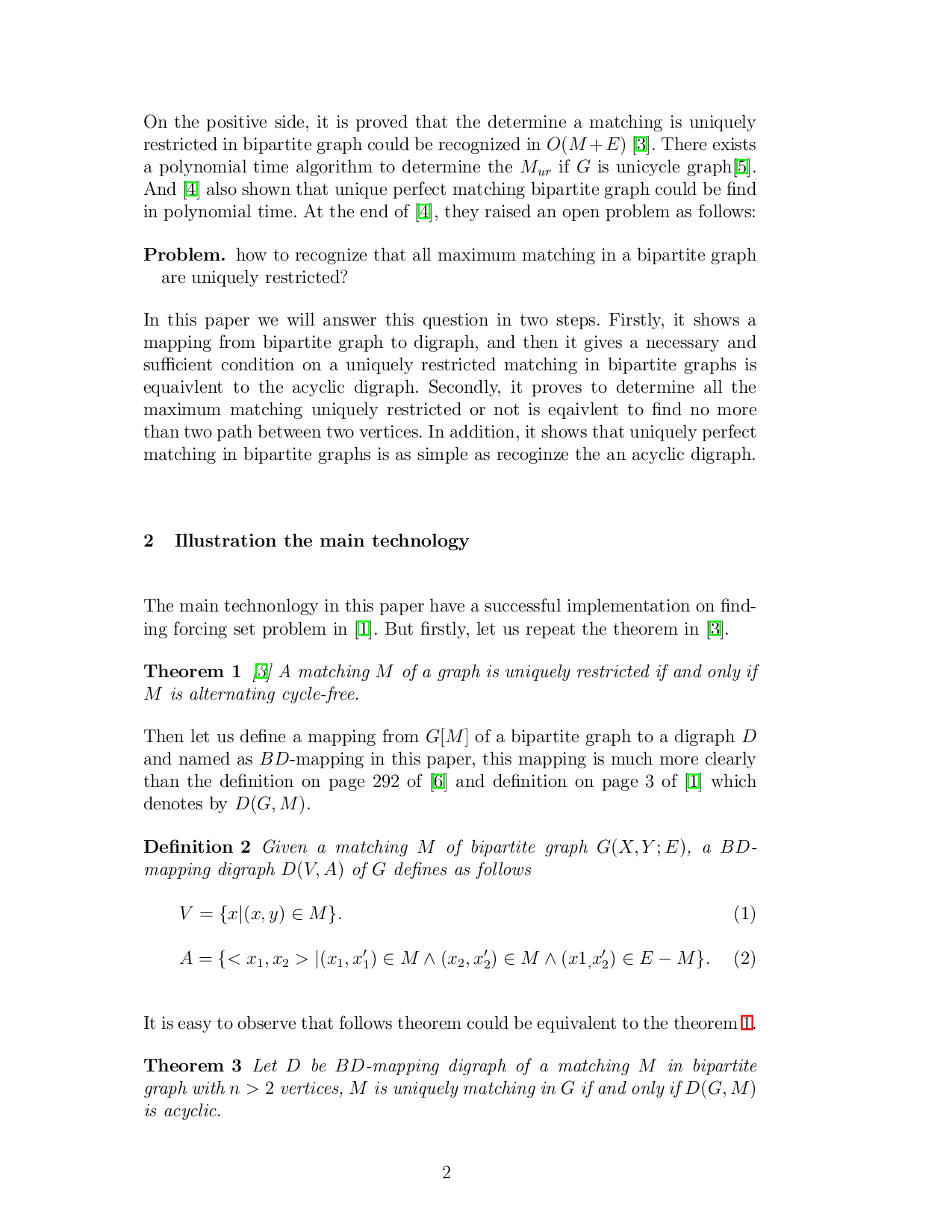
Definition 2 Given a matching M of bipartite graph G(X, Y ; E), a BDmapping digraph D(V, A) of G defines as follows
It is easy to observe that follows theorem could be equivalent to the theorem 1.
Theorem 3 Let D be BD-mapping digraph of a matching M in bipartite graph with n > 2 vertices, M is uniquely matching in G if and only if D(G, M) is acyclic.
PROOF. Suppose that D is acyclic digraph, every vertex x on D could be divided into a pair of vertex < x, x ′ > and become a new directed graph D ′ , which is also a acyclic digraph and without alternative cycle. Moreover, there has a matching M include number of |D| edges. Therefore M is a uniquely restricted matching.
On the other hand, assume M is a uniquely restricted matching but the BDmapping D(G, M) include at least one cycle C, where
Therefor, M ∪ M ′ has a even cycle, this contradict to the theorem 1.
Remark 4 Theorem 3 is very similar the proposition 3 in [1].
Proposition 5 [1] Let G be a bipartite graph, M is a perfect matching of G, and S ⊂ M is a focing set of M if and only if D(G, M) \ S is an acyclic digraph.
In fact, Theorem 3 can deduce the known results that Corollary 6 The bipartite graph G with uniquley perfect matching M has a forcing matching number 0 PROOF. Since D(G, M) with uniquely perfect matching is acyclic graph, the S in proposition 5 is empty set. Let us give an example to show a bipartite graph G and the D(G, M) in Fig. 1 to end of this section.
3 The complexity of uniquley restricted perfect matching [4]has proved that if and only all of local maximum stable set is a greedoid, then a bipartite graph has a unique perfect matching. However, how to recognize all of local maximum stable set are greediod is equivalent to the problem of all maximum maching are uniquely restricted according to the theorem 3.3 in [4]. This section would give a more efficient algorithm to determine the unique perfect matching.
It is easy to obervious to obtain the following theorem: Based on theorem 7 an algorithm shows in Algorithm 1.
It is clearly to see that the example in Fig. 2 (2) if M is not perfect then (3) return non unique perfect matching (4) else (5) if D is acyclic then return unique perfect matching (6) else return non unique perfect matching endif end 4 Determine all uniquely restricted maximum matching in polynomial time
In first glance, greedy algorithms can apply into determing all uniquely restricted maximum matching by remove the node with degree 1. Unfortunately, the worst case could be exponent.
For example, let consider the bipartite graph in Fig. 3
…(Full text truncated)…
This content is AI-processed based on ArXiv data.