In intensity-modulated radiation therapy, optimal intensity distributions of incoming beams are decomposed into linear combinations of leaf openings of a multileaf collimator (segments). In order to avoid inefficient dose delivery, the decomposition should satisfy a number of dosimetric constraints due to suboptimal dose characteristics of small segments. However, exact decomposition with dosimetric constraints is only in limited cases possible. The present work introduces new heuristic segmentation algorithms for the following optimization problem: Find a segmentation of an approximated matrix using only allowed fields and minimize the approximation error. Finally, the decomposition algorithms were implemented into an optimization programme in order to examine the assumptions of the algorithms for a clinical example. As a result, identical dose distributions with much fewer segments and a significantly smaller number of monitor units could be achieved using dosimetric constraints. Consequently, the dose delivery is more efficient and less time consuming.
Deep Dive into Approximated segmentation considering technical and dosimetric constraints in intensity-modulated radiation therapy with electrons.
In intensity-modulated radiation therapy, optimal intensity distributions of incoming beams are decomposed into linear combinations of leaf openings of a multileaf collimator (segments). In order to avoid inefficient dose delivery, the decomposition should satisfy a number of dosimetric constraints due to suboptimal dose characteristics of small segments. However, exact decomposition with dosimetric constraints is only in limited cases possible. The present work introduces new heuristic segmentation algorithms for the following optimization problem: Find a segmentation of an approximated matrix using only allowed fields and minimize the approximation error. Finally, the decomposition algorithms were implemented into an optimization programme in order to examine the assumptions of the algorithms for a clinical example. As a result, identical dose distributions with much fewer segments and a significantly smaller number of monitor units could be achieved using dosimetric constraints. Con
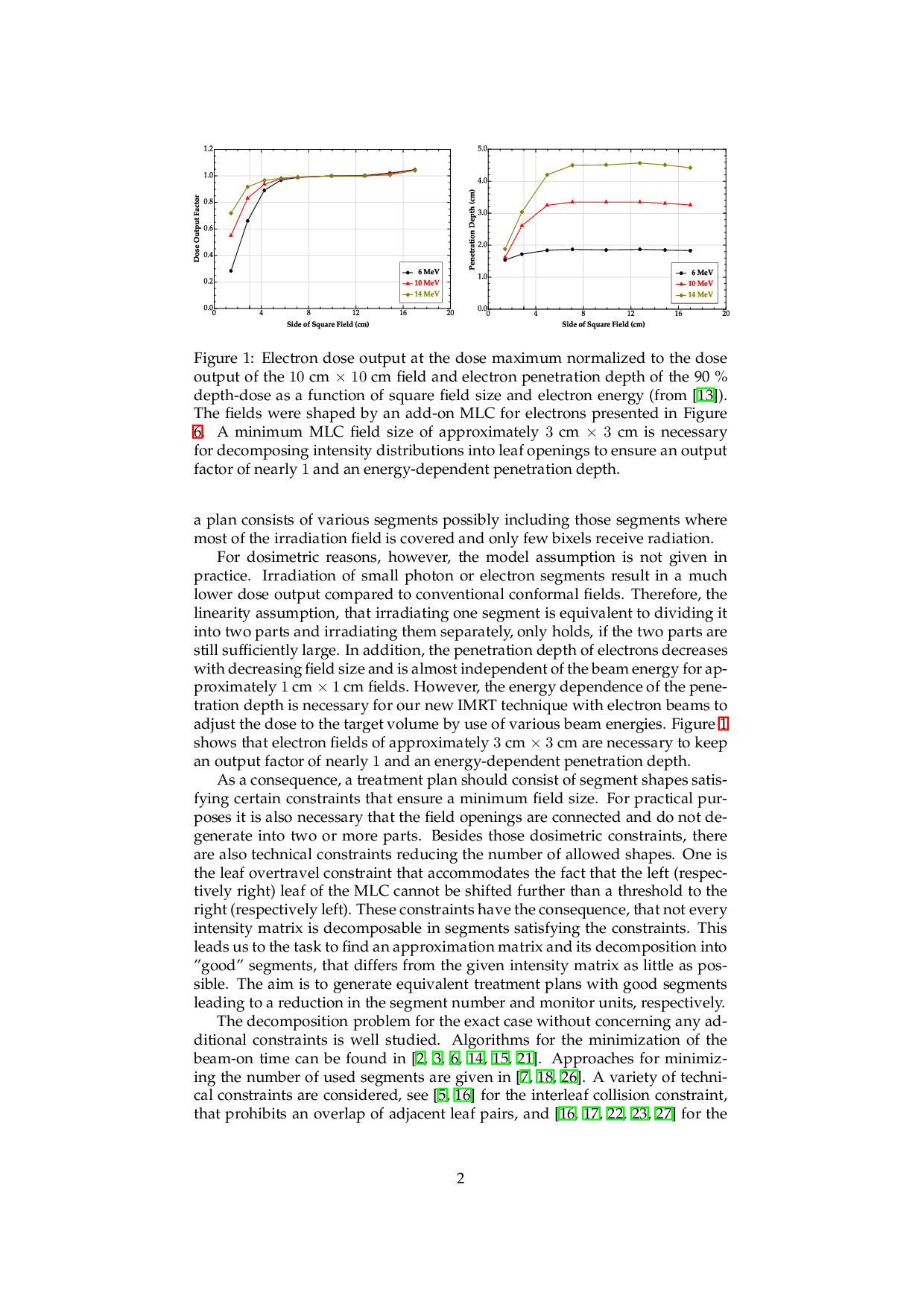
In intensity-modulated radiation therapy (IMRT), intensity matrices with nonnegative integer entries are computed for each irradiation field. After discretization of the field into bixels, each entry of the matrix corresponds to the required intensity within this bixel. The segmentation step consists in decomposing the matrix into a linear combination of subfields (segments) shaped by a multileaf collimator (MLC). The first intuition is that a treatment plan is optimal, if the linear combination of the chosen segments equals the matrix. Such Figure 1: Electron dose output at the dose maximum normalized to the dose output of the 10 cm × 10 cm field and electron penetration depth of the 90 % depth-dose as a function of square field size and electron energy (from [13]). The fields were shaped by an add-on MLC for electrons presented in Figure 6. A minimum MLC field size of approximately 3 cm × 3 cm is necessary for decomposing intensity distributions into leaf openings to ensure an output factor of nearly 1 and an energy-dependent penetration depth. a plan consists of various segments possibly including those segments where most of the irradiation field is covered and only few bixels receive radiation.
For dosimetric reasons, however, the model assumption is not given in practice. Irradiation of small photon or electron segments result in a much lower dose output compared to conventional conformal fields. Therefore, the linearity assumption, that irradiating one segment is equivalent to dividing it into two parts and irradiating them separately, only holds, if the two parts are still sufficiently large. In addition, the penetration depth of electrons decreases with decreasing field size and is almost independent of the beam energy for approximately 1 cm × 1 cm fields. However, the energy dependence of the penetration depth is necessary for our new IMRT technique with electron beams to adjust the dose to the target volume by use of various beam energies. Figure 1 shows that electron fields of approximately 3 cm × 3 cm are necessary to keep an output factor of nearly 1 and an energy-dependent penetration depth.
As a consequence, a treatment plan should consist of segment shapes satisfying certain constraints that ensure a minimum field size. For practical purposes it is also necessary that the field openings are connected and do not degenerate into two or more parts. Besides those dosimetric constraints, there are also technical constraints reducing the number of allowed shapes. One is the leaf overtravel constraint that accommodates the fact that the left (respectively right) leaf of the MLC cannot be shifted further than a threshold to the right (respectively left). These constraints have the consequence, that not every intensity matrix is decomposable in segments satisfying the constraints. This leads us to the task to find an approximation matrix and its decomposition into “good” segments, that differs from the given intensity matrix as little as possible. The aim is to generate equivalent treatment plans with good segments leading to a reduction in the segment number and monitor units, respectively.
The decomposition problem for the exact case without concerning any additional constraints is well studied. Algorithms for the minimization of the beam-on time can be found in [2,3,6,14,15,21]. Approaches for minimizing the number of used segments are given in [7,18,26]. A variety of technical constraints are considered, see [5,16] for the interleaf collision constraint, that prohibits an overlap of adjacent leaf pairs, and [16,17,22,23,27] for the tongue-and-groove constraint. Kamath et. al. [21] also investigate the minimum separation constraint that requires a minimum leaf opening in each row and develop a criterion for a matrix being decomposable under this constraint. Engelbeen and Fiorini [10] deal with the interleaf distance constraint where the allowed difference between two left (respectively right) leaf positions is bounded by some given threshold.
An approximation problem with the aim of reducing the total beam-on time was first formulated in [8] and generalized to approximated decomposition with interleaf-collision constraint in [19] and [20]. The dependence between field size and output factors, penetration depth and depth-dose fall-off is outlined in [13]. These considerations lead to the decomposition problem using segments that satisfy some minimum field size constraints. Under these constraints, an exact decomposition of the intensity matrices is, in general, no longer possible (cf. [21]) and an approximation problem has to be formulated.
Another algorithmic approach that aims at minimizing the number of segments while keeping the quality of the treatment plan is the direct aperture optimization that combines the choice of beams, apertures and weights without computing a leaf sequencing step. Shepard et al. [28] allow only a limited number of apertures for each beam, Bedford and Webb [4] al
…(Full text truncated)…
This content is AI-processed based on ArXiv data.