Diversity and Polarization of Research Performance: Evidence from Hungary
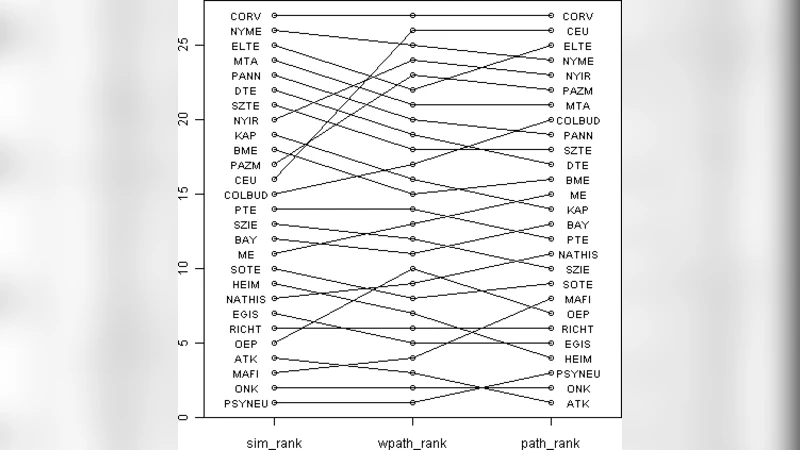
Measuring the intellectual diversity encoded in publication records as a proxy to the degree of interdisciplinarity has recently received considerable attention in the science mapping community. The present paper draws upon the use of the Stirling index as a diversity measure applied to a network model (customized science map) of research profiles, proposed by several authors. A modified version of the index is used and compared with the previous versions on a sample data set in order to rank top Hungarian research organizations (HROs) according to their research performance diversity. Results, unexpected in several respects, show that the modified index is a candidate for measuring the degree of polarization of a research profile. The study also points towards a possible typology of publication portfolios that instantiate different types of diversity.
💡 Research Summary
This paper investigates how to measure both the intellectual diversity and the degree of polarization in the research output of Hungarian research organizations (HROs) by adapting the well‑known Stirling diversity index. The authors begin by reviewing the literature on science mapping and the use of the Stirling index, which integrates three components—variety (the number of distinct fields), balance (the evenness of distribution across fields), and disparity (the cognitive distance between fields). While the traditional index has been applied mainly to capture overall diversity, it does not differentiate portfolios that are highly concentrated in a few, cognitively distant disciplines.
To address this gap, the authors construct a customized science map for Hungary. They collect all journal articles published between 2010 and 2020 by 30 major Hungarian research institutions, assign each article to a Web of Science subject category, and aggregate the data into institution‑by‑field matrices. Cognitive distances between subject categories are derived from co‑citation similarity, inverted to produce a distance matrix that serves as the backbone of a weighted network model.
The methodological contribution lies in a modified Stirling formula. In the classic version, diversity D is calculated as D = ∑ p_i p_j d_ij, where p_i and p_j are the proportion of output in fields i and j, and d_ij is the distance between them. The authors introduce two changes: (1) they apply a square‑root transformation to the field proportions to temper the influence of dominant fields, and (2) they square the distance term, thereby amplifying the contribution of pairs of fields that are far apart. The resulting “Polarization‑Stirling Index” (PSI) is designed to reward portfolios that are simultaneously concentrated and spread across cognitively distant domains.
Both the original Stirling index and the PSI are computed for each institution, and the resulting rankings are compared. The classic index places large, multidisciplinary universities at the top, reflecting high overall variety and balance. In contrast, the PSI highlights institutions whose output is heavily weighted toward a small set of fields that are far apart—for example, organizations publishing extensively in both theoretical physics and medieval studies. This divergence demonstrates that the PSI captures a distinct dimension—research polarization—that the traditional index overlooks.
The authors interpret the findings through a typology of publication portfolios: (1) “balanced multidisciplinary” (high diversity, low polarization), (2) “focused” (low diversity, low polarization), (3) “polarized” (low diversity, high polarization), and (4) “complex” (high diversity, high polarization). They argue that each type aligns with different strategic objectives. Policymakers seeking to foster broad interdisciplinary collaboration should encourage the balanced multidisciplinary type, whereas institutions aiming for world‑class leadership in a few, strategically distant fields may benefit from a polarized profile.
In conclusion, the modified Stirling index proves to be a viable metric for assessing research polarization alongside diversity. It offers research managers and national science agencies a more nuanced tool for evaluating institutional portfolios, informing funding allocation, and monitoring strategic shifts over time. The paper suggests future work to test the index across other national contexts, to explore temporal dynamics, and to integrate additional dimensions such as citation impact, thereby enriching the toolbox for science policy analytics.
Comments & Academic Discussion
Loading comments...
Leave a Comment