Determining All Maximum Uniquely Restricted Matching in Bipartite Graphs
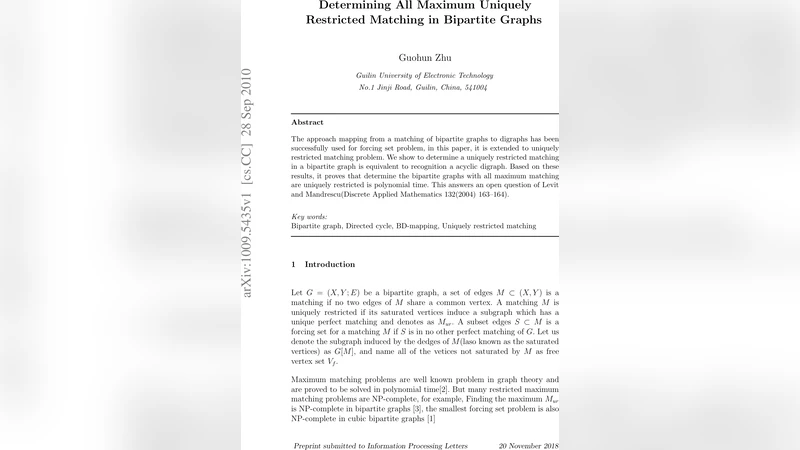
The approach mapping from a matching of bipartite graphs to digraphs has been successfully used for forcing set problem, in this paper, it is extended to uniquely restricted matching problem. We show to determine a uniquely restricted matching in a bipartite graph is equivalent to recognition a acyclic digraph. Based on these results, it proves that determine the bipartite graphs with all maximum matching are uniquely restricted is polynomial time. This answers an open question of Levit and Mandrescu(Discrete Applied Mathematics 132(2004) 163-164).
💡 Research Summary
The paper investigates the problem of recognizing whether all maximum matchings in a bipartite graph are uniquely restricted (UR), a question previously posed by Levit and Mandrescu (2004). The authors extend a known technique that maps a matching of a bipartite graph to a directed graph (digraph) – originally used for the forcing set problem – and show that this mapping can also be employed to characterize uniquely restricted matchings.
Key Definitions and Mapping (BD‑mapping).
Given a bipartite graph (G=(X,Y;E)) and a matching (M\subseteq E), the authors define a directed graph (D(G,M) = (V,A)) as follows:
- The vertex set (V) consists of the vertices of (X) that are incident to edges of (M).
- For each pair of matched edges ((x_1,y’_1)\in M) and ((x_2,y’_2)\in M) such that the non‑matched edge ((x_1,y’_2)) belongs to (E\setminus M), a directed arc (\langle x_1, x_2\rangle) is added to (A).
This construction is called the BD‑mapping. Intuitively, each vertex of (V) represents a matched edge, and an arc indicates the possibility of swapping the second endpoint of one matched edge with the first endpoint of another while staying inside the original graph.
Theorem 3 – Equivalence of UR and Acyclicity.
The central theoretical result states that a matching (M) is uniquely restricted if and only if the digraph (D(G,M)) is acyclic. The proof proceeds in two directions:
- If (D(G,M)) is acyclic, then no alternating cycle can be formed, which by the known characterization of UR matchings (Golumbic, Hirst, Lewenstein 2001) implies that (M) is UR.
- Conversely, if (M) were UR but (D(G,M)) contained a directed cycle, the edges of that cycle could be used to construct an alternating cycle in the original bipartite graph, contradicting the UR property.
Thus, checking whether a particular matching is UR reduces to a standard graph‑theoretic task: testing a digraph for cycles, which can be done in linear time.
Consequences for Perfect Matchings.
When (M) is a perfect matching, the authors derive two immediate corollaries:
- If (D(G,M)) is acyclic, the forcing number of the matching is zero (no edges need to be forced to guarantee uniqueness).
- For a UR perfect matching, the number of vertices in (D(G,M)) equals half the number of vertices in (G) ((|V(D)| = n/2)).
These observations connect the BD‑mapping framework with earlier results on forcing sets.
Extending to “All Maximum Matchings”.
The main challenge addressed in the paper is to decide whether every maximum matching of a given bipartite graph is UR. A naïve approach—enumerating all maximum matchings and testing each—would be exponential. To overcome this, the authors introduce the notion of a greedy matching: a maximum matching (M) such that the set of free vertices (V_f) (vertices not saturated by (M)) either is empty or consists solely of vertices of degree one.
They then define an extended BD‑mapping (D(G,M,V_f)) that augments the original BD‑digraph with the free vertices and arcs from each free vertex to the matched vertices it is adjacent to. This extended digraph captures the interaction between the unmatched part of the graph and the structure of (M).
Theorem 9 – Characterization of “All Maximum UR”.
Theorem 9 provides a necessary and sufficient condition for a bipartite graph to have the property that all its maximum matchings are uniquely restricted. Let (V_t) be the set of terminal (sink) vertices and (V_s) the set of source vertices in the extended digraph. The condition is that at least one of the following holds:
- For every free vertex (v_i\in V_f) there is at most one directed path from (v_i) to any terminal vertex in (V_t).
- For every free vertex (v_i\in V_f) there is at most one directed path from any source vertex in (V_s) to (v_i).
- For any two free vertices (v_i, v_j\in V_f), there exists at most one common vertex (v_k) that can be reached from both (v_i) and (v_j) (or, symmetrically, at most one vertex that can reach both of them).
Intuitively, these constraints forbid the existence of two vertex‑disjoint directed paths that would enable the construction of an alternating cycle, which would break the UR property for some maximum matching.
Algorithmic Implications.
Based on Theorem 9, the authors propose Algorithm 2, which runs in polynomial time:
- Construct the extended BD‑mapping for a greedy maximum matching (M).
- Perform a linear‑time cycle detection on the underlying digraph.
- Check the three path‑uniqueness conditions using BFS/DFS from each free vertex to the set of terminals (and symmetrically from sources).
- Return true if any condition holds (meaning all maximum matchings are UR); otherwise return false.
The overall complexity is (O(|V|+|E|)), dominated by the construction of the digraph and the BFS/DFS traversals. This resolves the open problem by providing a deterministic polynomial‑time algorithm for the global UR property.
Broader Impact and Discussion.
The paper demonstrates that many matching‑related problems can be reframed as questions about directed cycles and path uniqueness in appropriately constructed digraphs. By extending the BD‑mapping technique beyond forcing sets to uniquely restricted matchings, the authors bridge a gap between structural graph theory and algorithmic complexity. Their results not only answer a longstanding open question but also suggest a unified framework that could be applied to other constrained matching problems, such as those involving stability, greedoid structures, or specific graph classes (e.g., unicycle graphs).
In summary, the work establishes a clear equivalence between uniquely restricted matchings and acyclicity of a derived digraph, extends this equivalence to the global property of all maximum matchings, and delivers a concrete, efficient algorithmic solution, thereby advancing both the theoretical understanding and practical handling of constrained matchings in bipartite graphs.
Comments & Academic Discussion
Loading comments...
Leave a Comment