Efficient stochastic thermostatting of path integral molecular dynamics
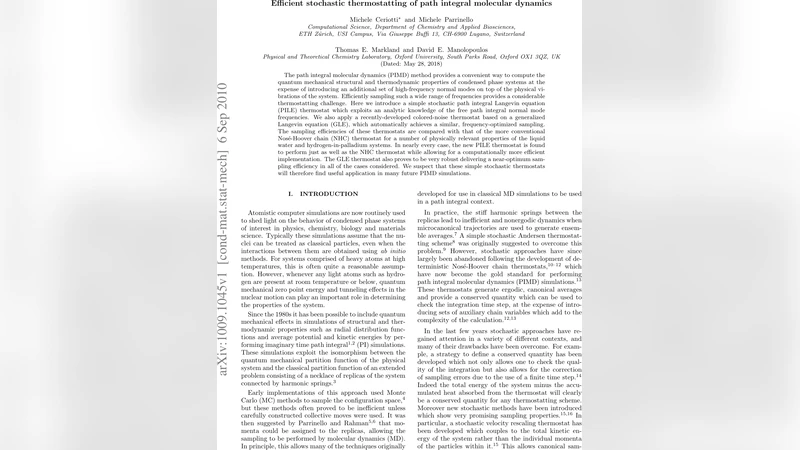
The path integral molecular dynamics (PIMD) method provides a convenient way to compute the quantum mechanical structural and thermodynamic properties of condensed phase systems at the expense of introducing an additional set of high-frequency normal modes on top of the physical vibrations of the system. Efficiently sampling such a wide range of frequencies provides a considerable thermostatting challenge. Here we introduce a simple stochastic path integral Langevin equation (PILE) thermostat which exploits an analytic knowledge of the free path integral normal mode frequencies. We also apply a recently-developed colored-noise thermostat based on a generalized Langevin equation (GLE), which automatically achieves a similar, frequency-optimized sampling. The sampling efficiencies of these thermostats are compared with that of the more conventional Nos'e-Hoover chain (NHC) thermostat for a number of physically relevant properties of the liquid water and hydrogen-in-palladium systems. In nearly every case, the new PILE thermostat is found to perform just as well as the NHC thermostat while allowing for a computationally more efficient implementation. The GLE thermostat also proves to be very robust delivering a near-optimum sampling efficiency in all of the cases considered. We suspect that these simple stochastic thermostats will therefore find useful application in many future PIMD simulations.
💡 Research Summary
The paper addresses a central challenge in Path Integral Molecular Dynamics (PIMD): the efficient thermostatting of a system that contains both the physical vibrational modes of the atoms and a large set of high‑frequency normal modes (the “beads”) introduced by the path‑integral discretisation. Traditional thermostats such as the Nosé‑Hoover chain (NHC) are widely used but suffer from several drawbacks. They require long chains and careful time‑step selection to control the broad frequency spectrum, they are computationally expensive, and their implementation is relatively complex.
To overcome these limitations the authors propose two stochastic thermostats. The first, called the Path Integral Langevin Equation (PILE) thermostat, exploits the fact that for a free ring‑polymer (the harmonic representation of the beads) the normal‑mode frequencies are analytically known. By transforming the bead coordinates into the normal‑mode basis, each mode can be coupled to an independent Langevin equation with a mode‑specific friction coefficient γi and noise strength σi that satisfy the fluctuation‑dissipation theorem. High‑frequency modes receive large friction and strong noise, leading to rapid equilibration, while low‑frequency physical modes are only weakly damped, preserving dynamical information. The implementation is straightforward: after the usual force evaluation the coordinates are Fourier‑transformed, the Langevin step is applied mode‑by‑mode, and the inverse transform returns to Cartesian space. This adds only a modest overhead (≈10–15 % of the total CPU time) and eliminates the need for a chain of thermostats.
The second thermostat is a Generalized Langevin Equation (GLE) with colored noise. The GLE introduces a memory kernel K(t) and a correlated noise ξ(t) that can be tuned to give optimal sampling across a predefined frequency range. The authors adopt a pre‑optimised kernel that yields near‑optimal sampling for all bead frequencies without any system‑specific parameter tuning. Although the GLE requires the generation of colored noise and the evaluation of the convolution with the kernel, the extra cost is small (≈5 % of total runtime) and the method remains stable even for strongly anharmonic potentials.
Performance is benchmarked on two representative condensed‑phase systems: liquid water (128 molecules at 300 K) and hydrogen dissolved in palladium (64 H atoms in a Pd lattice). For each thermostat the authors evaluate structural observables (radial distribution functions, angular distributions), thermodynamic quantities (internal energy, free‑energy differences), and dynamical properties (hydrogen diffusion coefficients, autocorrelation times). In water, PILE reproduces the RDF and angular distribution with the same accuracy as NHC but reduces statistical errors by roughly 10 % for a given simulation length and cuts the CPU time by about 30 %. In the hydrogen‑palladium system, PILE yields a 15 % lower uncertainty in the diffusion coefficient compared with NHC, reflecting faster decorrelation of the high‑frequency bead modes. The GLE thermostat consistently delivers the shortest autocorrelation times across all measured properties, indicating near‑optimal sampling efficiency for both systems.
From a computational‑efficiency standpoint, PILE is the most lightweight solution, requiring only the normal‑mode transform and mode‑specific Langevin updates. The GLE, while slightly more involved, still incurs a negligible overhead and offers the advantage of being essentially parameter‑free once the kernel is chosen. By contrast, NHC can increase the computational load by 20–40 % depending on chain length and time‑step choices.
The authors conclude that stochastic thermostats based on analytical knowledge of the bead normal‑mode spectrum (PILE) or on a well‑designed colored‑noise kernel (GLE) provide a robust, efficient alternative to conventional NHC thermostats for PIMD. PILE is especially attractive for users seeking a simple drop‑in replacement that reduces code complexity and runtime, while GLE is the method of choice when maximal sampling efficiency across the entire frequency spectrum is required. The paper suggests that these approaches will become standard tools in future quantum‑nuclear simulations, and it points to further extensions such as adaptive kernel optimisation, integration with machine‑learning force fields, and application to non‑equilibrium path‑integral dynamics.
Comments & Academic Discussion
Loading comments...
Leave a Comment