Introduction to Quantum Integrability
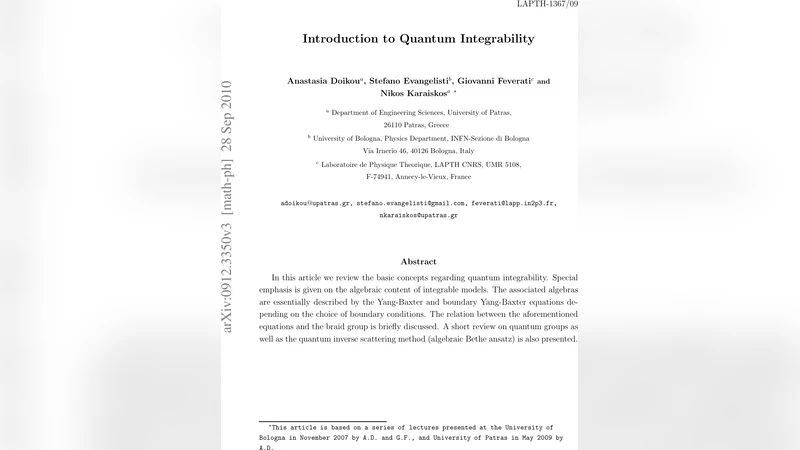
In this article we review the basic concepts regarding quantum integrability. Special emphasis is given on the algebraic content of integrable models. The associated algebras are essentially described by the Yang-Baxter and boundary Yang-Baxter equations depending on the choice of boundary conditions. The relation between the aforementioned equations and the braid group is briefly discussed. A short review on quantum groups as well as the quantum inverse scattering method (algebraic Bethe ansatz) is also presented.
💡 Research Summary
The paper provides a concise yet thorough review of the foundational concepts underlying quantum integrability, with a particular focus on the algebraic structures that make exact solutions possible. It begins by recalling the notion of integrability from classical mechanics—namely the existence of an extensive set of commuting conserved quantities—and explains how this idea translates into the quantum domain, where an infinite family of mutually commuting operators can be constructed.
The central mathematical object is the Yang‑Baxter equation (YBE). The author explains that the R‑matrix, which encodes the two‑body scattering data, must satisfy the three‑body consistency condition R₁₂(λ‑μ) R₁₃(λ) R₂₃(μ) = R₂₃(μ) R₁₃(λ) R₁₂(λ‑μ). This relation guarantees the commutativity of transfer matrices built from the R‑matrix and therefore the existence of an infinite hierarchy of conserved quantities. Concrete examples, such as the six‑vertex model’s R‑matrix, are presented to illustrate how the spectral parameter enters and how solutions are parametrised.
When open boundaries are considered, the paper introduces the boundary Yang‑Baxter equation (BYBE). Here a K‑matrix describing reflection at the boundary must satisfy K₁(λ) R₁₂(λ+μ) K₂(μ) R₂₁(λ‑μ) = R₁₂(λ‑μ) K₂(μ) R₂₁(λ+μ) K₁(λ). This additional constraint ensures that the double‑row transfer matrix remains commuting, thereby extending integrability to systems with non‑periodic boundary conditions. The author briefly discusses typical solutions for diagonal and non‑diagonal K‑matrices and their physical interpretation in open spin chains.
A significant portion of the review is devoted to the relationship between the YBE and the braid group. The braid generators σ_i obey σ_iσ_{i+1}σ_i = σ_{i+1}σ_iσ_{i+1}, which is algebraically identical to the YBE when the R‑matrix is identified with a representation of σ_i. This observation leads naturally to the introduction of quantum groups—deformations of universal enveloping algebras denoted U_q(g). The Drinfel’d‑Jimbo construction shows that the universal R‑matrix of a quantum group provides a systematic way to generate solutions of the YBE. The paper highlights the case of U_q(sl₂), explaining how its representation theory yields the familiar trigonometric R‑matrix of the XXZ model.
The quantum inverse scattering method (QISM) is then outlined. Starting from the R‑matrix, one builds the monodromy matrix T(λ) = R_{0N}(λ)…R_{01}(λ) acting on an auxiliary space 0 and the quantum space of the chain. The transfer matrix τ(λ) = tr₀ T(λ) generates commuting operators for different values of the spectral parameter. The algebraic Bethe ansatz (ABA) is presented as a constructive procedure to diagonalise τ(λ). By defining a reference (pseudo‑vacuum) state |0⟩ that is annihilated by the lower‑triangular elements of T(λ), one introduces creation operators B(λ) that build Bethe states |{λ_j}⟩ = B(λ₁)…B(λ_M)|0⟩. The commutation relations derived from the RTT‑relation lead to the Bethe equations, which determine the allowed rapidities {λ_j} and thus the spectrum of the Hamiltonian. Explicit examples for the XXZ spin‑½ chain and the six‑vertex model are given, showing how the energy eigenvalues are expressed in terms of the Bethe roots.
In the concluding section, the author surveys recent developments and open problems. Extensions to higher‑rank quantum groups, supersymmetric integrable models, and non‑diagonal boundary conditions are identified as active research areas. The review also mentions the growing interplay between algebraic integrability and numerical tensor‑network techniques, suggesting that hybrid approaches may unlock exact results for higher‑dimensional or strongly correlated quantum systems.
Overall, the article succeeds in stitching together the algebraic backbone of quantum integrability—YBE, BYBE, braid group, quantum groups, QISM, and ABA—into a coherent narrative that is accessible to newcomers while still offering depth for seasoned practitioners. It serves as a valuable reference point for anyone wishing to understand how exact solvability emerges from the underlying algebraic symmetries of quantum many‑body models.
Comments & Academic Discussion
Loading comments...
Leave a Comment