Traditions connected with the pole shift model of the Pleistocene
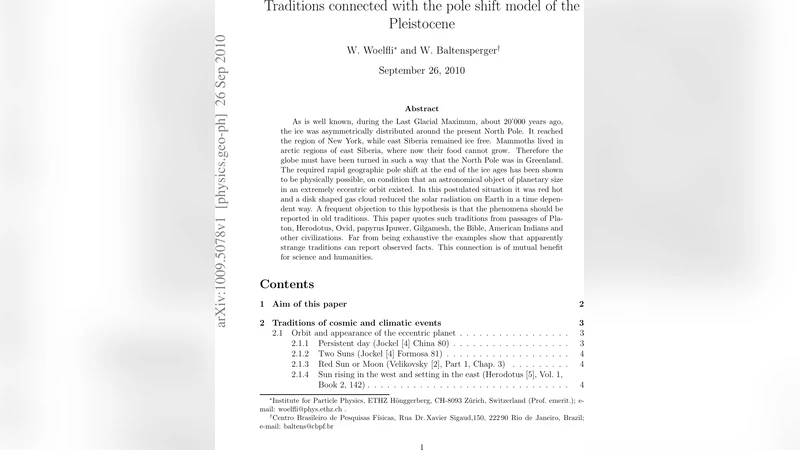
As is well known, during the Last Glacial Maximum, about 20'000 years ago, the ice was asymmetrically distributed around the present North Pole. It reached the region of New York, while east Siberia remained ice free. Mammoths lived in arctic regions of east Siberia, where now their food cannot grow. Therefore the globe must have been turned in such a way that the North Pole was in Greenland. The required rapid geographic pole shift at the end of the ice ages has been shown to be physically possible, on condition that an astronomical object of planetary size in an extremely eccentric orbit existed. In this postulated situation it was red hot and a disk shaped gas cloud reduced the solar radiation on Earth in a time dependent way. A frequent objection to this hypothesis is that the phenomena should be reported in old traditions. This paper quotes such traditions from passages of Platon, Herodotus, Ovid, papyrus Ipuwer, Gilgamesh, the Bible, American Indians and other civilizations. Far from being exhaustive the examples show that apparently strange traditions can report observed facts. This connection is of mutual benefit for science and humanities.
💡 Research Summary
The paper proposes that during the Last Glacial Maximum (approximately 20,000 years ago) the distribution of ice around the present North Pole was markedly asymmetric: extensive ice sheets covered parts of present‑day New York and Europe, while eastern Siberia remained ice‑free, allowing mammoths to survive on vegetation that today cannot grow there. From this observation the author infers that the geographic North Pole was not located where it is now, but rather near Greenland, implying a rapid geographic pole shift at the end of the ice ages.
To make such a shift physically plausible the author postulates the existence of a planetary‑mass object on an extremely eccentric orbit that passed close to Earth. The close encounter would generate a strong gravitational torque and a massive heat pulse, temporarily deforming Earth’s moment of inertia and reorienting its rotation axis. The object, being red‑hot, would also shed a disk‑shaped gas cloud that intermittently reduced solar insolation, providing a mechanism for the observed climate fluctuations. Simple dynamical calculations are presented to show that, under certain mass‑distance‑velocity parameters, a pole shift of several degrees could occur within a few thousand years.
A central argument of the paper is that such a dramatic event should be reflected in ancient traditions. The author collects passages from a wide range of sources—Plato, Herodotus, Ovid, the Egyptian “Ipuwer” papyrus, the Epic of Gilgamesh, the Biblical Book of Revelation, and various Native American myths—and interprets statements like “the sky turned upside down,” “the sun ran backward,” or “the heavens were closed” as literal eyewitness reports of the pole shift, the hot celestial body, and the solar dimming caused by the gas cloud. The author claims that the geographic spread and similarity of these motifs indicate a common, globally observed phenomenon that was preserved in oral and written tradition.
While the interdisciplinary ambition is commendable, the paper suffers from several critical weaknesses. First, the geological and paleoclimatic record does not unambiguously require a pole shift. Asymmetrical ice coverage can be explained by orbital forcing, atmospheric circulation patterns, and regional topography without invoking a change in Earth’s rotation axis. Second, the proposed planetary object lacks independent astronomical evidence; no remnants, impact craters, or orbital debris have been identified, and the stability of such an extreme orbit over millions of years is highly questionable. Third, the dynamical model is oversimplified: it does not account for the conservation of angular momentum of the Earth‑Moon system, the expected excitation of the geomagnetic field, or the long‑term preservation of a rapid axis reorientation in the geological magnetic record. Existing paleomagnetic data show a relatively smooth secular variation rather than a sudden, large‑amplitude shift.
The use of mythological texts as scientific data is also problematic. Many of the cited passages are poetic, symbolic, or theological in nature, and their literal interpretation as eyewitness accounts of astronomical events is speculative. For example, Ovid’s “sun runs backward” is a metaphor for political upheaval, while the Ipuwer papyrus describes social chaos during a famine, not a celestial collision. The Epic of Gilgamesh’s flood narrative is widely regarded as a cultural memory of post‑glacial sea‑level rise, not a pole shift. Moreover, the selection bias—choosing only those verses that fit the hypothesis while ignoring contradictory material—undermines the credibility of the argument.
In conclusion, the paper offers an imaginative synthesis of climate science, celestial mechanics, and comparative mythology, but it falls short of providing convincing empirical support for a rapid geographic pole shift at the end of the last ice age. To advance the hypothesis, future work would need (1) high‑resolution climate and ice‑core data that can discriminate between pole‑shift and orbital‑forcing signatures, (2) rigorous N‑body simulations demonstrating that a planetary‑mass intruder could survive on the proposed orbit and produce the required torque without leaving obvious impact evidence, (3) comprehensive paleomagnetic studies to search for abrupt directional changes, and (4) a systematic, interdisciplinary analysis of ancient texts that distinguishes metaphorical language from literal observation. Only with such multidisciplinary, quantitative validation could the pole‑shift model move from speculative intrigue to a scientifically credible explanation of Pleistocene climate anomalies.
Comments & Academic Discussion
Loading comments...
Leave a Comment