On the complexity of the multiple stack TSP, kSTSP
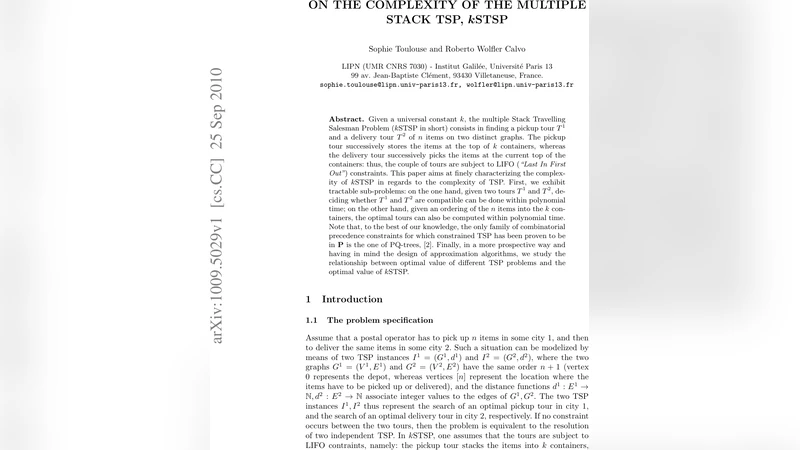
The multiple Stack Travelling Salesman Problem, STSP, deals with the collect and the deliverance of n commodities in two distinct cities. The two cities are represented by means of two edge-valued graphs (G1,d2) and (G2,d2). During the pick-up tour, the commodities are stored into a container whose rows are subject to LIFO constraints. As a generalisation of standard TSP, the problem obviously is NP-hard; nevertheless, one could wonder about what combinatorial structure of STSP does the most impact its complexity: the arrangement of the commodities into the container, or the tours themselves? The answer is not clear. First, given a pair (T1,T2) of pick-up and delivery tours, it is polynomial to decide whether these tours are or not compatible. Second, for a given arrangement of the commodities into the k rows of the container, the optimum pick-up and delivery tours w.r.t. this arrangement can be computed within a time that is polynomial in n, but exponential in k. Finally, we provide instances on which a tour that is optimum for one of three distances d1, d2 or d1+d2 lead to solutions of STSP that are arbitrarily far to the optimum STSP.
💡 Research Summary
The paper investigates the computational complexity of the Multiple‑Stack Travelling Salesman Problem (kSTSP), a natural extension of the classic TSP in which a set of n commodities must be picked up in one city and delivered in another while being stored in a container that consists of k rows (stacks) subject to LIFO (last‑in‑first‑out) constraints. The problem is defined on two edge‑weighted complete graphs G₁=(V,E,d₁) and G₂=(V,E,d₂), representing the pickup and delivery networks respectively. The authors focus on three fundamental questions that together reveal where the difficulty of kSTSP originates.
First, they consider the compatibility problem: given a pair of tours (T₁,T₂) – one for pickup on G₁ and one for delivery on G₂ – decide whether there exists an assignment of the commodities to the k rows that respects the LIFO rule. By constructing a precedence digraph that captures the order in which each commodity is visited in T₁ and T₂, they show that checking for cycles (i.e., violations of the LIFO order) can be done in polynomial time, essentially by a topological‑sort‑like procedure. Consequently, the compatibility sub‑problem lies in P, despite the overall problem being NP‑hard.
Second, the authors examine the optimisation problem when the assignment of commodities to rows is fixed in advance. They develop a dynamic‑programming (DP) scheme whose state records, for each row, the current stack content (or equivalently the set of commodities still pending in that row). The DP iterates over the n commodities, deciding at each step whether to push a new commodity onto a particular row during the pickup phase or to pop from a row during delivery. The transition cost is taken from d₁ for pickup moves and from d₂ for delivery moves. The DP runs in O(n·f(k)) time, where f(k) is exponential in k (roughly 2^k·k!). Hence the algorithm is polynomial in n for any fixed k, but becomes infeasible as k grows, establishing k as the primary source of combinatorial explosion.
Third, the paper demonstrates that optimising any single distance function (d₁ alone, d₂ alone, or the sum d₁+d₂) does not guarantee a good solution for the full kSTSP. By constructing families of instances in which the optimal T₁ for d₁ forces a very poor delivery order on G₂ (and vice‑versa), they prove that the ratio between the cost of a tour optimal for one of these three objectives and the true kSTSP optimum can be made arbitrarily large. This “gap” result underscores the intricate interaction between the two networks and the LIFO constraints: a tour that looks optimal when evaluated on one metric may be catastrophically sub‑optimal when the other metric and the stack feasibility are taken into account.
Overall, the paper provides a clear decomposition of the complexity landscape of kSTSP: (i) compatibility checking is easy (P), (i i) fixing the stack layout yields a DP that is polynomial in n but exponential in k, and (i i i) naïve optimisation of the individual distance measures can be arbitrarily far from the true optimum. These findings suggest two complementary research directions. For small, constant k one can aim for exact algorithms based on the presented DP, possibly enhanced with branch‑and‑bound or cutting‑plane techniques. For larger k, the focus should shift to approximation schemes, heuristic meta‑search (e.g., genetic algorithms, ant‑colony optimisation) or parameterised‑complexity approaches that treat k as a parameter. Moreover, the gap construction highlights the need for integrated objective functions that simultaneously respect both distance metrics and the stack feasibility, rather than treating the two tours independently. The work thus lays a solid theoretical foundation for future algorithmic developments and complexity analyses of multi‑stack vehicle routing and related logistics problems.
Comments & Academic Discussion
Loading comments...
Leave a Comment