The Complexity of Counting Eulerian Tours in 4-Regular Graphs
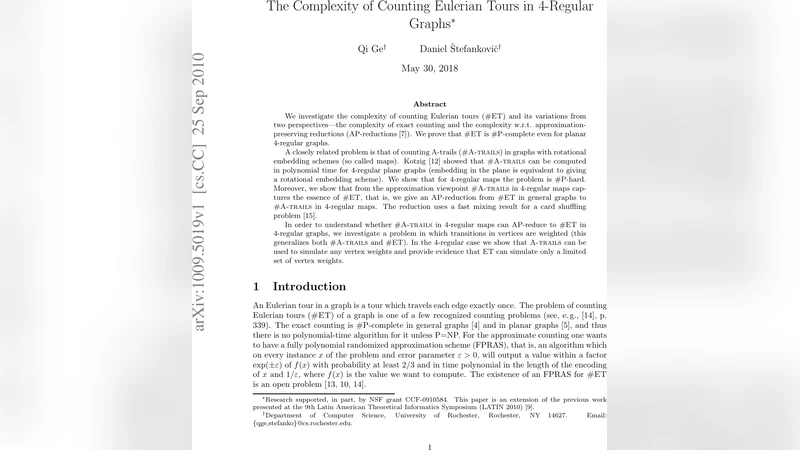
We investigate the complexity of counting Eulerian tours ({\sc #ET}) and its variations from two perspectives—the complexity of exact counting and the complexity w.r.t. approximation-preserving reductions (AP-reductions \cite{MR2044886}). We prove that {\sc #ET} is #P-complete even for planar 4-regular graphs. A closely related problem is that of counting A-trails ({\sc #A-trails}) in graphs with rotational embedding schemes (so called maps). Kotzig \cite{MR0248043} showed that {\sc #A-trails} can be computed in polynomial time for 4-regular plane graphs (embedding in the plane is equivalent to giving a rotational embedding scheme). We show that for 4-regular maps the problem is #P-hard. Moreover, we show that from the approximation viewpoint {\sc #A-trails} in 4-regular maps captures the essence of {\sc #ET}, that is, we give an AP-reduction from {\sc #ET} in general graphs to {\sc #A-trails} in 4-regular maps. The reduction uses a fast mixing result for a card shuffling problem \cite{MR2023023}. In order to understand whether #{\sc A-trails} in 4-regular maps can AP-reduce to #{\sc ET} in 4-regular graphs, we investigate a problem in which transitions in vertices are weighted (this generalizes both #{\sc A-trails} and #{\sc ET}). In the 4-regular case we show that {\sc A-trails} can be used to simulate any vertex weights and provide evidence that {\sc ET} can simulate only a limited set of vertex weights.
💡 Research Summary
The paper investigates the computational complexity of counting Eulerian tours (#ET) and counting A‑trails (#A‑trails) in the very restricted setting of 4‑regular graphs and 4‑regular maps (graphs equipped with a rotational embedding scheme). Two complementary perspectives are pursued: exact counting complexity (i.e., #P‑hardness) and approximation‑preserving reducibility (AP‑reductions).
First, the authors show that even when the input is a planar 4‑regular graph, counting Eulerian tours remains #P‑complete. The proof proceeds by a parsimonious reduction from 3‑SAT. Each variable and clause is encoded by a small 4‑regular “gadget” whose internal structure forces any Eulerian tour to correspond to a satisfying assignment. Careful planar embedding of these gadgets guarantees that the resulting graph is both planar and 4‑regular, thereby establishing that the degree bound and planarity do not simplify the exact counting problem.
Second, the paper turns to A‑trails in 4‑regular maps. Kotzig’s classic result tells us that for 4‑regular plane graphs (i.e., when the embedding is fixed to the plane) the number of A‑trails can be computed in polynomial time. The authors demonstrate that this tractability disappears as soon as the embedding is allowed to be an arbitrary rotation system. By exploiting the freedom to choose the cyclic order of incident edges at each vertex, they construct a reduction from #ET to #A‑trails in 4‑regular maps, proving #P‑hardness. The reduction essentially simulates the edge‑transition constraints of an Eulerian tour within the more flexible A‑trail framework.
From the approximation viewpoint, the paper’s most striking contribution is an AP‑reduction from #ET on general graphs to #A‑trails on 4‑regular maps. The reduction uses a fast‑mixing result for a card‑shuffling Markov chain (the “random transposition” shuffle). Each vertex of the original graph is replaced by a 4‑regular gadget equipped with a set of random transition probabilities. The resulting Markov chain on the map mixes rapidly, allowing one to sample A‑trails efficiently and to obtain an unbiased estimator for the number of Eulerian tours in the original graph. Because the reduction preserves approximation ratios, any fully polynomial‑time randomized approximation scheme (FPRAS) for #A‑trails would yield an FPRAS for #ET, and vice‑versa. This establishes that the approximation complexity of the two problems is essentially identical.
Finally, the authors introduce a weighted‑transition model that generalizes both #ET and #A‑trails. In this model each vertex carries a matrix of transition weights describing the probability of moving from any incident edge to any other. They prove that, in the 4‑regular case, A‑trails can simulate any such weight matrix, whereas Eulerian tours can only realize a restricted, symmetric subclass of matrices. This asymmetry provides evidence that #A‑trails is strictly more expressive than #ET, and suggests that a reduction in the opposite direction (from #A‑trails to #ET) is unlikely to exist without additional constraints.
In summary, the paper makes four major contributions: (1) #ET is #P‑complete even for planar 4‑regular graphs; (2) #A‑trails is polynomial‑time solvable for 4‑regular plane graphs but becomes #P‑hard for arbitrary 4‑regular maps; (3) there is an AP‑reduction from general #ET to #A‑trails in 4‑regular maps, equating their approximation complexities; and (4) a weighted‑transition framework reveals a fundamental expressive gap between Eulerian tours and A‑trails. These results deepen our understanding of counting problems on low‑degree graphs, clarify the role of embedding information in computational difficulty, and open new avenues for studying approximation algorithms in highly constrained combinatorial settings.
Comments & Academic Discussion
Loading comments...
Leave a Comment