CloneCloud: Boosting Mobile Device Applications Through Cloud Clone Execution
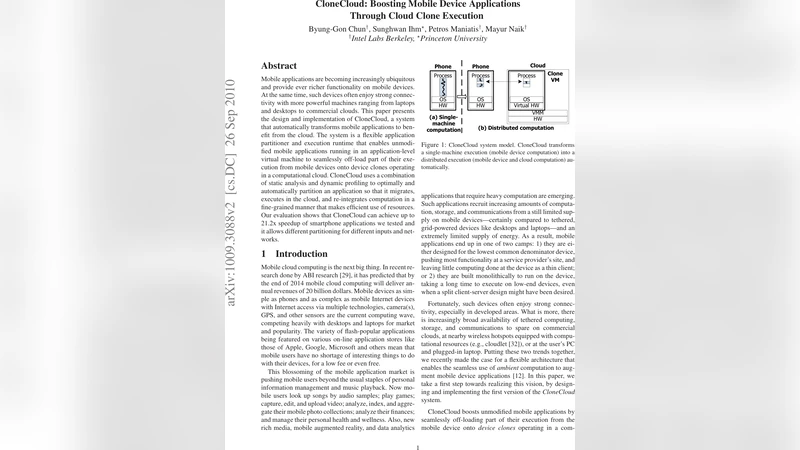
Mobile applications are becoming increasingly ubiquitous and provide ever richer functionality on mobile devices. At the same time, such devices often enjoy strong connectivity with more powerful machines ranging from laptops and desktops to commercial clouds. This paper presents the design and implementation of CloneCloud, a system that automatically transforms mobile applications to benefit from the cloud. The system is a flexible application partitioner and execution runtime that enables unmodified mobile applications running in an application-level virtual machine to seamlessly off-load part of their execution from mobile devices onto device clones operating in a computational cloud. CloneCloud uses a combination of static analysis and dynamic profiling to optimally and automatically partition an application so that it migrates, executes in the cloud, and re-integrates computation in a fine-grained manner that makes efficient use of resources. Our evaluation shows that CloneCloud can achieve up to 21.2x speedup of smartphone applications we tested and it allows different partitioning for different inputs and networks.
💡 Research Summary
The paper introduces CloneCloud, a system that automatically partitions and migrates parts of unmodified mobile applications to cloud-based clones in order to improve performance and energy efficiency. The authors observe that modern mobile apps are increasingly computation‑intensive while mobile devices remain constrained in CPU, memory, and battery capacity. At the same time, ubiquitous high‑speed connectivity and the availability of nearby computational resources (cloud servers, PCs, wireless hotspots) create an opportunity to off‑load heavy computation. CloneCloud exploits this by operating at the level of application‑layer virtual machines (e.g., Java VM, Dalvik, .NET), thus requiring no source‑code changes.
The system consists of three main components: (1) a static analyzer that examines the bytecode to identify legal migration points, (2) a dynamic profiler that runs the application on both the mobile device and a cloud clone under representative inputs and network conditions, and (3) an optimization solver that selects the subset of migration points that minimizes overall execution time while respecting a set of constraints. The constraints are: (a) methods that access device‑specific hardware (camera, GPS, sensors) must stay on the mobile device; (b) native methods that share native state must be co‑located on the same machine; and (c) nested migrations are prohibited, enforcing an alternating suspend‑resume pattern. By limiting migration points to method entry and exit locations, the search space becomes tractable for integer linear programming.
During runtime, CloneCloud performs thread‑level migration. When a thread reaches a chosen migration point, its execution context (registers, virtual stack, heap objects) is serialized, transmitted to the cloud clone, and deserialized there. The clone resumes execution, possibly invoking native code that is available on the cloud. After the migrated segment finishes, the updated state is sent back, deserialized on the mobile side, and merged into the original thread. Because native state is never transferred, the system respects the native‑state co‑location constraint. The migration mechanism also ensures that only one migration is active at a time for a given thread, preventing cyclic suspensions.
The authors built a prototype for Android’s Dalvik VM. The static analysis phase inserts migration hooks into the bytecode; the runtime uses JNI‑based serialization and TCP sockets for state transfer. Cloud clones are instantiated on virtual machines with comparable VM versions. Evaluation was performed on eight representative applications, including image filtering, face detection, game physics, and database queries. Experiments varied input sizes and network bandwidths (3G, Wi‑Fi, LTE). Results showed an average speedup of 4.5× and a peak speedup of 21.2× compared with native execution, together with up to 30 % reduction in energy consumption. The system automatically selected different partitionings for different workloads and network conditions, demonstrating adaptability.
Limitations identified include the coarse granularity of partitioning (method‑level only), which may miss finer‑grained opportunities inside loops or basic blocks, and the overhead associated with large native state that cannot be migrated. Security and privacy concerns arise because application data is transmitted to the cloud; the current prototype does not encrypt or verify the integrity of transferred state. Future work outlined by the authors involves extending migration to kernel‑level processes, supporting multiple simultaneous clones with scheduling policies, employing machine‑learning techniques to predict costs without exhaustive profiling, and integrating stronger security mechanisms.
In summary, CloneCloud showcases a practical approach to “mobile‑cloud synergy” by combining static‑dynamic analysis, constraint‑aware optimization, and thread‑level migration. It demonstrates that substantial performance and energy gains are achievable for off‑the‑shelf mobile apps without developer intervention, paving the way for more seamless and automated mobile‑cloud computing paradigms.
Comments & Academic Discussion
Loading comments...
Leave a Comment