On Some Sets of Dictionaries Whose omega-Powers Have a Given Complexity
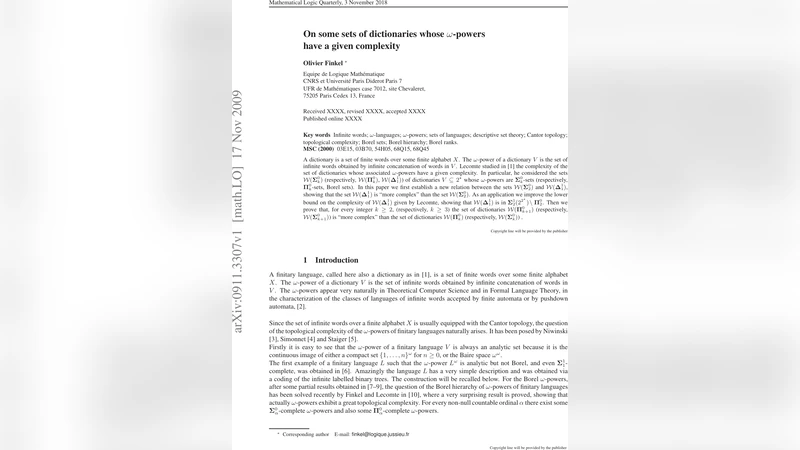
A dictionary is a set of finite words over some finite alphabet X. The omega-power of a dictionary V is the set of infinite words obtained by infinite concatenation of words in V. Lecomte studied in [Omega-powers and descriptive set theory, JSL 2005] the complexity of the set of dictionaries whose associated omega-powers have a given complexity. In particular, he considered the sets $W({\bf\Si}^0_{k})$ (respectively, $W({\bf\Pi}^0_{k})$, $W({\bf\Delta}1^1)$) of dictionaries $V \subseteq 2^\star$ whose omega-powers are ${\bf\Si}^0{k}$-sets (respectively, ${\bf\Pi}^0_{k}$-sets, Borel sets). In this paper we first establish a new relation between the sets $W({\bf\Sigma}^0_{2})$ and $W({\bf\Delta}1^1)$, showing that the set $W({\bf\Delta}1^1)$ is “more complex” than the set $W({\bf\Sigma}^0{2})$. As an application we improve the lower bound on the complexity of $W({\bf\Delta}1^1)$ given by Lecomte. Then we prove that, for every integer $k\geq 2$, (respectively, $k\geq 3$) the set of dictionaries $W({\bf\Pi}^0{k+1})$ (respectively, $W({\bf\Si}^0{k+1})$) is “more complex” than the set of dictionaries $W({\bf\Pi}^0_{k})$ (respectively, $W({\bf\Si}^0_{k})$) .
💡 Research Summary
The paper investigates the descriptive‑set‑theoretic complexity of ω‑powers of finite‑word dictionaries. For a dictionary V⊆2* the ω‑power V^ω consists of all infinite words obtained by concatenating infinitely many words from V. Following Lecomte (JSL 2005), the authors consider, for a given complexity class Γ, the set
W(Γ) = { V ⊆ 2* | V^ω ∈ Γ }.
In particular they study W(Σ⁰_k), W(Π⁰_k) (the collections of dictionaries whose ω‑powers are Σ⁰_k‑ or Π⁰_k‑sets) and W(Δ¹₁) (the dictionaries whose ω‑powers are Borel).
The first major contribution is a new comparison between W(Σ⁰_2) and W(Δ¹₁). By constructing a continuous reduction f that, given any dictionary V, inserts a fixed “complexity‑boosting pattern” into V, the authors show that f maps W(Σ⁰_2) into W(Δ¹₁) while there exist V∉W(Σ⁰_2) whose image still lies in W(Δ¹₁). Consequently W(Δ¹₁) is strictly more complex than W(Σ⁰_2). Moreover, the reduction proves that W(Δ¹₁) is Π¹₁‑complete, improving Lecomte’s earlier lower bound (Π¹₁‑hard) to an exact completeness result.
The second set of results establishes a strict hierarchy for the families W(Π⁰_k) and W(Σ⁰_k). For each integer k≥2 the authors define a continuous operator g_k that adjoins to any dictionary V a fixed “amplifier” dictionary E_k. The construction guarantees that E_k^ω is Π⁰_{k+1}‑complete (respectively Σ⁰_{k+1}‑complete) and that (E_k ∪ V)^ω belongs to Π⁰_{k+1} (resp. Σ⁰_{k+1}) exactly when V^ω belongs to Π⁰_k (resp. Σ⁰_k). Because the reduction is continuous and not onto, they obtain proper W‑reductions
W(Π⁰_k) <W W(Π⁰{k+1}) (k≥2)
W(Σ⁰_k) <W W(Σ⁰{k+1}) (k≥3).
Thus each step up the Borel hierarchy yields a strictly more complex family of dictionaries.
Technically, the paper’s core method is a coding scheme that splits a dictionary into a “preservation part” (the original V) and a “boost part” (E_k). By carefully arranging the words of E_k, the authors control the Borel rank of the resulting ω‑power. The reductions are realized by continuous functions on the Cantor space 2^{ω}, ensuring that the complexity comparison respects the standard W‑reducibility used in descriptive set theory.
The authors discuss the implications for automata theory and infinite‑game semantics. Since ω‑powers model the languages accepted by Büchi automata and other ω‑automata, knowing the exact Borel class of V^ω informs decidability and closure properties of the corresponding language families. The strict hierarchy results show that moving from Σ⁰_k to Σ⁰_{k+1} (or Π⁰_k to Π⁰_{k+1}) cannot be simulated by any continuous transformation of dictionaries, highlighting intrinsic expressive gaps.
Finally, the paper outlines future directions: (i) determining the exact complexity of W(Σ⁰_1) and W(Π⁰_1); (ii) exploring reductions that are not continuous, which may yield even higher lower bounds; (iii) extending the analysis to multi‑alphabet or multi‑dictionary settings, where interactions between several ω‑powers could produce new phenomena. Overall, the work refines our understanding of how the descriptive‑set‑theoretic complexity of ω‑powers is reflected at the level of the underlying finite‑word dictionaries, and it establishes a clean, strict hierarchy among the families W(Γ).
Comments & Academic Discussion
Loading comments...
Leave a Comment