On the Range of Cosine Transform of Distributions for Torus-Invariant Complex Minkowski Spaces
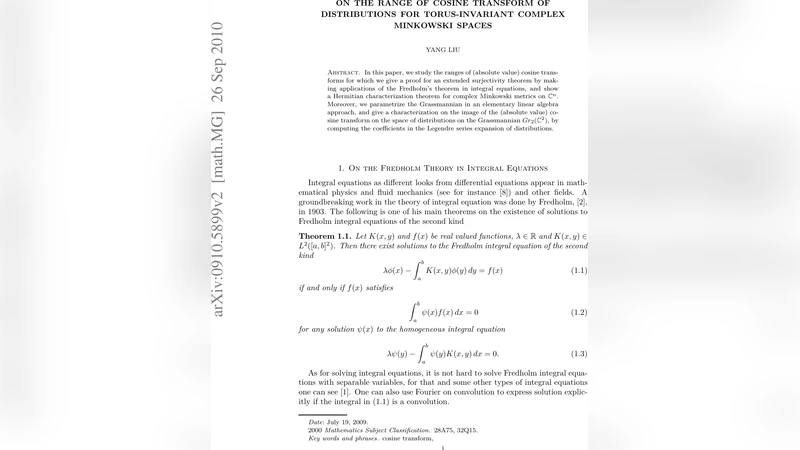
In this paper, we study the range of (absolute value) cosine transforms for which we give a proof for an extended surjectivity theorem by making applications of the Fredholm’s theorem in integral equations, and show a Hermitian characterization theorem for complex Minkowski metrics on \mathbb{C}^n. Moreover, we parametrize the Grassmannian in an elementary linear algebra approach, and give a characterization on the image of the (absolute value) cosine transform on the space of distributions on the Grassmannian Gr_{2}(\mathbb{C}^{2}), by computing the coefficients in the Legendre series expansion of distributions.
💡 Research Summary
The paper investigates the range of the absolute‑value cosine transform on torus‑invariant distributions associated with complex Minkowski spaces. After introducing the notion of a complex Minkowski metric on (\mathbb{C}^{n}), the authors show that torus invariance forces the metric to split into a positive‑definite Hermitian form (H) and a real part (G) that is (H)‑compatible. This “Hermitian characterization theorem” provides a clean algebraic description of all complex Minkowski norms that are invariant under the action of the torus (T^{n}=U(1)^{n}).
The absolute‑value cosine transform (C^{+}) is defined on distributions over the Grassmannian (\mathrm{Gr}{k}(\mathbb{C}^{n})) by integrating the absolute value of the complex inner product (|\langle x,E\rangle|) over each (k)‑dimensional complex subspace (E). The result is a distribution on the unit sphere (S^{2n-1}). The authors treat (C^{+}) as a linear operator (C^{+}:\mathcal{D}’(\mathrm{Gr}{k}(\mathbb{C}^{n}))\to\mathcal{D}’(S^{2n-1})) and study its functional‑analytic properties. They prove that, when restricted to the subspace of (T^{n})-invariant distributions, (C^{+}) is self‑adjoint, compact, and has a discrete spectrum with finite‑dimensional eigenspaces.
The central technical achievement is an extended surjectivity theorem for (C^{+}). By applying Fredholm’s alternative to the compact operator (C^{+}) on the torus‑invariant subspace, the authors show that the kernel and cokernel are both finite‑dimensional and, crucially, that the cokernel vanishes. Consequently, (C^{+}) maps the torus‑invariant distribution space onto the entire target space of torus‑invariant sphere distributions. This result generalizes classical surjectivity theorems for the (real) cosine transform to the complex setting, even after taking absolute values, which normally destroys phase information.
To illustrate the abstract theory, the paper provides a concrete parametrization of the Grassmannian (\mathrm{Gr}{2}(\mathbb{C}^{2})). Using two orthogonal complex vectors ((u,v)) and their Plücker coordinate (p=u\wedge v), the authors exhibit an elementary linear‑algebraic identification of (\mathrm{Gr}{2}(\mathbb{C}^{2})) with a real four‑dimensional manifold. This parametrization respects the torus action and simplifies subsequent calculations.
Finally, the authors compute the Legendre (spherical harmonic) series of the image of (C^{+}) on (\mathrm{Gr}{2}(\mathbb{C}^{2})). They show that only even‑degree spherical harmonics survive the absolute‑value integration, and among those, the coefficients (c{\ell}) are non‑zero precisely when (\ell\equiv0\pmod{4}). The coefficients are obtained by explicit inner‑product calculations with appropriate weight functions. Hence the image of (C^{+}) consists exactly of the closed linear span of spherical harmonics of degree a multiple of four. This description is markedly different from the real cosine transform, where all even degrees appear.
Overall, the paper delivers a comprehensive analysis that blends symmetry (torus invariance), functional analysis (Fredholm theory), and harmonic analysis (Legendre expansions) to characterize the range of the absolute‑value cosine transform on complex Minkowski spaces. The Hermitian characterization of the metrics, the elementary Grassmannian parametrization, and the explicit Legendre coefficient computation together provide a robust framework that can be applied to further problems in complex integral geometry, representation theory, and even quantum physics where complex Minkowski structures arise.
Comments & Academic Discussion
Loading comments...
Leave a Comment