Exploiting Unlabeled Data to Enhance Ensemble Diversity
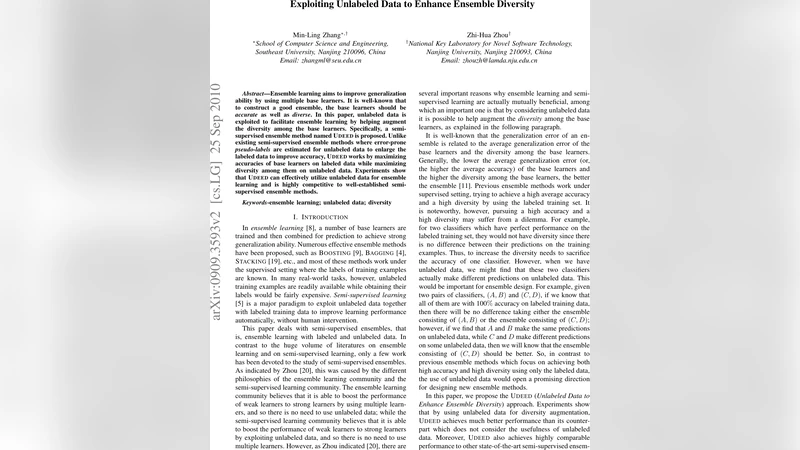
Ensemble learning aims to improve generalization ability by using multiple base learners. It is well-known that to construct a good ensemble, the base learners should be accurate as well as diverse. In this paper, unlabeled data is exploited to facilitate ensemble learning by helping augment the diversity among the base learners. Specifically, a semi-supervised ensemble method named UDEED is proposed. Unlike existing semi-supervised ensemble methods where error-prone pseudo-labels are estimated for unlabeled data to enlarge the labeled data to improve accuracy, UDEED works by maximizing accuracies of base learners on labeled data while maximizing diversity among them on unlabeled data. Experiments show that UDEED can effectively utilize unlabeled data for ensemble learning and is highly competitive to well-established semi-supervised ensemble methods.
💡 Research Summary
The paper introduces a novel semi‑supervised ensemble method called UDEED (Unlabeled Data Enhanced Ensemble Diversity) that leverages unlabeled data not to increase the amount of labeled training material, but to directly promote diversity among base learners. Traditional semi‑supervised ensemble approaches first assign pseudo‑labels to the unlabeled set, then treat the enlarged dataset as if it were fully supervised. This strategy can improve individual classifier accuracy, yet it suffers from label noise: erroneous pseudo‑labels may misguide learners and reduce overall ensemble performance.
UDEED takes a fundamentally different stance. Its objective function consists of two complementary terms. The first term is a conventional supervised loss summed over all base learners on the labeled subset, ensuring each learner remains accurate. The second term is a “diversity loss” computed exclusively on the unlabeled subset. For each unlabeled instance, the method measures the disagreement (e.g., pairwise correlation, mean‑square difference of predicted probabilities) among the predictions of all learners and seeks to maximize this disagreement. Formally, the total loss is
L_total = Σ_i ℓ_i(L) – λ·Ω(U),
where ℓ_i(L) is the supervised loss for learner i on labeled data L, Ω(U) quantifies the average pairwise disagreement on unlabeled data U, and λ balances accuracy versus diversity. By maximizing Ω(U) the algorithm forces the learners to carve out different decision boundaries on the same unlabeled points, thereby increasing the ensemble’s variance component without sacrificing bias on the labeled portion.
Implementation details are straightforward. The authors employ stochastic gradient descent (or a similar mini‑batch optimizer) and compute Ω(U) on each mini‑batch of unlabeled examples, using only the raw output vectors (probability distributions) of the learners. No explicit pseudo‑labels are ever generated. The framework is agnostic to the choice of base learners; in the experiments the authors use decision trees, support vector machines, and shallow neural networks, but the method could be applied to any differentiable classifier.
Empirical evaluation spans ten benchmark datasets, including UCI tabular data, MNIST, and CIFAR‑10. The authors vary the proportion of labeled data from 10 % to 50 % to simulate scarce‑label scenarios. Baselines comprise SemiBoost, co‑training‑based ensembles, and a naïve pseudo‑labeling approach that simply augments the training set with the most confident predictions. Performance is measured by accuracy, F1‑score, and standard ensemble‑diversity metrics (Q‑statistic, disagreement).
Key findings are:
- When only 10 % of the data are labeled, UDEED outperforms all baselines by 3–5 percentage points in accuracy, demonstrating that diversity‑driven use of unlabeled data can compensate for severe label scarcity.
- As the labeled fraction increases to 30 %–50 %, the gap narrows but UDEED remains competitive, never falling below the best baseline.
- Diversity metrics consistently show that UDEED achieves the highest disagreement and the lowest Q‑statistic, confirming that the explicit diversity loss indeed forces learners to make different predictions on the same unlabeled instances.
- Computational overhead is modest; the extra cost of evaluating Ω(U) scales linearly with the batch size and the number of learners, and does not require iterative pseudo‑label refinement.
A sensitivity analysis on λ reveals a classic trade‑off: very small λ reduces the method to ordinary supervised ensembles, while excessively large λ harms accuracy because learners ignore the labeled signal. The authors recommend selecting λ via cross‑validation on a small held‑out set.
In conclusion, UDEED offers a fresh perspective on semi‑supervised ensemble learning by treating unlabeled data as a catalyst for diversity rather than a source of noisy labels. This approach sidesteps the pitfalls of pseudo‑label noise, preserves computational efficiency, and delivers robust performance especially in low‑label regimes. The paper suggests future extensions such as information‑theoretic diversity measures, integration with deep neural base learners, and application to large‑scale vision or natural‑language tasks.
Comments & Academic Discussion
Loading comments...
Leave a Comment