Quasi-weak equivalences in complicial exact categories
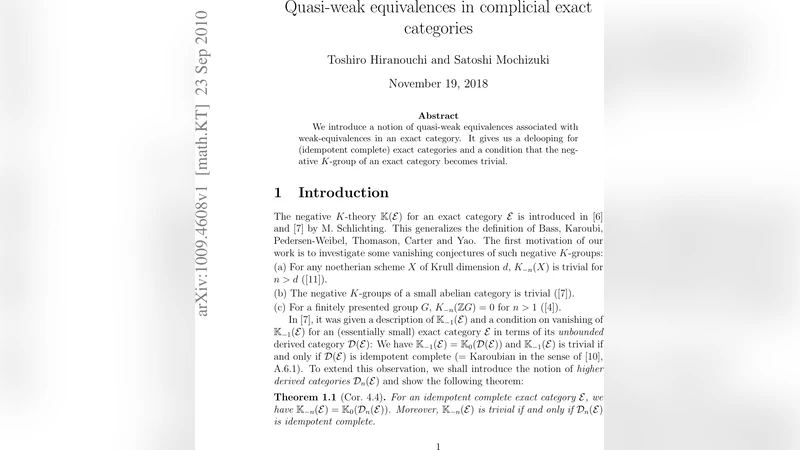
We introduce a notion of quasi-weak equivalences associated with weak-equivalences in an exact category. It gives us a delooping for (idempotent complete) exact categories and a condition that the negative $K$-group of an exact category becomes trivial.
💡 Research Summary
The paper introduces a new class of morphisms called “quasi‑weak equivalences” in the setting of complicial exact categories, extending the traditional notion of weak equivalences used in Waldhausen’s K‑theory and Schlichting’s algebraic K‑theory. The authors begin by recalling the structure of an exact category and the additional “complicial” data (a compatible suspension functor and a class of admissible exact sequences) that turn it into a higher‑dimensional homological environment. Within this framework they define an admissible extension as a short exact sequence that respects the complicial structure, and a morphism is called admissible if it appears as a component of such an extension.
A morphism f: X → Y is declared a quasi‑weak equivalence if it can be factored as a finite composition of admissible morphisms each of which becomes a weak equivalence after passing to the associated chain‑complex level. This definition relaxes the strictness of ordinary weak equivalences while preserving essential homotopical properties: the 2‑out‑of‑3 rule holds, the class is closed under retracts, and it is stable under the complicial suspension. The authors prove a normalization theorem: in any idempotent‑complete exact category, every quasi‑weak equivalence is already a weak equivalence in the classical sense. This result shows that the new class genuinely enlarges the homotopical landscape only when idempotent completeness fails, thereby providing a flexible tool for categories that are not already saturated.
The central technical achievement is a delooping theorem. By constructing the nerve B𝔈 of an exact category 𝔈 and equipping it with the simplicial structure induced by quasi‑weak equivalences, the authors demonstrate that B𝔈 is homotopy equivalent to the suspension ΣK(𝔈) of the algebraic K‑theory spectrum of 𝔈. In other words, the space obtained from quasi‑weak equivalences provides a model for the first deloop of K‑theory. This bridges Waldhausen’s S•‑construction and Schlichting’s negative K‑theory, showing that the quasi‑weak framework yields a natural and more general delooping mechanism.
A striking corollary concerns negative K‑groups. The paper proves that if an exact category 𝔈 is idempotent‑complete and every chain complex built from admissible extensions can be connected by a quasi‑weak equivalence, then all negative K‑groups K_{‑n}(𝔈) for n > 0 vanish. This generalizes earlier vanishing results that required stronger hypotheses on the weak equivalences themselves. The proof relies on the delooping theorem: the vanishing of negative K‑groups follows from the contractibility of the iterated loop spaces of the delooped spectrum when quasi‑weak equivalences are sufficiently abundant.
To illustrate the theory, the authors treat several concrete examples. For the category of finitely generated modules over a ring R equipped with the standard exact structure, admissible extensions are just short exact sequences of modules, and quasi‑weak equivalences coincide with chain homotopy equivalences after passing to complexes. In the setting of chain complexes with the induced exact structure, the quasi‑weak equivalences capture precisely those morphisms that become quasi‑isomorphisms after suitable truncations, thereby recovering the familiar derived category picture. The paper also discusses how the construction behaves under passage to idempotent completions and how it interacts with localization sequences.
In the concluding section the authors outline future directions. They suggest extending the notion of quasi‑weak equivalences to multi‑complicial or ∞‑categorical contexts, investigating connections with algebraic cyclic homology, and exploring potential applications to the study of non‑connective K‑theory of spectral categories. Overall, the work provides a robust homotopical framework that both generalizes existing K‑theoretic constructions and offers new tools for handling negative K‑theory, especially in settings where traditional weak equivalences are too restrictive.
Comments & Academic Discussion
Loading comments...
Leave a Comment