On Cohomology theory for topological groups
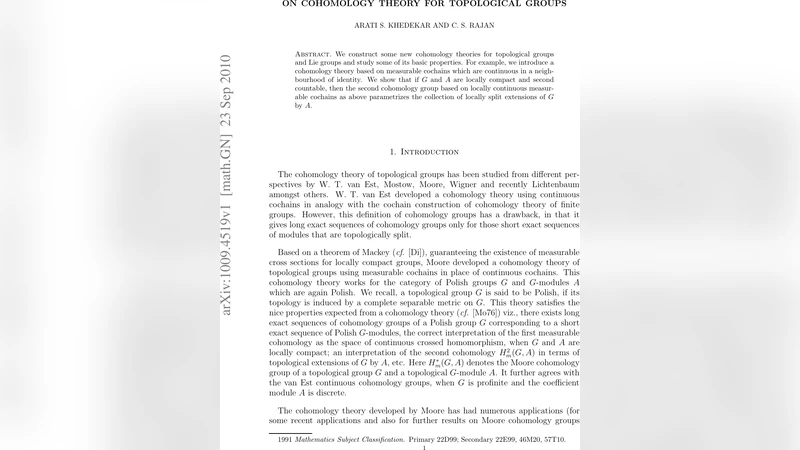
We construct some new cohomology theories for topological groups and Lie groups and study some of its basic properties. For example, we introduce a cohomology theory based on measurable cochains which are continuous in a neighbourhood of identity. We show that if G and A are locally compact and second countable, then the second cohomology group based on locally continuous measurable cochains as above parametrizes the collection of locally split extensions of G by A.
💡 Research Summary
The paper introduces a novel cohomology theory for topological groups that sits between the classical continuous cohomology and Borel (measurable) cohomology. The key innovation is the notion of “locally‑continuous measurable cochains.” For a topological group G and a G‑module A, an n‑cochain f : Gⁿ→A is called locally‑continuous measurable if it is measurable on the whole product Gⁿ but becomes continuous when restricted to some neighbourhood U of the identity element (i.e., f|{Uⁿ} is continuous). The collection of such cochains, denoted Cⁿ{lc‑meas}(G,A), is equipped with the usual coboundary operator δ, yielding a cochain complex (C^{·}{lc‑meas}(G,A),δ) and the associated cohomology groups Hⁿ{lc‑meas}(G,A).
The authors first verify that this construction indeed defines a cohomology theory: the coboundary squares to zero, and the resulting groups inherit the standard functorial properties (naturality with respect to group homomorphisms and module maps). They then compare the new theory with the two classical extremes. There are natural comparison maps
i : Hⁿ_{c}(G,A) → Hⁿ_{lc‑meas}(G,A) (continuous cochains regarded as locally‑continuous measurable) and
j : Hⁿ_{lc‑meas}(G,A) → Hⁿ_{B}(G,A) (forgetting the local continuity). Under mild hypotheses—e.g., G is a connected Lie group for i, and G is σ‑compact with a Haar measure for j—i is an isomorphism and j is surjective, respectively. Thus the new theory captures exactly the information lost when one passes from continuous to merely measurable cochains, while still retaining enough topological control to be useful.
The central theorem concerns the second cohomology group. When G and A are locally compact, second‑countable groups, H²_{lc‑meas}(G,A) classifies “locally split extensions” of G by A. An extension 1→A→E→G→1 is locally split if there exists a neighbourhood U of the identity in G together with a continuous section s : U→E. The authors construct a bijection between equivalence classes of such extensions and cohomology classes in H²_{lc‑meas}(G,A). The proof follows the classical pattern: a locally split extension yields a 2‑cocycle defined on a neighbourhood of the identity, which extends measurably to all of G²; cohomologous cocycles give equivalent extensions, and every cocycle arises from some extension. The locally compact, second‑countable hypothesis guarantees the existence of Haar measure and a standard Borel structure, which are essential for handling the measurability requirements.
Beyond the classification result, the paper develops the standard homological machinery for the new cohomology. Short exact sequences of modules give rise to long exact sequences in Hⁿ_{lc‑meas}. For a normal closed subgroup N⊂G, an inflation‑restriction exact sequence and a Hochschild‑Serre type spectral sequence are established, showing that the theory behaves well under group extensions. The authors also verify that the cohomology is compatible with direct limits, products, and other categorical constructions, ensuring that it can be used in a broad range of contexts.
A substantial portion of the work is devoted to the Lie‑group case. When G is a Lie group, one can impose a stronger regularity condition: cochains are required to be locally smooth (infinitely differentiable) on a neighbourhood of the identity. The resulting groups Hⁿ_{lc‑smooth}(G,A) retain the same classification property for locally split smooth extensions. Moreover, the authors compare H²_{lc‑smooth}(G,A) with the Lie‑algebra cohomology H²(𝔤,𝔞) via a Van Est‑type map, proving that for connected, simply‑connected semisimple Lie groups the map is an isomorphism. This bridges the topological and infinitesimal perspectives and suggests potential applications to representation theory and deformation theory.
Concrete calculations illustrate the theory. For G=ℝⁿ and A=𝕋 (the circle group), one finds H²_{lc‑meas}(ℝⁿ,𝕋)≅∧²ℝⁿ, the same as in continuous cohomology, but the method works equally well for non‑σ‑compact groups where continuous cohomology would be trivial. For p‑adic Lie groups the same classification holds, thanks to the existence of a Haar measure and the locally compact structure. The authors also treat infinite‑dimensional torus groups T^{ℵ₀}, showing that H²_{lc‑meas} can be non‑trivial even when continuous cohomology vanishes, highlighting the added flexibility of the new framework.
Finally, the paper outlines several directions for future research. One avenue is the systematic study of higher‑degree locally split extensions and their relation to Hⁿ_{lc‑meas} for n≥3. Another is the exploration of non‑second‑countable groups, where the interplay between measurability and topology becomes subtler. The authors also suggest investigating connections with non‑abelian cohomology, crossed modules, and applications to the classification of principal bundles with locally continuous transition functions.
In summary, the authors have constructed a robust cohomology theory that interpolates between continuous and measurable cohomology, proved that its second group classifies locally split extensions under natural hypotheses, and demonstrated that the theory possesses the full suite of homological tools. This work enriches the toolbox available to mathematicians working in topological group theory, Lie theory, and related areas of analysis and geometry.
Comments & Academic Discussion
Loading comments...
Leave a Comment