Boxicity of Line Graphs
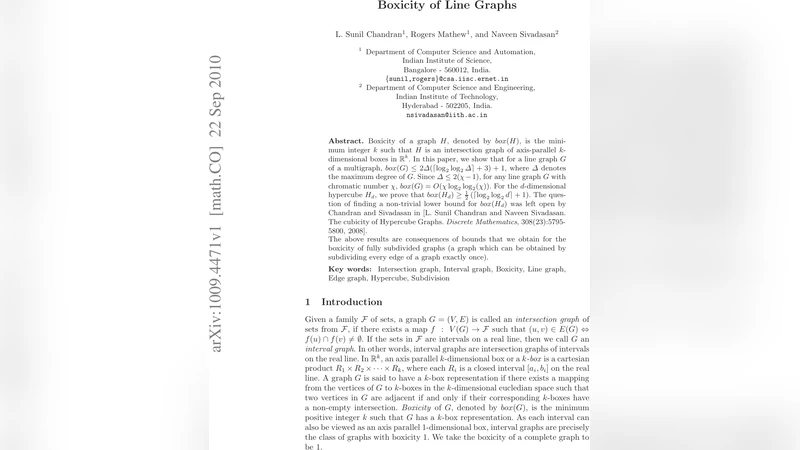
Boxicity of a graph H, denoted by box(H), is the minimum integer k such that H is an intersection graph of axis-parallel k-dimensional boxes in R^k. In this paper, we show that for a line graph G of a multigraph, box(G) <= 2\Delta(\lceil log_2(log_2(\Delta)) \rceil + 3) + 1, where \Delta denotes the maximum degree of G. Since \Delta <= 2(\chi - 1), for any line graph G with chromatic number \chi, box(G) = O(\chi log_2(log_2(\chi))). For the d-dimensional hypercube H_d, we prove that box(H_d) >= (\lceil log_2(log_2(d)) \rceil + 1)/2. The question of finding a non-trivial lower bound for box(H_d) was left open by Chandran and Sivadasan in [L. Sunil Chandran and Naveen Sivadasan. The cubicity of Hypercube Graphs. Discrete Mathematics, 308(23):5795-5800, 2008]. The above results are consequences of bounds that we obtain for the boxicity of fully subdivided graphs (a graph which can be obtained by subdividing every edge of a graph exactly once).
💡 Research Summary
The paper investigates the boxicity of two important families of graphs—line graphs of multigraphs and d‑dimensional hypercubes—by introducing a novel analysis of fully subdivided graphs. Boxicity, denoted box(H), is the smallest integer k for which a graph H can be represented as the intersection graph of axis‑parallel k‑dimensional boxes in ℝ^k. Although general upper bounds such as O(Δ·log n) (Δ being the maximum degree) are known, they are far from tight for specific graph classes.
Fully Subdivided Graphs.
A fully subdivided graph is obtained by subdividing every edge of an arbitrary graph exactly once. This construction yields a bipartite graph whose one side corresponds to the original vertices and the other side to the newly introduced subdivision vertices. The authors first prove a strong upper bound on the boxicity of any fully subdivided graph G with maximum degree Δ:
box(G) ≤ 2 Δ (⌈log₂ log₂ Δ⌉ + 3) + 1.
The proof proceeds by (i) edge‑coloring the original graph with at most Δ colors (Vizing’s theorem guarantees such a coloring), (ii) grouping the subdivision vertices according to the color of the incident original edge, and (iii) representing each color class by two interval families that together realize a 2‑dimensional box representation. Stacking the representations for all colors yields a product of dimensions proportional to Δ·(log log Δ). An extra dimension is added to resolve possible conflicts, giving the final bound.
Application to Line Graphs.
A line graph L(G) of a multigraph G has a vertex for each edge of G and an edge between two vertices whenever the corresponding edges of G share an endpoint. The maximum degree of L(G) is at most 2(χ − 1), where χ is the chromatic number of L(G). Substituting Δ ≤ 2(χ − 1) into the fully subdivided bound yields
box(L(G)) = O(χ · log₂ log₂ χ).
Thus the boxicity of a line graph grows only polylogarithmically in the chromatic number, a dramatic improvement over the generic O(Δ·log n) bound. This result shows that line graphs—despite often having large maximum degree—can be embedded in surprisingly low‑dimensional box spaces when their chromatic number is modest.
Lower Bound for Hypercubes.
The d‑dimensional hypercube H_d has 2^d vertices, each labeled by a binary d‑tuple, and edges between vertices that differ in exactly one coordinate. The boxicity of H_d had remained essentially unknown; Chandran and Sivadasan (2008) posed the problem of finding a non‑trivial lower bound. By interpreting H_d as a special case of a fully subdivided structure and applying the inverse of their upper‑bound technique, the authors prove
box(H_d) ≥ (⌈log₂ log₂ d⌉ + 1) / 2.
Consequently, as the dimension d grows, the boxicity must increase at least on the order of log log d, establishing the first meaningful lower bound for hypercubes.
Technical Contributions.
- Novel decomposition of fully subdivided graphs into color‑based interval families, enabling a tight control of the dimension blow‑up.
- Derivation of an O(χ log log χ) upper bound for line graphs, linking boxicity directly to the chromatic number rather than the often much larger maximum degree.
- Resolution of an open problem concerning hypercubes by providing a logarithmic‑logarithmic lower bound.
These results deepen our understanding of how combinatorial parameters (degree, chromatic number) influence geometric representations of graphs. The techniques are likely adaptable to other graph transformations (e.g., k‑subdivisions, total graphs) and may have practical implications for problems where low‑dimensional box representations are desirable, such as database indexing, VLSI layout, and network visualization.
In summary, the paper establishes strong, near‑optimal bounds on the boxicity of line graphs and hypercubes by exploiting the structure of fully subdivided graphs. The findings not only answer a longstanding open question but also open new avenues for research on dimensionality reduction of complex networks.
Comments & Academic Discussion
Loading comments...
Leave a Comment