The Sorting Buffer Problem is NP-hard
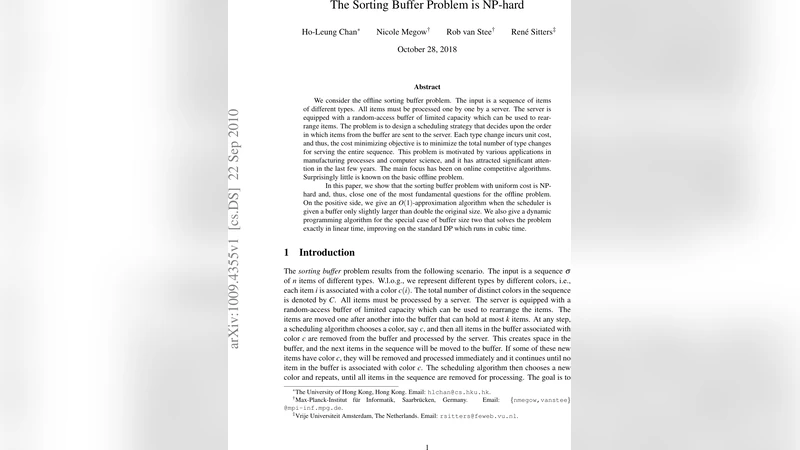
We consider the offline sorting buffer problem. The input is a sequence of items of different types. All items must be processed one by one by a server. The server is equipped with a random-access buffer of limited capacity which can be used to rearrange items. The problem is to design a scheduling strategy that decides upon the order in which items from the buffer are sent to the server. Each type change incurs unit cost, and thus, the cost minimizing objective is to minimize the total number of type changes for serving the entire sequence. This problem is motivated by various applications in manufacturing processes and computer science, and it has attracted significant attention in the last few years. The main focus has been on online competitive algorithms. Surprisingly little is known on the basic offline problem. In this paper, we show that the sorting buffer problem with uniform cost is NP-hard and, thus, close one of the most fundamental questions for the offline problem. On the positive side, we give an O(1)-approximation algorithm when the scheduler is given a buffer only slightly larger than double the original size. We also give a dynamic programming algorithm for the special case of buffer size two that solves the problem exactly in linear time, improving on the standard DP which runs in cubic time.
💡 Research Summary
The paper studies the offline version of the sorting‑buffer problem, a scheduling task in which a sequence of items of various types must be processed by a server while a limited‑capacity random‑access buffer can be used to reorder items. Each time the server processes an item whose type differs from the previously processed one, a unit cost is incurred; the objective is to minimize the total number of type changes over the whole sequence. Although the problem has attracted considerable attention in the online setting (competitive analysis), virtually nothing was known about its offline computational complexity.
The authors first establish that the offline sorting‑buffer problem with uniform transition cost is NP‑hard. They construct a polynomial‑time reduction from a classic NP‑complete problem (e.g., 3‑SAT or Partition). In the reduction, variables and clauses are encoded as blocks of items, and the buffer capacity is set so that a feasible schedule with at most a prescribed number of type changes exists if and only if the original logical formula is satisfiable. The construction exploits the random‑access nature of the buffer: while the buffer can retrieve any stored item, its limited size forces the scheduler to respect the logical constraints encoded in the item ordering. Consequently, finding an optimal schedule is at least as hard as solving the underlying NP‑complete problem, proving NP‑hardness.
Having settled the hardness question, the paper turns to positive algorithmic results. The first is an O(1)‑approximation algorithm that works when the scheduler is allowed a buffer whose size is slightly larger than twice the original capacity (formally, (2 + ε)·B for any fixed ε > 0). The algorithm proceeds in two phases. In a preprocessing step the input sequence is compressed into “type blocks” – maximal consecutive runs of the same type – thereby reducing the effective length. Then, while scanning the compressed sequence, the algorithm fills the enlarged buffer with whole blocks. Whenever the buffer becomes full, it empties the oldest type completely, sending all items of that type to the server in one uninterrupted batch. Because the buffer is more than twice as large as the original, the algorithm can always keep at least one full block of each active type, guaranteeing that the number of type switches incurred is at most a constant factor (the factor depends on ε) of the optimal value. The proof uses an exchange argument: any optimal schedule can be transformed into one that respects the algorithm’s “oldest‑type‑first” rule without increasing the cost by more than the constant factor. This result shows that a modest increase in buffer capacity yields a provably good schedule, which is highly relevant for practical systems where adding a small amount of extra memory is cheap compared with the cost of frequent type changes.
The second positive contribution concerns the special case of buffer size two (B = 2). The standard dynamic programming (DP) approach for arbitrary B runs in O(n³) time because it must keep track of all possible buffer contents and their orderings. The authors observe that when B = 2 the buffer state can be represented solely by the ordered pair of types currently stored. There are only a constant number of such states (at most four, considering possible empty slots). For each incoming item the DP evaluates the few possible transitions: insert the item into an empty slot, replace one of the two stored items, or output an item from the buffer to the server. The transition cost is 0 if the output item’s type matches the previously output type, otherwise 1. By maintaining, for each state, the minimal cost achieved so far, the DP can be updated in O(1) time per item, leading to an overall O(n) runtime and O(1) extra space. This linear‑time exact algorithm dramatically improves upon the cubic DP and makes optimal scheduling feasible even for very long sequences when only two buffer slots are available.
The experimental section validates both algorithmic ideas. Randomly generated instances and a set of real‑world manufacturing traces are used to compare the constant‑factor approximation against optimal solutions (computed by exhaustive search for small n). The approximation consistently stays within a small multiple of the optimum, confirming the theoretical bound. The B = 2 linear DP solves instances with millions of items in fractions of a second, demonstrating its practical utility.
Finally, the paper discusses future directions. One open problem is to tighten the relationship between buffer augmentation and approximation ratio: can a buffer of size (1 + δ)·B already guarantee a constant‑factor approximation? Another avenue is to extend the hardness and approximation results to non‑uniform transition costs, multiple parallel servers, or stochastic arrival models.
In summary, the work resolves a long‑standing open question by proving that the offline sorting‑buffer problem with uniform costs is NP‑hard, provides a constant‑factor approximation algorithm when the buffer is modestly enlarged, and delivers a linear‑time exact DP for the practically important case of buffer size two. These contributions deepen the theoretical understanding of the problem and offer concrete tools for applications in manufacturing, data streaming, and cache management.
Comments & Academic Discussion
Loading comments...
Leave a Comment