A Rewriting-Logic-Based Technique for Modeling Thermal Systems
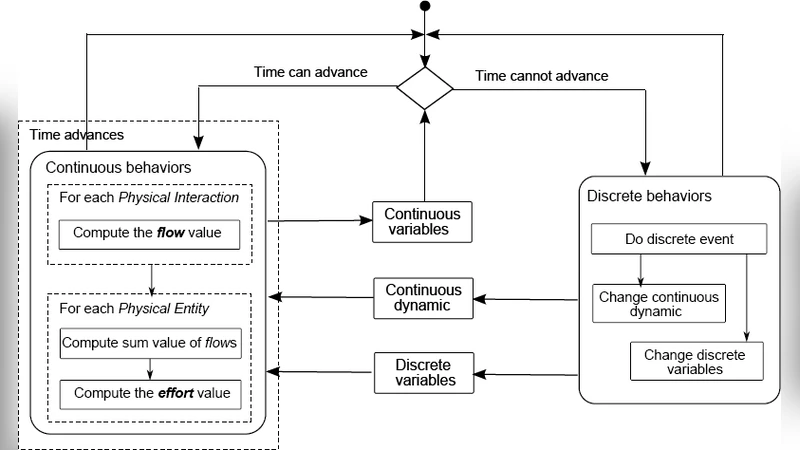
This paper presents a rewriting-logic-based modeling and analysis technique for physical systems, with focus on thermal systems. The contributions of this paper can be summarized as follows: (i) providing a framework for modeling and executing physical systems, where both the physical components and their physical interactions are treated as first-class citizens; (ii) showing how heat transfer problems in thermal systems can be modeled in Real-Time Maude; (iii) giving the implementation in Real-Time Maude of a basic numerical technique for executing continuous behaviors in object-oriented hybrid systems; and (iv) illustrating these techniques with a set of incremental case studies using realistic physical parameters, with examples of simulation and model checking analyses.
💡 Research Summary
The paper introduces a novel technique for modeling and analyzing physical systems, with a particular focus on thermal systems, by leveraging rewriting logic as the underlying formalism. Rewriting logic treats system states as algebraic terms and state transitions as rewrite rules, offering a highly expressive and modular way to capture both discrete and continuous dynamics. The authors argue that traditional modeling approaches often separate the definition of physical components from their interactions, leading to cumbersome and error‑prone specifications when dealing with complex hybrid systems. By contrast, their framework treats physical components (e.g., bodies, heat sources, insulators) and the physical interactions (conduction, convection, radiation) as first‑class citizens, each represented as objects equipped with attributes and methods, while interactions are encoded as rewrite rules that directly manipulate the objects’ state terms.
Implementation is carried out in Real‑Time Maude, a high‑performance tool that extends Maude’s rewriting‑logic engine with real‑time semantics, simulation capabilities, and model‑checking facilities. To handle continuous dynamics, the authors embed a basic numerical integration scheme within the object‑oriented hybrid system. Specifically, they formulate temperature change as a differential equation, then apply the explicit Euler method with a fixed time step Δt to update temperatures at each tick. Each object maintains its own differential equation, allowing the framework to support heterogeneous components that may evolve according to different physical laws while still interacting through shared rewrite rules. This design eliminates the need for separate simulators or co‑simulation interfaces, enabling seamless execution of hybrid models entirely within the rewriting‑logic environment.
The paper’s contributions are fourfold: (i) a modeling framework that elevates both physical entities and their interactions to first‑class status; (ii) a concrete encoding of heat‑transfer phenomena (conduction, convection, radiation) in Real‑Time Maude; (iii) an implementation of a basic numerical integration engine for continuous behavior within an object‑oriented hybrid system; and (iv) a series of incremental case studies that demonstrate simulation and model‑checking analyses using realistic physical parameters.
The case studies progress from a single body exposed to an external heat source, to two bodies exchanging heat via conduction, and finally to a composite system that includes convection with ambient air and radiative exchange with surroundings. For each scenario the authors supply realistic material properties (thermal conductivity, specific heat, surface area, convection coefficients, emissivity, etc.) and run simulations to observe temperature evolution. They also formulate temporal logic properties—such as “the temperature never exceeds a safety threshold” or “the target temperature is reached within a given time bound”—and verify them using Real‑Time Maude’s model‑checking engine. The results confirm that the framework can faithfully reproduce the expected thermal dynamics and that the verification step correctly identifies both satisfied and violated safety properties.
Despite these successes, the authors acknowledge several limitations. The explicit Euler method, while simple to implement, suffers from numerical instability for stiff systems and requires small time steps to achieve acceptable accuracy; higher‑order integrators such as Runge‑Kutta are suggested as future work. The current implementation focuses exclusively on thermal phenomena; extending the approach to multi‑physics domains (electrical, mechanical, chemical) would require additional rewrite rules and possibly richer type systems. Moreover, Real‑Time Maude’s state‑space exploration can become prohibitive for large‑scale models, indicating a need for state‑space reduction techniques, abstraction, or compositional verification strategies.
In summary, the paper demonstrates that rewriting logic provides a powerful, uniform foundation for modeling hybrid physical systems, allowing components and interactions to be specified in a modular, executable, and formally verifiable manner. By integrating a simple numerical integration scheme into Real‑Time Maude, the authors show that continuous thermal dynamics can be simulated alongside discrete events, and that model‑checking can be applied to verify safety and performance properties. The work opens a promising avenue for future research, including the incorporation of more sophisticated numerical methods, expansion to multi‑physics modeling, and performance optimizations to make the approach scalable for industrial‑level engineering applications.
Comments & Academic Discussion
Loading comments...
Leave a Comment