Pontryagin duality between compact and discrete abelian inverse monoids
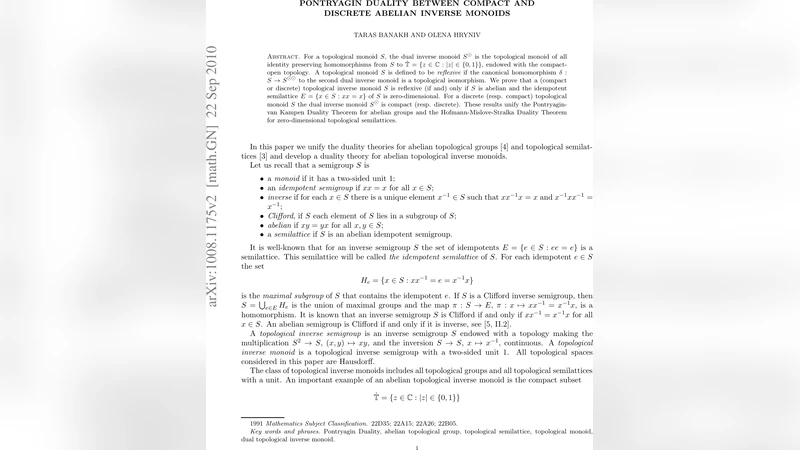
For a topological monoid S the dual inverse monoid is the topological monoid of all identity preserving homomorphisms from S to the circle with attached zero. A topological monoid S is defined to be reflexive if the canonical homomorphism from S to its second dual inverse monoid is a topological isomorphism. We prove that a (compact or discrete) topological inverse monoid S is reflexive (if and) only if S is abelian and the idempotent semilattice of S is zero-dimensional. For a discrete (resp. compact) topological monoid its dual inverse monoid is compact (resp. discrete). These results unify the Pontryagin-van Kampen Duality Theorem for abelian groups and the Hofmann-Mislove-Stralka Duality Theorem for zero-dimensional topological semilattices.
💡 Research Summary
The paper introduces a duality theory for topological inverse monoids that extends the classical Pontryagin‑van Kampen duality for abelian groups and the Hofmann‑Mislove‑Stralka duality for zero‑dimensional semilattices. For a topological monoid (S) the authors define its dual inverse monoid (\widehat{S}) as the set of all continuous, identity‑preserving homomorphisms from (S) into the circle (\mathbb{T}) with an adjoined zero element. The multiplication in (\widehat{S}) is pointwise, and the zero acts as an absorbing element. This construction yields a topological inverse monoid again, and the natural evaluation map \
Comments & Academic Discussion
Loading comments...
Leave a Comment