Frameworks, Symmetry and Rigidity
Symmetry equations are obtained for the rigidity matrix of a bar-joint framework in R^d. These form the basis for a short proof of the Fowler-Guest symmetry group generalisation of the Calladine-Maxwell counting rules. Similar symmetry equations are …
Authors: J. C. Owen, S. C. Power
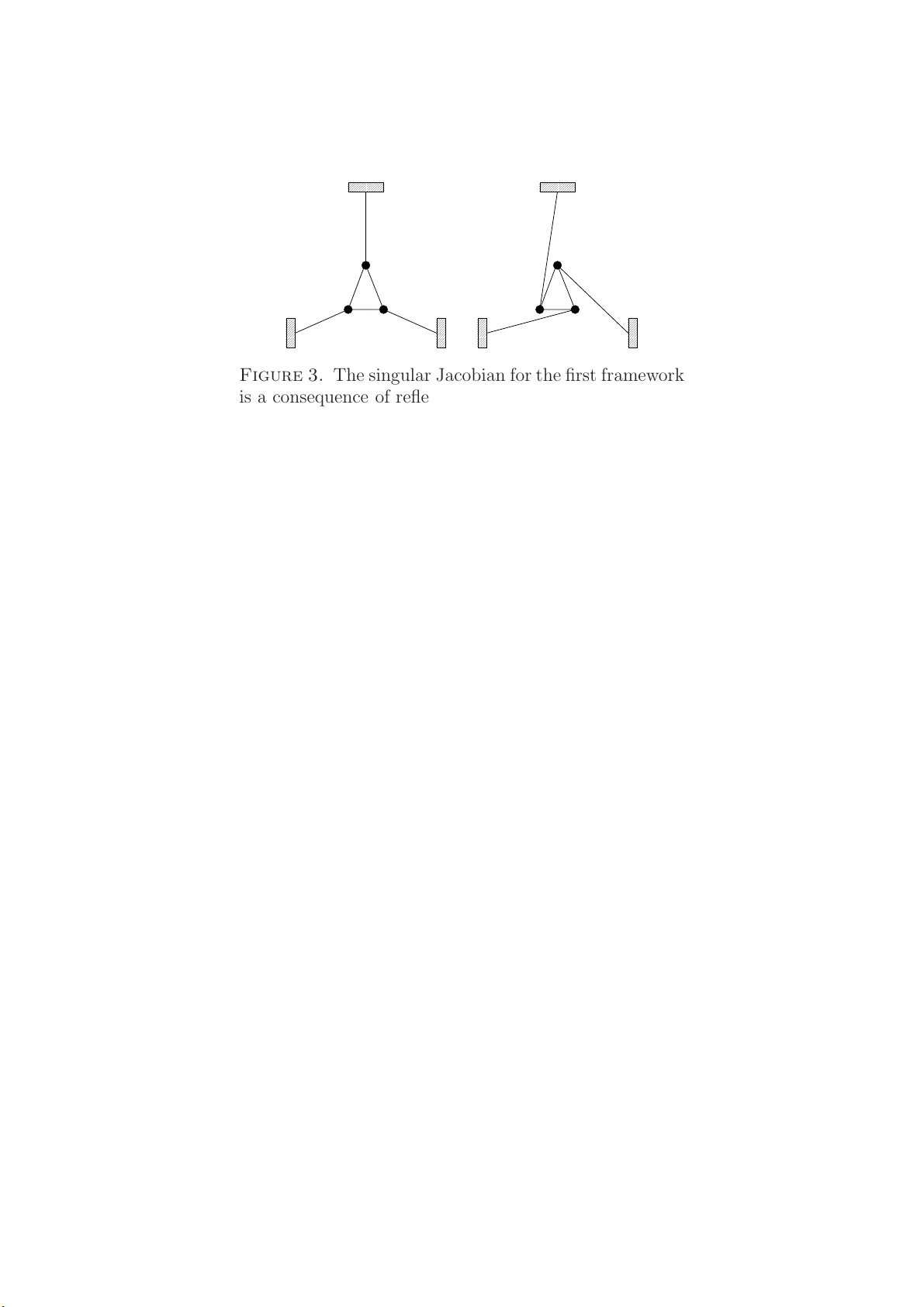
1 FRAMEW ORKS SYMMETR Y AND RIGIDITY J. C. OWEN AND S. C. POWER Abstract. Symmetry equations are obtained for the r igidity ma- trix of a bar-joint f ramework in R d . These form the basis for a short pro of of the F owler-Guest symmetry g roup generalis ation of the Calladine-Maxwell counting rules. Simila r symmetry equations are obtained for the Jaco bia n o f diverse framework sy stems, includ- ing c o nstrained p oint-line systems that a ppea r in CAD, b o dy-pin frameworks, hybrid systems of distance constra ined ob jects and infinite bar-joint frameworks. This lea ds to genera lised forms of the F owler-Guest character formula together with c o un ting rules in terms of counts of symmetry - fixed elements. Necessary condi- tions for isostaticity are obtained for asy mmetric fra mew orks, bo th when sy mmetries a re pres en t in subframeworks and when symme- tries o ccur in partitio n- derived frameworks. Bar-joint framew ork; s ymmetry; rigidity . 1. Introduction Let ( G, p ) be a fr am ework in R d whic h, b y definition, consists of an abstract gra ph G = ( V , E ) a nd a ve ctor p = ( p 1 , . . . , p v ) comp osed of framew ork p o in ts in R d . When ( G, p ) is view ed in the natural w a y as a pin-j oin ted bar framew ork in R d then t here is a counting condition for bars a nd join ts that the framew ork m ust satisfy if it is know n to b e isostatic, whic h is to sa y that the structure is rigid in a natural sense (infinitesimally rigid) and at the same time is not ov erconstrained. More generally , in the nonisostatic case, there is a single condition relating the four quan tities , v = | V | , e = | E | , the n um b er m of non- trivial indep enden t infinitesimal mot ions (a lso known as mec hanisms), and the n um ber s of independen t stresses that the structure can carry . F or d = 2 this is the extended Maxw ell rule (Calladine[1]) (1.1) m − s = 2 v − e − 3 while for d = 3 one has m − s = 3 v − e − 6. The equations arise from a consideration of the k ernel and cok ernel o f the rigidity matrix for the framew ork and t heir respectiv e dimensions, m and s . Recen tly , in the context of the analysis of loads and stresses in sym- metric structures , F ow ler and Guest [2] ha v e obtained an extended coun ting rule for symmetric framew orks in t w o and three dimensions 1 Suppo rted b y a London Mathematica l So ciety Sc heme 7 Grant. 1 2 J. C. OWEN AN D S. C. POWER and these formulae are a source of additional neces sary coun ting con- ditions. In three dimensions the form ula tak es the elegant for m (1.2) Γ( m ) − Γ( s ) = Γ( v ) × Γ xy z − Γ( e ) − Γ xy z − Γ R x R y R z where each Γ denotes a character list for a represen t ation of the rigid motion symmetry group G of the framew ork. Th us the equation rep- resen t s a set of equations, one fo r eac h elemen t of G . The list Γ( e ), for example, arises fro m an elemen tary p erm utation represen tation ρ e of G on a real v ec tor space with basis indexed b y the edges of G . Specifically Γ( e ) = trace( ρ e ( g 1 ) , . . . , tra ce( ρ e ( g r )) for some ch oice of elemen ts g 1 , . . . , g r of G , typically a set of g enerating elemen ts with g 1 the iden t it y elemen t. The significance of the form ulae lie in the fact that the right-hand side is r eadily computable dep ending only on the abstract g raph G of the framew ork rather than t he metrical detail. In part icular trace( ρ e ( g k )) is the n umber of edges that are left unmo v ed b y the symmetry g k . The left hand side how ev er carries information on the p ossibilities fo r stresses and flexes. Ev aluating the fo rm ula for the iden t it y elemen t g 1 of G giv es the Calladine-Maxw ell r ules. See also Ceulemans and F o wler [3] for an analogous symmetry v aria n t of Euler’s form ula for polyhedra. Our first purp ose is to obtain an explicit sym metry equation (1.3) R = ρ e ( g − 1 ) R ˆ ρ v ( g ) , g ∈ G , for the rigidit y matrix R = R ( G, p ) of a bar-join t framew or k in R d , whic h sho ws h o w the matrix intert wines represen tations of G asso ciated with the edges and with the ve rtices. Here ˆ ρ v is the represen tatio n ρ n ⊗ ρ sp where ρ n is the natural perm utation represen tation ass o ciated with the v ertices (no des ) and ρ sp is the usual orthogona l repres en tation of G in R d . F rom this w e obtain a sim ple proof of a general F o wler- Guest form ula for framew o rks in R d . The pro of is co ordinate free and in f act the unita ry equiv alence of subrepresen tations tha t underlies t he form ula ma y b e implemen ted by the pa rtially isometric part of the p olar decompo sition R = U ( R ∗ R ) 1 / 2 . Our second purp ose is to sho w that the metho d is v ersatile and readily applicable to higher order f ramew orks. F or example, w e con- sider b o dy-bar framew orks and constrain t systems for geometric ob- jects, such as the constrain ts of geometries arising in CAD. O nce again w e obtain sym metry equations, equiv a len t represen ta tions, character form ulae and coun ting conditions. Figure 1 sho ws a pra ctical a pplication in CAD for the symmetry adapted Maxw ell coun ting rule. The geometric figure on the right sho ws a triangle which has reflection symmetry ab o ut a v ertical a xis. The graph on the righ t sho ws the corresponding constraint graph tak en FRAMEWORKS SYMMETR Y AN D RIGIDITY 3 0 0 90 10 5 10 5 Figure 1. The geometric dra wing has an abstract gra ph in whic h lines are represen ted b y circular v ertices and the p oin ts b y square ve rtices. The lab eled edges repre sen t angular dimensions of 90 degrees and distances of 0, 5 and 10. A count for the refle ction symmetry of the graph implies the singularit y of the equation syste m for the dra wing. from a CAD constrain t solving application. In this graph the square no des represen t p oin ts, the circular no des represen t lines and the edges represen t either a distance or ang le dimension with the specified v alue or a p oint-line coincidence. Notice tha t this graph has a corresp onding t w o -fold symmetry . The equations represen ted b y the geometric figure and the constrain t graph ar e singular for the f ollo wing reason. If the dimension with v alue 5 whic h specifies the heigh t of the triangle is re- mo v ed then the a p ex of the triang le can b e placed a n yw here o n a circle with the base of the triangle as dia meter (due to the perp endicular con- strain t sho wn) and so this circle has r adius 5. Th us in the symmetric configuration s ho wn the heigh t dimension has attained its maxim um p ossible v alue and cannot b e inc reased. This indicates singularity in the equations. In this example v = 6 and e = 9 so the righ t hand side of Equation (1.1) ev aluates to zero and is compatible with m = s = 0. F or this reflection symmetry we will show that the symmetry adapted equation tak es the form g ( m ) − g ( s ) = g ( e ) − 1. Since g ( e ), the n um ber of edges of the graph whic h are unch anged b y the t w o-f old s ymmetry , is three, this equation requires that m > 0 whic h says tha t the equations ha v e at least one infinitesimal mot ion whic h means here that they are singular. W e also sho w ho w one ma y o btain sym metry equations and the c ha r- acter formu la f or infinite framew orks. In particular, in the case o f p e- rio dic framew orks w e obtain the p erio dic form (1.4) Γ p ( m ) − Γ p ( s ) = Γ p ( v ) · Γ( sp ) − Γ p ( e ) − Γ p ( r ig ) , in whic h the trace lists ar e asso ciated with finite-dimensional repre- sen tations of a translation subgroup quotient of the spatial symmetry group. 4 J. C. OWEN AN D S. C. POWER Finally w e indicate how the symmetry analysis may b e exploited further in t w o distinct w a ys , and ev en for asymmetric framew orks. In the first w e consider sy mmetries in vertex induced subframew orks while in the second we consider laten t symmetries in partition-deriv ed framew orks. F or the symmetry group iden tit y elemen t the prop erties of sub-framew orks and deriv ed framew orks b oth giv e the same w ell- kno wn necessary requiremen t for non- singularit y of the relev an t Ja- cobian (suc h as, in t w o dimensions, 2 v − e ≥ 3 for ev ery sub-graph with e edges and v v ertices). How eve r, symmetry in subframew orks or partition deriv ed framew orks b oth giv e new and useful predictions. F or example w e obtain in Theorem 5.1 a ”singularit y predictor”, in the form o f a set of ne cessary coun ting conditions for an isos tatic framew ork ( G, p ) in R d . As a simple coro llary of this w e observ e tha t for a planar isostatic fr amew ork with a reflection symmetry g in a subframew ork X we hav e the necessary condition | − e g X + 1 | ≤ 2 v X − e X − 3 . where e g X is the n umber of edges of X left unmov ed by g . Man y authors ha v e considered group repres en tations in the analysis of symmetric structures, often adopting symmetry adapted coor dinate spaces for stresses and flexes . See, for example, Kangw ai and Guest[4 ] and the surv ey Ka ngw ai, Guest and Pe llegrino[5]. In this v ein irre- ducible group considerations w ere in tro duced in the detailed engineer- ing c alculations of Ka ngw ai and Guest[4] and subsequ en tly put in to the useful character equational form b y F owler and Guest[2]. In contrast to t his we bring out the symmetry equations as the essen tial feature of symmetric bar-join t framew orks and we use them to iden tify in v aria n t subspaces and thereb y obtain a short deriv a tion of the form ula. W e note that Sch ulze[6 ] has giv en another rigourous pro of of the F owler- Guest form ula whic h uses a more expansiv e analysis of subspaces for the blo c k diagonalisation of the rigidit y matrix. Moreo v er intere st- ing applications are giv en to noninjectiv e fra mew or ks with coinciden t v ertices whic h are not consid ered here. The usefulness of the F owler-Guest form ula has been sho wn in Con- nelly , F ow ler, Guest, Sc h ulze and Whiteley[7] where it w as used to deriv e a complete list of the necessary counting conditions for bar- join t framew orks in tw o and three dimensions. These c onditions are in terms of counts for the n um ber of v ertices o r edges that are left unmov ed by v arious symmetries. In our Corollary 3.2 we reco v er some o f these re- sults while Theorems 4.1, 4.5, 5.1 and 5.2 lead to analo gous coun ting constrain ts. F or a planar isostatic fra mew o rk one has m = s = 0 and hence the necessary equalit y 2 v − e − 3 = 0. This is not a suffic ien t condition as one also n eeds subframew o rks not to be o v ercons trained. Ho w ev er, it is a fundamental and celebrated theorem of Laman[8] that the necessary FRAMEWORKS SYMMETR Y AN D RIGIDITY 5 coun t condition 2 v − e = 3 together with the inequalit y 2 v X − e X ≥ 3 for all subgraphs X is a sufficien t condition for a generic fra mew o rk to b e isostatic. Th us necessary and sufficien t conditions are kno wn for the t w o dimensional generic case. W e do not consider sufficiency conditions b elo w but we note that Sc h ulze[9 ] has recen tly o btained Laman theorems for f ramew orks in the plane with v ario us symmetry . F or f urther bac kground on rigidity and div erse constraint problems see, for ex ample, Asimo w and Ro th[10], Connelly et al[7], Gra v er, Ser- v atius and Serv atius[11], Jacks on and Jo rdan[13], O w en[14], Ow en and P o w er[15 ], and Whiteley[16]. W e would lik e to thank Simon Guest and Nadia Mazza for in teresting discussions and the anon y mous referees for helpful commen ts. 2. Frameworks and Symmetries. W e b egin with a f ormal in tro duction to mathematical bar-jo in t frame- w orks ( G, p ) in R d , to the rigidity matrix R ( G, p ) and to the spatial symmetry group G of a framew ork. Also, viewin g G as an abstract gr oup w e consider elemen tary represen tations of G as p erm utation transfor- mations of v ector spaces asso ciated with the vertice s a nd with the edges. 2.1. The r igidity matrix. Let G = ( V , E ), n = | V | , m = | E | b e a finite connected g raph, with no mu ltiple edges. A fr amew ork in R 2 is a pair ( G, p ) where p = ( p 1 , . . . , p n ) is a fr amew ork v ector with framew ork p oin ts p i = ( x i , y i ) in R 2 that are associated with an ordering v 1 , . . . , v n of the v ertices. Th us w e allo w framework p oints to coincide. The rigidity matrix R = R ( G, p ) for the framew ork ( G, p ) is a n m × 2 n real matrix whose columns are lab eled by x 1 , y 1 , x 2 , y 2 , . . . , x n , y n , and whose rows are lab eled b y some ordering e 1 , . . . , e m of t he edges. If e = ( v i , v j ) is an edge of G then the matrix entries of R in the ro w for e are zero except p ossibly in the columns for x i , y i , x j , y j where w e ha v e , resp ectiv ely , x i − x j , y i − y j , x j − x i , y j − y i , 1 ≤ i ≤ n . Th us for notationa l econom y w e allow framew ork p o in t co ordinates to agree with their labels. The rig idit y matrix giv es a linear transformation from the 2 n -dimensional real v ec tor space H v = n X k =1 ⊕ ( R x k ⊕ R y k ) , asso ciated with the v ertices, to the m -dimensional real v ec tor space, H e = m X k =1 ⊕ R e k asso ciated with edges. Here eac h v ector space summand R x k , R y k , R e k is a cop y of R . Let ξ x k , ξ y k , 1 ≤ k ≤ n , denote the standard basis for H v and write ξ e k , 1 ≤ k ≤ m, for the standard basis for H e . Then the 6 J. C. OWEN AN D S. C. POWER matrix entry x i − x j in row e = ( v i , v j ) and column x i is give n by the standard inner pro duct h Rξ x i , ξ e i . The rigidity matrix R ( G, p ) of a framew ork ( G, p ) in R d is defined in exactly the same manner. Alternat iv ely it ma y b e defined as o ne half of the Jacobian deriv ativ e of the nonlinear map fr om H v to H e whic h is determined b y the quadratic distance equations for the framew ork. W e adopt this view p oin t in Section 4. The rigidit y matrix deriv es its name from the fact that ve ctors u = ( u i ) = ( u x i , u y i ) in its k ernel (n ullspace) are infinitesimal flexes in the follo wing sense. They indicate directions (or v elo cit y directions) in whic h for each edge t he disturbance s of edge length | p i − p j | − | ( p i + tu x i − ( p j + tu y i ) | is O ( t 2 ) a s t tends to zero. Also, v ectors in the cokerne l (the kerne l of the t ransp ose matrix) correspond to self stress es. Moreov er w e hav e the follo wing fundamen tal definition. Definition 2.1. A fr am ework ( G, p ) in the plane (r esp. in R 3 ) with gr aph G = ( V , E ) is infinitesimal ly rigid if the r a nk of R ( G, p ) is 2 | V | − 3 (r esp. 3 | V | − 6 ) and is isostatic if it is infinitesimal ly rigid and the r ank of R ( G, p ) is | E | . As an illustratio n w e shall k eep in view the symmetric fra mew or k ( G, p ) in R 2 indicated in Figure 1, with framew ork v ector p = ((2 , 0) , (3 , 1) , (4 , 0) , (3 , − 1) , ( − 4 , 0) , ( − 3 , 1) , ( − 2 , 0) , ( − 3 , − 1)) . The subframew ork on the first four v ertices is infinitesimally rigid as is its mirror image in the y -axis. The en tire framew ork app ears to ha v e one non-trivial infinitesimal flex in addition to the t hree spatial flexes and this is readily confirmed. 4 8 6 7 5 3 2 1 Figure 2. A symmetric bar-joint framew ork. The rigidit y matrix ha s the f orm R = R 1 0 0 R 1 T 1 T 2 FRAMEWORKS SYMMETR Y AN D RIGIDITY 7 where R 1 is the 5 by 8 matrix R 1 = − 1 − 1 1 1 0 0 0 0 0 0 − 1 1 0 0 1 − 1 0 0 0 0 1 1 − 1 − 1 − 1 1 0 0 0 0 1 − 1 2 0 0 0 − 2 0 0 0 and where the submatrix T 1 T 2 is the 2 b y 16 matrix corres p onding to the t wo lo ng framew ork edges [ p 2 , p 8 ] , [ p 4 , p 6 ]. 2.2. Graph symmetry . Let G ha v e v ertices v 1 , . . . , v n and let σ b e a p ermu tation of (1 , . . . , n ) corresp onding to an automorphism of G . W e a lso write σ : V → V and σ : E → E for the corresp onding bijectiv e ma ps so that σ ( v i ) = v σ ( i ) . Let σ e denote the asso ciated linear transforma tion of H e , whe re σ e ξ f = ξ σ ( f ) , and let σ e also denote its represen ting matrix. The transformatio n and matrix σ v is similarly defined on t he space H v b y the specification σ v ξ x i = ξ x σ ( i ) , σ v ξ y i = ξ y σ ( i ) , 1 ≤ i ≤ n . W e first no te how R ( G , p ) is transformed, ev en in the absence o f framew ork symmetry , on replacing the framew ork v ector p = ( p 1 , . . . , p n ) b y σ ( p ) = ( p σ (1) , . . . , p σ ( n ) ). Lemma 2.2. L e t ( G, p ) b e a fr ame work in R d with rigidity matrix R ( G, p ) an d let σ b e a gr aph automorphism. Then (2.1) R ( G, σ ( p ) ) = σ − 1 e R ( G, p ) σ v Pr o of. F or notational simplicit y let d = 2. Let σ ( p ) = ( p σ (1) , . . . , p σ ( n ) ) = ( p ′ 1 , . . . , p ′ n ) , and p ′ i = ( x ′ i , y ′ i ) , 1 ≤ i ≤ n . Asso ciated with e = ( v i , v j ) w e hav e x ′ i − x ′ j = x σ ( i ) − x σ ( j ) . This difference app ears in the σ ( e ) ro w and σ ( x i ) column of R ( G, p ) and so x ′ i − x ′ j = h R ( G, p ) ξ σ ( x i ) , ξ σ ( e ) i . On the other hand, from the definition of R ( G, σ ( p )), x ′ i − x ′ j = h R ( G, σ ( p )) ξ x i , ξ e i = h R ( G, σ ( p )) σ − 1 v ξ σ ( x i ) , σ − 1 e ξ σ ( e ) i = h σ e R ( G, σ ( p ) ) σ − 1 v ξ σ ( x i ) , ξ σ ( e ) i and so R ( G, p ) and σ e R ( G, σ ( p ) ) σ − 1 v ha v e the same entry in the σ ( e ) ro w and σ ( x i ) column. Similarly , all en tries agree. 2.3. F ramew or k symmetries. Let ( G, p ) b e a f ramew ork in R d whic h is p r op er in the sense that the framew or k po in ts are all distinct. Then a fr a mework symmetry is a gra ph automorphism σ of G with the ad- ditional prop ert y | p σ ( i ) − p σ ( j ) | = | p i − p j | 8 J. C. OWEN AN D S. C. POWER for all edges ( v i , v j ), where | p i − p j | denotes Euclidean distance. Note that such a symmetry ma y just act lo cally . The fra mew or k of Figure 1 for example ha s suc h a symmetry whic h exc hanges p 1 and p 3 . W e shall mainly b e concerned with the stricter glo b al symmetries of fra mew o rks that are determ ined by is ometric maps of the am bient Euclide an space. Th us we formally define a sp atial symmetry of ( G, p ) as a framew ork symmetry whic h is effected by an isometric map T : R d → R d in the sense that σ ( p ) = T p := ( T p 1 , . . . , T p n ) and w e let G denote the sp atial s ymmetry g r oup of a ll suc h symmetries. In the final section ho w e v er w e shall relax this a nd consider spatial symmetries in subframew orks, and also laten t spatial sym metries that app ear after a pa rtitioning. The framew ork of Figure 1 has tw o eviden t mirr or symmetries whic h are spatial symmetries and G is isomorphic to t he fo ur group C 2 × C 2 . Recall that an isometric map T admits a factorisation as a pro duct T = T 1 S T 2 , where T 1 , T 2 are translations and S is a linear isome- try . The linearity of the entrie s in the rigidity matrix ensures t hat R ( G, p ) = R ( G, X p ) if X is a translation, and it follo ws t hat R ( G, T p ) = R ( G, S p ). Conside r S also in terms o f the d × d real o rthogonal matrix whic h effects the tr ansformation p i → S p i b y right matrix m ul- tiplication. In fact this matrix is S − 1 (where S denotes also the matrix that effects the transformatio n S ). F or example, in case d = 2, writing ( x ′ i , y ′ i ) for the image S p i of p i under S , w e ha v e x ′ i y ′ i = x i y i S − 1 . It follo ws from linearity that ( x ′ i − x ′ j ) ( y ′ i − y ′ j ) = ( x i − x j ) ( y i − y j ) S − 1 , and so (2.2) R ( G, σ ( p ) ) = R ( G, T p ) = R ( G, S p ) = R ( G, p ) ˜ S − 1 where ˜ S = S ⊕ · · · ⊕ S is the blo ck diagonal matrix transformation of H v . W e now ha v e all the ing redien t s for t he pro of of t he individual sym- metry equation of part (i) of Theorem 2.3. F or the general formula of part (ii) w e no w sp ecify fiv e represen ta tions of the spatial symmetry group G . W rite ρ e : G → L( H e ) fo r the p erm utation represen tation of G where ρ e ( g ) is the transformation and the matrix whic h is asso ciated as ab ov e with the spatial symmetry g . D efine ρ v : G → L( H v ) similarly . Let ρ sp : G → L( R d ) b e the or thogonal group r epresen tatio n (one o ften iden tifies G with its image under this map) and let ˜ ρ sp = ρ sp ⊕ · · · ⊕ ρ sp ( n times) b e the asso ciated blo c k diago nal represen tation of G on H v . FRAMEWORKS SYMMETR Y AN D RIGIDITY 9 Finally , note that ˜ ρ sp and ρ v comm ute, that is, ˜ ρ sp ( g 1 ) ρ v ( g 2 ) = ρ v ( g 2 ) ˜ ρ sp ( g 1 ) for all g 1 , g 2 . Th us the pro duct represen tation, denoted ˆ ρ v , is w ell- defined. Indeed, these represen tat ions can b e view ed as r epresen ta- tions in differen t factors o f the natura l tensor pro duct iden tification H v = R n ⊗ R d and ˆ ρ v = ρ n ⊗ ρ sp , where ρ n is the (m ultiplicit y one) rep- resen t ation fo r the vertice s, so that ρ v = ρ n ⊗ I d d , and ˜ ρ sp = I d n ⊗ ρ sp , where I d n denotes the iden tity represen tation of m ultiplicit y n . The next theorem pro v ides sym metry equations for the rigidit y ma- trix. F or an alternative somewhat more sophisticated deriv a tion one ma y emplo y the c hain rule for the deriv ativ e of comp osite multi-v ariable functions and w e do this in Section 4 in a more abstract setting. Theorem 2.3. L et ( G, p ) b e a fr am ework in R d with gr a ph G = ( V , E ) . (i) If T is a sp atial symm etry for the fr amework ( G, p ) with asso ciate d gr aph symmetry σ : V → V and line ar tr a nsformation matric es σ v and σ e then R ( G, p ) = σ − 1 e R ( G, p ) σ v ˜ S wher e S is the line ar isom etry fac tor o f T an d ˜ S = S ⊕ · · · ⊕ S is the induc e d op er ator on H v . (ii) L et G b e the sp atial symmetry gr oup of the fr amework ( G, p ) with r epr esentation ˆ ρ v = ρ n ⊗ ρ sp on H v and r epr esentation ρ e on H e . Then, for a l l g ∈ G , R ( G, p ) = ρ e ( g − 1 ) R ( G, p ) ˆ ρ v ( g ) . Pr o of. W e may comb ine the equations 2.1 and 2.2 to obta in σ − 1 e R ( G, p ) σ v = R ( G, p ) ˜ S − 1 , from whic h (i) follow s. No w (ii) follows from (i) and t he definition of the represen tations ρ e and ˆ ρ v ( g ) . W e note some immediate consequences for rigidity and isostaticit y . The analysis ab ov e applies also to what one migh t call gr o unde d or supp orte d f ramew orks ( G, p ∗ ) in whic h certain vertice s are fixed absolutely . The relev ant symmetries in this case p ermute these sp e- cial p oints . Suc h examples can b e found in the or iginal three-p oint- supp orted symmetric t w o-dimensional structures in Kangw ai and Guest[4] and F o wler and Guest[2 ]. The conte xt is simpler since spatial flexes a re absen t a nd isostaticit y o f the susp ended framew ork corresp onds to the in v ertibilit y of the Jaco- bian J ( G, p ∗ ) for the equation sy stem for the free points . The argumen t for Theorem 2.2 (ii) a pplies a nd w e obtain J ( G, p ∗ ) = ρ e ( g − 1 ) J ( G, p ∗ ) ˆ ρ v ( g ) , 10 J. C. OWEN AN D S. C. POWER 0 0 0 0 1 1 1 1 00 00 00 00 11 11 11 11 0 0 0 0 1 1 1 1 00 00 00 00 11 11 11 11 0000 1111 00000 11111 Figure 3. The singular Ja cobian fo r the first framew ork is a consequence o f reflec tion symmetry . whic h is v alid for elemen ts g of the spatial symmetry group G , where ρ v is the repre sen tation for free v ertices. In particular if ( G, p ∗ ) is isostatic then ρ e ( g ) = J ( G, p ∗ ) ˆ ρ v ( g ) J ( G, p ∗ ) − 1 and so w e obtain the fo llo wing equalities of traces (also called c harac- ters); for eac h spatial symmetry group elemen t g , trace( ρ e ( g ) ) = trace( ˆ ρ v ( g ) ) = trace( ρ n ( g ) ⊗ ρ sp ( g ) ) = trace( ρ n ( g ) ) tr ace( ρ sp ( g ) ) . F or the iden tit y symmetry elemen t one obtains the simple coun ting condition e ′ = 2 v ′ , where e ′ is the n um ber of bars and v ′ is the n um- b er of free join ts. If a reflection symmetry g = σ exists then since trace( ρ sp ( σ )) = 0 one obta ins tr ace( ρ e ( σ )) = 0 whic h is to say that there can be no edges that are left fixed b y the reflection. As an illustratio n, consider the bilaterally sym metric framew orks of Figure 2. F rom the ab o v e it follo w s that ( G, p ) is no t isostatic if there is a reflection symmetry of the framew or k whic h lea v es in v arian t at least one edge. In this manner the symmetry eq uation serv es as a device for recognising singular systems whic h is somewhat simpler tha n t he full F ow ler-Guest equation. 3. Flexes , Stress es and the F o wler-Guest Form ula Let ( G, p ) b e a prop er framew ork in R d , that is, one with distinct framew ork points, and let H f l = k er R ( G, p ) and let H st = k er R ( G, p ) ∗ denote the k ernel (n ullspace) of t he adjo in t (conjugat e tra nsp ose) ma- trix. The notation reflects the f act that the v ec tors of H f l can b e in- terpreted as infinitesimal flexes of the framew ork and that the v ectors of H st represen t self str esses of the fra mew o rk, as w e hav e indicated ab ov e. In fact the infinitesimal flexes are t he ve ctors in the k ernel of the deriv ativ e of the nonlinear mapping from framew ork p oin ts co or- dinates to f ramew ork edge lengths. This deriv ativ e, as w e ha v e noted is t wic e the rigidit y matrix. FRAMEWORKS SYMMETR Y AN D RIGIDITY 11 The sym metry equation sho ws immediately the key f act that for all g ∈ G , ˆ ρ v ( g ) H f l = H f l , ρ e ( g ) H st = H st . That is, t hat these spaces are invariant subsp ac es for the represe n- tations. Th us with resp ect t o the orthogonal decomp ositions H v = H v ′ ⊕ H f l , H e = H e ′ ⊕ H st the matrix R tak es the blo c k f orm R = R ′ 0 0 0 where R ′ has trivial kernel and maps H v ′ on to H e ′ . Certainly H f l is nonzero since it contains the space, H r ig sa y , corresp onding to am bien t rigid b o dy motion. In the case d = 2 o ne ma y tak e a s a basis for H r ig the v e ctors u x = (1 , 0 , 1 , 0 , . . . , 1 , 0) , u y = (0 , 1 , 0 , 1 , . . . , 0 , 1) , (whic h are a sso ciated with infinitesimal translation), together with the v ector u xy (asso ciated an infinitesimal rotation ab out the origin) giv en b y u xy = ( − y 1 , x 1 , − y 2 , x 2 , . . . , − y n , x n ) , where ( x i , y i ) are the co ordinates of the f ramew ork p oin ts p i . In fact for the associated three dimensional subspace H r ig = H x ⊕ H y ⊕ H xy the subrepresen tation ρ r ig of ˆ ρ v (obtained by restriction to H r ig ) de- comp oses as 3 copies of the trivial one-dimensional represen tation. Finally , define H mech as the comple men tary spac e to H r ig in H f l , so that H f l = H mech ⊕ H r ig . The notation reflects the fact that this su b- space ma y b e view ed as the space for non-trivial infinitesimal motions (mec hanism s) of the framew ork. With these Euclidean space decomp ositions, whic h are a ll in terms of in v ariant subs paces for ˆ ρ v ), w e ha v e the asso ciated decomp ositions (3.1) ˆ ρ v = ρ v ′ ⊕ ρ f l = ρ v ′ ⊕ ρ mech ⊕ ρ r ig . F or the other represen tation ρ e w e ha v e the tw o-fold decomp osition (3.2) ρ e = ρ e ′ ⊕ ρ st asso ciated with the orthogonal decomp osition H e = H e ′ ⊕ H st . W e can no w giv e a complete pro of o f a general form of the F owler- Guest form ula 1.2. In brief, the form ula follo ws immediately from the similarit y (and unitary equiv alence) of the ” residual” represen t ations ρ v ′ and ρ e ′ follo wing the remo v a l o f subrepresen t ations corresp onding to flexes (b oth am bien t and non trivial) and to stresses, a nd this similarit y follo ws from the symmetry equation for the rigidit y matrix. 12 J. C. OWEN AN D S. C. POWER W rite [ ρ x ] to denote the c haracter list o f a represen tation ρ x . Explic- itly , this is the list (tra ce( ρ x ( g 1 )) , . . . , trace( ρ x ( g N ))) fo r some en umer- ation of the elemen ts (or the generators) of G . Theorem 3.1. L et ( G, p ) b e a b ar- joint fr ame work in R d , with n di s- tinct joints and m b ars, and with sp atial symm etry gr oup G with ortho g- onal r epr esentation ρ sp in R d . L et ρ n , ρ e b e the joint and b ar (p ermu- tation) r epr esentations of G on R n and R m r esp e ctively, let ρ r ig b e the subr epr esentation of ρ n ⊗ ρ sp for the sp ac e of trivial infinitesim al flexes, let ρ mech b e the subr epr esentation for nontrivial flexes, and let ρ st b e the subr epr esentation of ρ e for the sp ac e of internal str e sses. Then (3.3) [ ρ mech ] − [ ρ st ] = [ ρ n ] · [ ρ sp ] − [ ρ e ] − [ ρ r ig ] wher e [ ] · [ ] denotes entry-wise pr o duct of char acters. Pr o of. Recall that with resp ect to the orthogonal decomp osition H v = H ′ v ⊕ H f l , H e = H ′ e ⊕ H st the rigidit y ma trix R tak es the blo c k form R = R ′ 0 0 0 . The matrix R ′ is a squ are nonsingular matrix whic h w e view as a linear transformation R ′ : H ′ v → H ′ e . F rom the symmetry equation w e hav e the comm ut ation relations R ′ ρ v ′ ( g ) = ρ e ′ ( g ) R ′ and so trace( ρ v ′ ( g ) ) = trace(( R ′ ) − 1 ) ρ e ′ ( g ) R ′ = trace( ρ e ′ ( g ) ) . Th us ρ v ′ and ρ e ′ ha v e the same character list; [ ρ v ′ ] = [ ρ e ′ ]. W e ha v e [ ρ n ] · [ ρ sp ] = [ ρ n ⊗ ρ sp ] = [ ρ v ′ ] + [ ρ mech ] + [ ρ r ig ] and [ ρ e ] = [ ρ ′ e ] + [ ρ st ] and so f rom [ ρ v ′ ] = [ ρ e ′ ] w e obtain equation 3.3. W e note that one can also mak e explicit an orthogonal equiv alence b et w een the residual represen tations ρ v ′ , ρ e ′ through the isometric par t U of the p olar decomp osition R ′ = U | R ′ | as this o p erator also inte r- t wines the represen tations; U ρ v ′ ( g ) = ρ e ′ ( g ) U , fo r g ∈ G . The righ t hand side of the F owler-Guest fo rm ula is readily com- putable in terms of t he n um ber of elemen ts fixed b y a framew or k sym- metry . Th us one ma y quic kly obtain necessary coun ting conditions for suc h elemen ts when the num b er of indep enden t stresses and mec ha- nisms are sp ecified. Recall that a framework ( G, p ) is isostatic if it is infinitesimally rigid and is stress free. Th us, in the case of planar FRAMEWORKS SYMMETR Y AN D RIGIDITY 13 isostatic framew ork if there is a mirror symmetry σ ev aluat ion of the form ula at σ giv es 0 − 0 = trace( ρ n ( σ )) trace( ρ sp ( σ )) − trace( ρ e ( σ )) − trace( ρ r ig ( σ ) . Since trace( ρ sp ( σ )) = 0 and trace( ρ r ig ( σ )) = 1 w e o btain 0 = 0 − b σ + 1 where here w e follow Connelly et al[7] and write j σ and b σ for the n um b er of framew ork p oin ts (joints) and framew ork edges (bars) that are not displace d b y σ . Let us consider the framew ork of Figure 1 o nce more. Adding a cross edge b et w e en one of p 1 , p 2 , p 3 , p 4 and one of p 5 , p 6 , p 7 , p 8 will create realisations of a Laman graph. Addition of [ p 2 , p 6 ] remo v es b oth mirror symmetries , so the coun t condition ab o v e is ir relev an t and indeed the framew ork is isostatic. Also no te that addition o f [ p 2 , p 6 ] is consisten t with t he necessary condition for the one remaining mirror symmetry . On the ot her hand additio n of an edge on the x -axis violates the coun t b σ = 1, for b oth mirror symme tries, and for t his reason the resulting framew ork is not isostatic. W e can obtain also the following corollary whic h is indicativ e of the results obtained in Connelly et al[7]. Corollary 3.2. L et ( G, p ) b e an isostatic fr amework in R 3 which do es not lie in a hyp e rplane and which has a pr op er sp atial s ymmetry σ . Then the fol low ing e quations hold. (i) If σ is a half turn then 0 = − j σ − b σ + 2 . (ii) If σ is a r efle ction then 0 = j σ − b σ . (iii) If σ is an invers ion then 0 = − 3 j σ − b σ . Pr o of. (i) In this case trace( ρ n ( σ )) = j σ since ρ n ( σ ) is a p ermu tation matrix with a nonzero diagonal en try if and only if the corresp onding v ertex is fixed b y σ . Also trace( ρ sp ( σ )) = − 1 , since ρ sp ( σ ) is equiv a len t to a diagonal matrix with entries − 1 , − 1 , 1, and ρ r ig ( σ ) = − 2 since in the three dimensional subspace for infinitesimal translation flexes ρ r ig ( σ ) is diagonal with en tries − 1 , − 1 , 1, a nd in the three dime nsional subspace for infinitesimal rotation flexes ρ r ig ( σ ) is similarly diagonal with en t ries − 1 , − 1 , 1. F rom these o bserv ations and the previous character form ula, ev a l- uated at σ , statemen t (i) fo llo ws. The for m ulae o f (ii) and (iii) a re similarly v erified; in case (ii), trace( ρ sp ( σ )) = 1 , trace( ρ r ig ( σ )) = 0 and in case (iii), t race( ρ sp ( σ )) = − 3 and trace( ρ r ig ( σ )) = 0. 4. Higher Order Framewo rks and Symmetr y W e no w sho w ho w the approac h ab ov e adapts readily to higher di- mensional framew orks suc h a s p oin t-line framew orks in R 2 , b o dy-bar framew orks in R 3 , and ev en infinite framew orks. 14 J. C. OWEN AN D S. C. POWER 4.1. Character form ulae for p oin t-line framew orks. Consider, in R 2 , a se t P of points a nd a set L of straigh t lines , P = { p 1 , . . . , p n } , L = { L 1 , . . . , L r } . Considering only certain pairs fro m P ∪ L we can compute g ener- alised distances inv olving the lines, namely p oint-line distances, b eing the usual nonnegativ e distance, and line-line angles, taking v alues in [0 , π / 2]. The c hosen pairs dete rmine edges e ∈ E in an abstract graph whose v ertex set V is partitioned V = V p ∪ V l and whose edge set is similarly partitioned, E = E pp ∪ E pl ∪ E ll . The abstract partitioned graph G and the pair P , L give r ise to a distance lab eled g raph. This is t he pair ( G, d ) where d is a map from E to the set of distances; d ( e ) = d ( p i , p j ) , for e = ( i, j ) ∈ E pp , d ( e ) = d ( p i , L j ) , for e ∈ E pl and d ( e ) = d ( L i , L j ) for e = ( i, j ) ∈ E ll . It is of interes t to understand the in v erse problem, that is, t he na- ture o f solutions of the constraint equations determined b y an abstract distance lab eled partitioned graph. These equations are in the co ordi- nate v ariables fo r the p oints and lines. The p oints are co ordinatised a s usual, with v ariables x i , y i for the framew ork p oin t p i . W e may assume b y translating that the lines L j do not pass through the origin and so ma y b e parameterized b y their closest p oints ( x ′ j , y ′ j ) to the origin. W riting x for the set of all v ariables, this system can b e indicated as the equation set f e ( x ) = d ( e ) , e ∈ E . Let ( G , P , L) b e a p o in t-line f ramew ork a s a b o v e . Define H e and H v as b efore but with the natural additional structure: H v = H p ⊕ H l and, according to edge type, H e = H pp ⊕ H pl ⊕ H ll . Also, H p = n X k =1 ⊕ ( R x k ⊕ R y k ) , H l = n + r X k = n +1 ⊕ ( R x ′ k ⊕ R y ′ k ) . W e define the rigidit y matrix for a line-plane framew ork, or a dimen- sioned abstract graph, s imply as the Jacobian o f the distance constrain t equation sy stem. The Jacobian has a 3 × 2 blo c k structure implied b y the v e ctor space decompo sitions and tak es the fo rm, R ( G, P , L) = R ( G, P ) 0 0 R ( G, L) R 1 R 2 , and the represen tations ρ e and ˆ ρ v ha v e a corresponding three-fold and t w o -fold diagonal blo c k structure, respectiv ely . FRAMEWORKS SYMMETR Y AN D RIGIDITY 15 As b efore w e ha v e a spatia l symmetry group G for the p o in t-line framew ork ( G , P , L). F or simplicit y w e assume that the framew ork con tains lines and p oin ts, that 0 ∈ R 2 is the cen tre of symmetry and that there are no lines through the origin. As b efore w e ha v e fiv e represen ta tions : ρ e , ρ v , ρ sp , ˜ ρ sp and ˆ ρ v = ρ n ⊗ ρ sp . Note in particular that the co ordinates for the lines are analo gous to the co ordinates for p oin ts in that for a p oin t-line framew ork symmetry g , given b y a linear isometric transformation T of R 2 , the co ordinat es for the transformed line T ( L j ) are T ( x ′ j , y ′ j ). Define H st = cok er R ( G, P , L) and let k er R ( G, P , L) = H r ig ⊕ H mech where H r ig is the three dimensional space of infinitesimally rigid flexes. Th us the space H mech is defined as the (p o ssibly zero) or thogonal com- plemen t of H r ig in k er R ( G, P , L). The p oin t-line framew ork is said to b e isostatic if it is infinitesimally rigid, that is, if if H mech = { 0 } , and also that it is stress free in the sens e that H st = { 0 } . Theorem 4.1. L et ( G, P , L ) b e a p oin t-line fr amework as ab ove with sp atial symmetry gr oup G . Then R ( G, P , L ) = ρ e ( g − 1 ) R ( G, P , L ) ˆ ρ v ( g ) , g ∈ G , and, as an e quality of char acter lists, [ ρ mech ] − [ ρ st ] = [ ρ n ] · [ ρ sp ] − [ ρ e ] − [ ρ r ig ] . In p articular if the fr amework is i sostatic and has a pr op er r efle ction symmetry, with gr aph automorphism σ 6 = id , then b pp + b ll + b pl − 1 = 0 wher e b pp , b ll and b pl ar e the numb er of p oint-p oint e dges, line-line e d ges and p oint-line e dges which ar e unchange d by the r efle ction. Pr o of. In the next subsection w e obtain a general symmetry form ula and the stated form ula is a sp ecial case of this. The c haracter list for- m ula is prov en in exactly the same manner as in the pro of of Theorem 3.1 As w e hav e not ed in the introduction, this theorem can b e useful for predicting t he singularity of an equation sys tem underlying a CAD diagram. 4.2. Higher order framew orks. W e no w deriv e symmetry equations for the rigidit y matrix of quite general distance constrained sy stems us- ing a more direct pro of using the Jacob ean deriv a tiv e of the generalised edge map. A simple example o f the a bstract formulation b elow is the case of finite systems of p oin ts and (unorien ted) planes in R 3 , with con- strain ts of Euclidean distance b et w ee n p oin ts, and p oin ts and planes, 16 J. C. OWEN AN D S. C. POWER and with angular constraints b etw een planes. Planes ma y b e co ordi- natised by the three co ordinates of the p oint closest to the origin and so pla y a role similar to p oin ts. Let ( G, E ) b e a finite, connected, undirected graph and let V = V 1 ∪ · · · ∪ V n b e a partition in wh ic h V i = { v i,k : 1 ≤ k ≤ ν i } is a set of v ertices whic h lab el a set P i = { p i,k : 1 ≤ k ≤ ν i } of geometric ob j ects of the same kind. F ormally , eac h obje ct of the i th kind, p i,k ⊆ R d , is a r eal manifold, or, more generally , a real semi-alg ebraic set, whic h is determined by a sp ecification x i = ( x i, 1 , . . . , x i,t i ) of t i parameters. F or example, a straigh t line in three dimensions requires four v ariables. F or a pa ir of sp ecified ob jects ( p, q ), either of the same or differ- ing type, a generalised distance equation is giv en whic h has the fo rm f ( p, q ) = d where d is real and f is a function in the parameters for p, q . W e say that the constrain t is a Euclide an c o nstr aint if f or all isometries of R d and all ob j ects p, q of the appropriate type, w e hav e f ( T p, T q ) = f ( p, q ). Definition 4.2. A Euclide an f r amework is a p air ( G, P ) to gether with a fa mily of distanc e functions f e ( p, q ) , e ∈ E wher e (i) G = ( V , E ) is a gr aph with p artitione d vertex set V l ab eling a set P of sp e cifie d obje c ts, with ob je cts of the same kind in e ach p artition set, an d (ii) the distanc e functions f e ( p, q ) a r e Euclide an invariant and d e- p end only on the typ e of the o bje cts p, q . T o consider the rigidit y or flexibilit y of a particular Euclidean frame- w ork ( G, P ) w e consider the fr a mework e quation s ystem , whic h, b y def- inition, is the cons train t system f e ( x i,k , x j,l ) = d e , e = ( v i,k , v j,l ) ∈ E , A prop er Euclidean fra mew o rk ( G, P ) is one f or whic h the ob jects do not a ll lie in a h yp erplane. W e say that a framew ork of this type is infinitesimal ly rigid if the Jacob ean J ( G, P ) of the constraint system has rank equal to N − d ( d + 1) / 2 where N = ν 1 t 1 + · · · + ν n t n is the total num b er of v ariables. Also w e sa y t hat ( G, P ) is isostatic if in addition the rank is equal to | E | . Let ( G, P ) b e a Euclidean fra mew o rk with geometric ob jects p 1 , . . . , p n . F ollowin g the terminology for fr amew o rks w e define the constraint func- tion, or edge map, of ( G, P ) to b e t he nonlinear function f : R N → R m with f ( x ) = ( f e 1 ( x ) , . . . , f e m ( x )) , where m = | E | . Here the i th constrain t func tion for the edge e i dep ends on the v ariables x k , x l for the ob jects p k , p l asso ciated with e i . FRAMEWORKS SYMMETR Y AN D RIGIDITY 17 W e ha v e H v = n X k =1 ν k X i =1 ⊕ R t i , as the ve ctor space for co or dinate v ar iables and if T is an isometric transformation of R d then there is an asso ciated blo c k diagonal trans- formation ˜ T = n X k =1 ν k X i =1 ⊕ T k , where e ac h T k is the p arameter transformation induced by T . In partic- ular, if σ is a spatial symmetry of ( G, P ) whic h additionally is induced b y a spatial isometry T then we call ˜ T the lo cal symmetry tr ansforma- tion for σ . Similarly w e ha v e the edge space H e on w hic h the spatial symmetries g act a p erm utation transformations. W e no w obtain the symmetry equation for the rigidit y matrix o f a Euclidean framework, defined here as Jacob ean deriv ative D ( f )( x ) of the constrain t map ev aluated at the framew ork coordinates to yield the matrix J ( G, P ) . Theorem 4.3. L et ( G, P ) b e a Euclide an fr amew ork, with gener alise d distanc e e quations f e ( p, q ) = d e , e ∈ E , wher e p, q den ote the p a r am- eters of the two g e ometric elements c ons tr aine d by distanc e d e , le t f : R N → R m b e the ge ner alise d c onstr aint m ap and let ( σ, T ) b e a sp atial symmetry of ( G, P ) . Then the rigidity matrix J ( G, P ) satisfies the symme try e q uation J ( G, P ) = σ − 1 e J ( G, P ) σ v ˜ T = σ − 1 e J ( G, P ) ˜ T σ v . wher e σ v and σ e ar e the induc e d p ermutation tr ans formations o f the vertex sp ac e H v and the e dge sp ac e H e and wher e ˜ T is the lo c a l sym- metry tr ansformation for σ . Pr o of. Let σ a nd T b e as a b o v e . Then from the graph symmetry σ it follo ws, as in Lemma 2.2, that ev aluating the Jacobian at σ ( x ) giv es the same matrix as corresp onding ro w and column op erations on the Jacobian, that is, D f ( σ ( x )) = σ − 1 e D f ( x ) σ v . On the other hand, by Euc lidian inv a riance f ( ˜ T x ) = f ( x ) for all v alues of the v aria bles, and so by the c hain rule, ( D f )( ˜ T x ) ˜ T = D f ( x ) . Ho w ever, w e hav e σ ( x ) = ˜ T x for the giv en framew ork co or dinates and putting these fact together yie lds in this case D f ( x ) ˜ T − 1 = D f ( ˜ T x ) = D f ( σ ( x )) = σ − 1 e D f ( x ) σ v , as required. 18 J. C. OWEN AN D S. C. POWER 4.3. Pin-join ted b o dy framew orks. W e now consider a generalisa- tion o f bar- join t framew orks b y allowing the edges to b e general rigid b o dies whic h may then ha v e more than 2 v ertices. Infor mally this lo oks lik e a set of rig id b o dies whic h are held together by a set of pins or hinges, eac h of whic h passes through t w o or more bo dies. Not e that bar-j oin t and b o dy-bar fra mew o rks are b ot h sp ecial cases of pin- join ted b o dy framew orks. The discussion b elo w is self-con tained. F or other info rmation o n b o dy bar framew orks see T ay and Whiteley [1 2] and Jacks on and Jordan[13]. W e limit a tten tion to pin-jointed b o dy framew orks in R 2 . Definition 4.4. A pin-jo inte d b o dy fr amework is a p air ( S , p ) wh er e p = { p i } is a set of p oints in R 2 and S = { S e } a c ol le ction of subsets of the p oin ts such that: (i) every p o int is in at le ast two sets, (ii) every set c ontains at l e ast two p oints. W e also shorten the term to ” b o dy framew or k” and we call the sets S e ”b o dies”. The lab elling not ation here reflects the sp ecial case o f edges and w e o ccasionally denote a set S e i simply by e i . Eve ry b o dy framew ork defin es a bipartite graph G = G ( S ) in whic h the p oints ar e the v ertice s of o ne partition and the b o dies are the v ertices of the other partition. The edges of G represen t the occurrence of a p oint in a b o dy . Con v ersely a bipar tite graph with minimum v ertex degree greater than one defines a b o dy framew ork. A flex ( or infinitesimal flex, or infinitesimal motion) o f a b o dy frame- w ork is an assignmen t of v elo cities u i to the points p i and an ass ignmen t of infinitesimal motio ns ( v e , a e ) to the b o dies suc h that for eac h b o dy the velocities of its p oints are compatible with the rigid mo tion ( v e , a e ) of the b o dy . Here v e ∈ R 2 is t he v elo cit y of the cen troid of the b o dy e and a e ∈ R is its angular v elo cit y , and the cen troid is defined as p e = 1 | S e | P p i ∈ S e p i . The compatibilit y condition is the equation u i = v e + a e ( p i − p e ) π / 2 , where v π / 2 denotes the rotated v ector ( − y , x ) when v = ( x, y ). Th us there are t wo linear equ ations for ev ery occurrence of a p oin t in a bo dy , that is, for eve ry edge of the bipartite graph. With the co ordinate notation u i = ( u i ( x ) , u i ( y ) ) they take the fo rm. u i ( x ) − v e ( x ) + a e ( p i ( y ) − p e ( y ) ) = 0 , u i ( y ) − v e ( y ) − a e ( p i ( x ) − p e ( x )) = 0 . Supp ose no w tha t there are n p oints , e b o dies and c p oint-b o dy o ccur- rences, that is, n + e v ertices and c edges in G ( S ). W e define a (2 n + 3 e ) b y 2 c rigidit y matrix R = R ( S , p ) as follo ws. (i) R has 2 columns for eac h point and 3 columns for eac h bo dy . (ii) R has 2 rows for eac h p oin t-b o dy o ccurrence. FRAMEWORKS SYMMETR Y AN D RIGIDITY 19 (iii) The 2 by 5 submatrix for ( i) and (ii) with a ppropriately lab eled columns, tak es the f orm u i ( x ) u i ( y ) v e ( x ) v e ( y ) a e 1 0 − 1 0 − ( p i ( y ) − p e ( y ) ) 0 1 0 − 1 ( p i ( x ) − p e ( x )) A b o dy framew ork is infinitesimal ly rigid if it has no non-trivial flexes. As usual there is a three-dimensional space of trivial flexes and so infinitesimal r igidit y corresp onds to t here b eing no other nonzero solutions to the compatibility equations. This is simply the condi- tion dim(k er R ) = 3. W e sa y that a b o dy framew ork is isostatic if 2 c = 2 n + 3 e − 3 and rank R = 2 c . Consider now the natural decomp ositions of the domain space and the co domain space for the rigidity matrix regarded as a linear trans- formation. Let p 1 , . . . , p r b e the pin p oints of ( S , p ) and let e 1 , . . . , e s b e the b o dies. Let H dom = H b ⊕ H p , where H b = H body ⊗ R 3 = s X i =1 ⊕ R 3 , H p = H pin ⊗ R 2 = r X i =1 ⊕ R 2 , where the sum mands R 2 represen t the spaces of dis placemen t ve lo cities u i for p i and where the summands R 3 are the spaces of b o dy velocities ( v e ( x ) , v e ( y ) , a e ). Similarly , the co domain space for R has the f orm H codom = H mem ⊗ R 2 = N X i =1 ⊕ R 2 , asso ciated with the N edges of the bipartite gra ph of ( S , p ), that is, with the mem b ership conditions p i ∈ e j . Let G = G ( S , p ) b e the gro up o f isometries T of R 2 that are b o dy- framew ork symmetries. Th us T p i = p π ( i ) for some p erm utation π of the pins, and π resp ects b o dies, that is, the set π ( e i ) is equal to e τ ( i ) for some p erm utation τ . In part icular the pair ( π , τ ) giv es an automor- phism of the a bstract bipartite graph o f the b o dy framew ork. Once a gain w e consider v arious natural represen tations of G . First w e hav e ρ b = ρ body ⊗ I d 3 and ρ p = ρ pin ⊗ I d 2 , the (inflat ed) p ermu - tation represen tations of the spatial symmetry g roup G on H b and H p asso ciated with π and τ resp ectiv ely . As b efore, let ρ sp b e the spatial represen ta tion of G as o rthogonal transforma tions o f R 2 , and let ρ + sp b e the represen ta tion ρ sp ⊕ ∆ on R 3 where ∆ is the one dimensional determinan t represen tation. W e then ha v e the natura l represen ta tion of G on H dom giv en b y ρ dom := ˆ ρ b ⊕ ˆ ρ p := ( ρ body ⊗ ρ + sp ) ⊕ ( ρ pin ⊗ ρ sp ) 20 J. C. OWEN AN D S. C. POWER where ρ body and ρ pin are the basic p erm utation represen tations fo r b o d- ies and for pins. Secondly , there is a r epresen tation ρ codom = ρ mem ⊗ ρ sp of G asso ciated with the p erm utation r epresen tatio n ρ mem for the edges of the bipartitie graph In view of the form of the 2 b y 5 subm atrices ab o v e dir ect c alculation giv es the symmetry equations R = ρ codom ( g − 1 ) Rρ dom ( g ) , for g ∈ G . As b efore these equations give to the in v ariance of v arious subspaces under the represen t ations ρ dom and ρ codom ; ρ r ig is the subrepres en tation of ρ dom determined b y restriction to the subspace H r ig of trivial rigid b o dy mot ion flexes, ρ mech is determined b y t he restriction to H mech := k er R ⊖ H r ig , and ρ st is the restriction of ρ codom to the (internal stress) subspace H st := cok er R . Theorem 4.5. L et ( S , p ) b e a b o dy fr amework in R 2 with sp atial sym- metry gr oup G . Then the r epr esentation char acter lists satisfy the e qua- tion [ ρ mech ] − [ ρ st ] = [ ρ + sp ] · [ ρ body ] + [ ρ sp ] · [ ρ pin ] − [ ρ codom ] − [ ρ r ig ] . Pr o of. The restriction of R to the subspace H dom ⊖ ( H mech ⊕ H r ig ) giv es a linear bijection to H codom ⊖ H st and so the asso ciated (” residual”) represen ta tions are equiv a len t. The form ula now follo ws, as in t he pro of of Theorem 3.1 As a corollary w e see that if the b o dy framew ork is isostatic and has a reflection sym metry σ then 0 = n σ body − 1 , where n σ body is the n um ber of b o dies left unmov ed by σ . Indeed this follo ws from ev aluating the character list equation at σ , f or we then ha v e trace( ρ + sp ( σ )) = 1 , trace( ρ body ( σ )) = n σ body , as w e ll as trace( ρ sp ( σ )) = 0 , trace( ρ codom ( σ )) = 0 , and trace( ρ r ig ( σ )) = − 1 . 4.4. Symmetry equations for infinite framew orks. In Ow en and P o w er[17 , 18, 1 9] w e ha v e indicated some p ersp ectiv es fo r a mathe- matical theory of infinite ba r-join t f ramew orks . Part of the motiv ation for suc h a dev elopmen t also comes from materials analysis (Do nev a nd T orquato [20]), the analysis of rep etitiv e structures (Guest and Hutc hi- son [21]) and from applications in c hemistry (Ceulemans et al[22] a nd crystallograph y (Borcea a nd Strein u[23]). W e now consider the rigid- it y matrix symmetry equations in this setting. In particular w e give a Hilb ert space v ariant of Theorem 3.1 for a natural notion of square- summable isostaticit y , and we giv e a F owler-Guest form ula for p erio dic FRAMEWORKS SYMMETR Y AN D RIGIDITY 21 framew orks. O f course a nov elt y for infinite framew orks is that the spatial symmetry group G can b e infinite. 4.4.1. Infinite fr ameworks. Let ( G , p ) b e a coun table (and nonfinite) bar-joint fra mew or k in R 2 asso ciated with a coun table connected graph G , w here the framew ork ve ctor p = ( p 1 , p 2 , . . . ) has framew ork p oin ts p i in R 2 indexed a s usual b y the v e rtices of G . The consideration of suc h infinite framew orks o f a general c haracter, without tra nslation symme- tries, w as b egun in Ow en and P ow er[17 ]. Here the div ergence of v arious notions of rig idit y w as indicated as w ell as fo rms of rigidity allied to op erator in terpretations of the rigidity matrix. This la tter theme is dev eloped further in Ow en and P o w er[19]. In addition to to ols from op erator theory it seem s that general notions from functional analysis (suc h as uniform con v ergence, compactness, ap erio dicit y) will b ecome of r elev a nce to the analysis o f infinite framew ork deformability . F or our presen t consideration w e address only infinitesimal rigidity rather than contin uo us rig idit y and so we need only restrict a tten tion to the rigidit y matrix and it s in terpretat ions as a linear tra nsformation. Define the rigidit y matrix R ( G, p ) as in Section 2.1, with the ro ws lab eled b y edges and the columns lab eled b y vertices (twice ov er, for x a nd y co ordinates). Assume that eac h v e rtex has finite degree. This en tails that each column of the matrix has finitely many nonzero en- tries. This rigidity matrix ma y b e view ed as a linear transformation T from the direct pro duct v ector space H v = Π V R 2 to the v ector space H e = Π E R . Here the direct pro duct notation Π E R indicates the set of al l real sequences indexed by the edges of G , with the usual v ector space structure. The p erm utation represen tation ˆ ρ v and ρ e are defined on the spaces H v and H e , respectiv ely , as b efore. Theorem 4.6. L et ( G, p ) b e an infinite b ar-joint fr amework in R d with rigidity ma trix tr ansformation R ( G, p ) : H v → H e . Then R ( G, p ) = ρ e ( g − 1 ) R ( G, p ) ˆ ρ v ( g ) , g ∈ G . Pr o of. The sparse nature of the matr ix fo r R ( G, p ) ensures that the v arious infinite sums implied by matr ix multiplication ar e sums o v er finitely man y no nzero t erms. With this c hange only the pro of follows that of Theorem 2.3 . Once again, w e may c hoose three linearly indep enden t vec tors in the k ernel of T to span the linear subspace of rigid motion flexes asso ciated with a t hree-dimensional space H r ig for translations and rotations. It is also natural to consider R ( G, p ) a s a linear transformation b e- t w een o ther smaller seque nce spaces whic h are in v arian t fo r the repre- sen tations, and in t his case the symmetry equations will hold as ab ov e. F or example, let T 0 b e the r estriction of R ( G, p ) to the v ector space direct sum, H 0 = Σ V ⊕ R 2 , which consists of finite linear com binations of the usual standard ba sis v ec tors ( ξ x i and ξ y i , i = 1 , 2 , . . . ). These a re 22 J. C. OWEN AN D S. C. POWER the ”finitely supp orted vectors”, that is, the sequences u = ( u v ) v ∈ V in H 0 whic h ha v e a ll but finitely ma n y en tries equal to zero. One may view the v e ctor u as an assignmen t of velocity v ec tors to a finite n um ber o f join ts o f the infinite fr amew ork and vie w T 0 and asso ciated mathemat- ical constructs as mo deling a ve ry large system and its finitely a cting disturbances. Note that T 0 maps in to Σ E ⊕ R , in view of the finiteness of v ertex degrees. Also note that the tr anslation and rotat ion flexes do not lie in the domain of T 0 . It is natural then to sa y that ( G, p ) is finitely in finitesimal ly rigid if the kerne l of T 0 is trivial. The regular square grid framew ork (with framew ork p oin ts ( i, j ) , i, j ∈ Z ) has this prop ert y as do g rid framew orks with mor e generic ve rtex lo cations. In- deed it is enough to show that for any finite large square grid there is no nonzero flex whic h assigns zero v elo cities to the b oundary jo in ts. In fact w e say t hat this framew ork is finitely isostatic since in this case there a re also no non trivial finitely supp orted stresses (v ectors in the cok ernel). One can also consider ot her less sev ere constrain ts on the domain space, that is, on the allo w able v elocity v ectors a nd flexes u , suc h as b oundedness (eac h domain ve ctor u is a b ounded seque nce), summa- bilit y ( P v | u v | < ∞ ), or square summ abilit y ( P v | u v | 2 < ∞ ). Let us define a s quar e-summably isostatic f r amework in R d as one for whic h (i) the rig idit y matrix R ( G, p ) determines a b ounded Hilb ert space op erator T ( G, p ) from the real Hilb ert space H 2 v := ℓ 2 ( V ) ⊗ R d to the real Hilb ert space H 2 e := ℓ 2 ( E ), (ii) the kernel and cok ernel of T ( G, p ) a re the ze ro subspaces. Once again, for the spatial symmetry g roup w e hav e the represen ta- tions ˆ ρ v = ρ v ⊗ ρ sp , on H 2 v and ρ e on H 2 e . The follow ing propo sition is an infinite framew ork generalisation of the unitary equiv alence noted in the finite case fo r the residual represen tations of G . Prop osition 4.7. L et ( G, p ) b e a squar e-summabl y isostatic fr amework in R d . Th en ˆ ρ v and ρ e ar e unitarily e quivalent r epr esentations and in p articular have the sam e irr e ducible c omp onents. Pr o of. W e use a standard argumen t to sho w that the unita ry par t of T = T ( G, p ) implemen ts the equiv alence. Since ( G, p ) is square summably isostatic T has a unique p olar de- comp osition of the form T = U | T | with U unitary . W e hav e ρ e ( g ) T = T ˆ ρ v ( g ) for all g . Th us ( ρ e ( g ) T ) ∗ = ( T ˆ ρ v ( g ) ) ∗ and so T ∗ ρ e ( g ) ∗ = ( ˆ ρ v ( g ) ) ∗ T ∗ , that is T ∗ ρ e ( g − 1 ) = ( ˆ ρ v ( g − 1 )) T ∗ . Restating this, T ∗ ρ e ( g ) = ( ˆ ρ v ( g ) ) T ∗ , for a ll g . Th us, suppressing some notation, T ∗ T ˆ ρ v = T ∗ ρ e T = T ∗ T ˆ ρ v . Since T ∗ T comm utes with ˆ ρ v so to o do es its square ro ot | T | . W e hav e ρ e U | T | = U | T | ˆ ρ v = U ˆ ρ v | T | and it follo ws , sin ce | T | has dense range for example, that ρ e U = U ˆ ρ v as desired. FRAMEWORKS SYMMETR Y AN D RIGIDITY 23 4.4.2. Perio d ic fr ameworks. W e now show ho w the arguments of Sec- tion 3 can be applied to obtain F ow ler-Guest t y p e form ulae for p erio dic bar-joint framew orks in R d . The trace lists indicated in Theorem 4.8 are asso ciated with finite-dimensional r epresen tations of a finite group quotien t G / T of the spatial symm etry group G , as we desc rib e b elow . Let ( G, p ) b e a coun tably infinite fra mew or k in R d with distinct framew ork p oints and with spatial symmetry group G whic h contains a subgroup T isomorphic to Z d with d indep enden t generators W 1 , . . . , W d . It is in this sense that the framew ork is p erio dic. W e assume that the framew ork p oints are discrete in the sense tha t there are finitely man y T − orbits of framework p oints . With this condition it f ollo ws that G is a crystallographic group. W e do not assume that T is t he minimal suc h subgroup. In that case the quotien t G / T w ould b e the asso ciated p oin t group of G but it is also of in terest to consider p erio dicit y with resp ect to perio ds greater that the minimal p erio d. Consider the finite-dimensional Eu clidean spaces H p v ⊆ H v and H p e ⊆ H e consisting of the v ectors that are perio dic with resp ect to T . F rom the symme try equations ρ e ( W i ) R ( G, p ) = R ( G, p ) ˆ ρ v ( W i ) , i = 1 , . . . , d, it follows readily tha t the rigidity matrix R ( G, p ) determines a linear transformation R ( p ) from H p v to H p e . The space ker R ( p ) is the space k er R ( G, p ) ∩ H p v , whic h can b e vie w ed as the space of p erio dic ”infini- tesimal” flexes for the framew ork ( G, p ). Similarly the spac e cok er R ( p ) is the space o f p erio dic ”infinitesimal” stresses. (Note t hat a rota tion flex u = ( u v ) v ∈ V , whic h is in the k ernel of R ( G, p ), is not a b ounded sequence .) The represen tations ˆ ρ v , ρ e of G induce represen tation ˆ π v , π e of G / T on the p erio dic v ector spaces. Explicitly , if w = ( w f ) f ∈ E is in H p e then π e ( g + T ) is w ell-defined b y the equation ( π e ( g + T ) w ) f = w σ − 1 ( f ) . The represen tat ion ˆ π v is defined similarly a nd the tensor factorisation of ˆ π giv es the tens or factorisation ˆ π v = π n ⊗ ρ sp . Since the rigidit y matrix tra nsformation R ( G, p ) and the transforma- tions ˆ ρ v ( h ) , ρ e ( h ) , h ∈ G , lea v e inv a rian t the spaces of p erio dic vec tors w e obtain from the symmetry equations f or R ( G, p ) and ˆ ρ v , ρ e the in- duced symmetry equations (4.1) π e ( h ) R ( p ) = R ( p ) ˆ π v ( h ) , h ∈ G / T . As b efore, the represen tations ˆ π , π e do not dep end on metrical detail and c haracter lists for them are readily computable in terms of fixed elemen ts. F ollowin g the argumen t in Section 3, consider the orthogonal decom- p ositions H p v = H p v ′ ⊕ H p m ⊕ H p r ig 24 J. C. OWEN AN D S. C. POWER where H p r ig = H p ∩ H r ig and H p mech is the complemen tary space o f H per r ig in k er R ( p ) , and H p v ′ is the complemen tary space o f k er R ( p ) in H p v . The rotational rigid motion flexe s are not perio dic and so this in tersection is a d - dimensional space corr esponding to the translation flexes. Similarly w e ha v e the decomp osition H p e = H p e ′ ⊕ H p str . F rom the symm etry equations w e see that the comp onen t spaces H p v ′ , H p m , H p r ig are inv aria n t for ˆ π v and so define subre presen t ations of ˆ π v whose trace lists w e shall denote as Γ p ( v ′ ) , Γ p ( m ) , Γ p ( r ig ) , Similarly for the t w o subrepres en tations of π e w e obtain the c haracter lists Γ p ( e ′ ) , Γ p ( s ) All fiv e lists corresp ond to some fixed suppressed set h 1 , . . . , h s of g en- erating elemen ts of G / T . Theorem 4.8. L et ( G, p ) b e a discr ete p erio dic fr amework in R d with sp atial symmetry gr oup G and let T ⊆ G b e a ful l r ank tr an slation sub gr oup isomorphic to Z d . Then (4.2) Γ p ( m ) − Γ p ( s ) = Γ p ( v ) · Γ( sp ) − Γ p ( e ) − Γ p ( r ig ) wher e Γ p ( m ) (r esp. Γ p ( s ) ) ar e char acter lists for the r epr esentation of the finite gr oup G / T in the sp ac e of p erio dic (pr op er in finitesimal) me cha nisms (r esp. the sp a c e of p erio dic str esses ). Pr o of. The transformation R ( p ) induces an equiv alence of the r epresen- tations whic h sho ws that Γ p ( v ′ ) = Γ p ( e ′ ). Since Γ( ˆ π v ) = Γ p ( v ) · Γ( sp ) = Γ p ( v ′ ) + Γ p ( m ) + Γ p ( r ig ) and Γ( π e ) = Γ( e ) = Γ p ( e ′ ) + Γ p ( s ) equation (11) follo ws. Remark 4.9. In the case of plana r p erio dic framew orks ev aluating at the iden t it y matrix giv e a perio dic Maxw ell rule, namely m p − s p = 2 | V p | − | E p | − 2 where m p and m s are the dimension of the spaces of p erio dic infinites- imal mec ha nisms and stresses , resp ectiv ely , and | V p | a nd | E p | are the n um b er of T - orbits of v ertices and edges, resp ectiv ely . In the p erio dic isostatic case m p = s p = 0 (b y definition) and w e hav e the necessary condition 2 | V p | − | E p | − 2. FRAMEWORKS SYMMETR Y AN D RIGIDITY 25 P eriodic r igidit y and isostaticit y has b een dev eloped in in teresting w ork of Ro ss[24] who has obtained a p erio dic version of L aman’s the- orem in the case that the v ertices in a unit cell for T are generically lo cated. W e also note that Borcea and Streinu [23] ha v e considered more general forms of deformabilit y of p erio dic framew orks. See also Ow en and Po wer[19]. 5. Symmetr y in s ubframew orks and p ar titions W e now sho w how laten t symmetries can play a role in predicting the singularit y of a symmetric framew orks. 5.1. Subframew or k symmetry . Let ( G, p ) b e a prop er bar- join t frame- w ork in R 2 with a subframew ork ( X , p ), where X is a subgraph of G (with at least o ne edge). Here, and b elo w, it is con v enie n t to use the redundan t notation ( X , p ) with p the full fra mew o rk vec tor. The F ow ler-Guest for m ula holds for ( X , p ) and in our notat ion takes the form [ ρ X mech ] − [ ρ X st ] = [ ρ X sp ] · [ ρ X n ] − [ ρ X e ] − [ ρ X r ig ] where eac h ρ X is a represen tation of the spatial symmetry group of ( X , p ). In par ticular ev aluating t races of the represen tations o f the iden tit y symmetry g iv es the Calla dine-Maxw ell iden tity fo r ( X , p ) , while ev aluating at a reflection symmetry , g sa y , gives an identit y whic h w e write as m g X − s g X = 0 − b g X + 1 . Here b g X = tr ace( ρ X e ( g ) ) is the num b er of framew ork edges (bars) left in v arian t by g . The term 0 arises from trace( ρ X sp ( g ) ) = 0, a nd for the three-dimensional represen ta tion ρ X r ig w e ha v e tra ce( ρ X r ig ( g ) ) = − 1. W e no w ex ploit the e viden t fact that the natura l inclus ion H X e ⊆ H G e resp ects stresses, that is, H X st ⊆ H G st . This is simply b ecause a v ector in the cok ernel of R ( X, p ) extends trivially to a v ector in the cokerne l of R ( G, p ). The fo llo wing theorem giv es a family of necessary conditions all of whic h a re computable b y simple counting. Com bining thes e facts w e obtain Theorem 5.1. L et ( G, p ) b e a pr o p er isostatic fr amework in R d . The n (i) for e ach pr o p er subfr amework ( X , p ) and e a ch sp atial symmetry g of ( X, p ) we have | trace( g ) .v g X − e g X − trace( ρ r ig ( g ) ) | ≤ dv X − e X − d ( d + 1) / 2 wher e v g X (r esp. e g X ) is the numb er of vertic es (r esp. e dges) in the g r aph X that ar e unmove d by the symmetry. (ii) F o r planar fr am eworks a ne c essary c ondition fo r isostaticity is that for e ach r efle ction symme try g of a subfr amework ( X , p ) | − e g X + 1 | ≤ 2 v X − e X − 3 . 26 J. C. OWEN AN D S. C. POWER Pr o of. In ( X , p ) w e ha v e m X = dv X − e X − d ( d + 1) / 2 , whic h follow s on ev aluating the general formula at the iden tit y symme- try and noting as ab ov e that s X = 0. F or the symmetry g of ( X , p ) w e ha v e | m g X | ≤ m X , since m X is the dimension of the mech anism space of ( X , p ). On the other hand the ev aluation of traces on the iden tit y elemen t giv es m g X − s g X = trace( g ) .v g X − e g X − trace( ρ r ig ( g ) ) Com bining these facts w e obtain (i), from whic h (ii) follows. Figure 4. A framew ork with reflection symme try in a sub-graph and a singular Jacobian. The second part of t he theorem is illustrated in Figure 4 where there is an eviden t subframew ork X with six v ertices with a mirror symme- try . Since the inequality of the theorem is violated for X the en tire framew ork fails t o b e isostatic. 5.2. P artition symmetry. W e no w show how symmetries asso ciated with verte x partitioning can b e s ignifican t for singularit y . The idea here is that on r emo ving the f ramew ork edges connecting ve rtices within eac h of the sets of a partition of V one ma y b e left with a set of ”crossing” edges whic h has eviden t symmetry . In this ev en t one can add edges to create complete gr aph framew orks within the partition sets thereb y creating a b o dy fra mew o rk. If, by sym metry a nd coun ting conditions, t he resulting framew ork has prop er flexes then the original framew ork inherits the same prop er flexes. This situation o ccurs for example in the sim ple framew ork of Figure 5. More precisely let G = ( V , p ) b e a fr amew o rk in R 2 , where each v ertex has degree greater than 1, and let V 1 , . . . , V n b e a partition of V . Let S = { V 1 , . . . , V n , e 1 , . . . , e m } FRAMEWORKS SYMMETR Y AN D RIGIDITY 27 where e 1 , . . . , e m are t he edges of G whic h hav e v ertices in distinct partition sets. Delete from p the framew ork p oints whic h are not end- p oin ts o f the edges e i to create a framew ork v ector p ′ (represen ting pins). Then ( S , p ′ ) is a b o dy framew ork and w e sa y that it is deriv ed from ( G, p ), or tha t it is a partitio n-deriv ed b o dy framew ork. Note that for a trivially deriv ed b o dy framew ork, where eac h partition set is a singleton, the t otal n um ber of p oin t b o dy o ccurrences is the sum of t he degrees of the v ertices in G , whic h is 2 e . Th us c = 2 e and the isostatic condition in t he tr ivially derive d framework giv es 2 c = 2 n + 3( e − 1), whic h implies e = 2 n − 3 as expected. The following theorem, together with Theorem 4.5 giv e necess ary conditions for isostaticit y . Theorem 5.2. L et ( G, p ) b e a f r amework in R 2 and let ( S , p ) b e a p artition-derive d b o dy b ar fr am ework. Th en (i) a (non-trivial) flex of ( S , p ) giv es a (non-trivial) flex of ( G, p ) . (ii) if ( G, p ) is isostatic then a r efle ction symmetry of ( S , p ) fixes exactly on e e dg e of ( S , p ) . Pr o of. Let the set of v elo cit y v ectors { u i , v e , a e } be a flex of ( S , p ). F or a n y tw o p o in ts p i and p j in b o dy e , u i = v e + a e ( p i − p e ) π / 2 , u j = v e + a e ( p j − p e ). Th us u i − u j = a e ( pi − p j ) π / 2 and ( u i − u j ) . ( p i − p j ) = 0. Since ev ery pair of p oints joined b y a framew ork edge are b o th in some b o dy of S it follows that t he set { u i } is a flex of ( G, p ). No w ( i) fo llo ws and (ii) follo ws from (i). Figure 5. A framew ork with vertical reflection symme- try in a partition deriv ed graph and a singular Jacobian. 28 J. C. OWEN AN D S. C. POWER Reference s [1] C.R. C a lladine. Buckminster F uller’s T enseg rity structures and Clerk Max w ell’s rules for the co ns truction of stiff frames International Jour nal o f Solids and Structures 14 (197 8) p. 161. [2] P .W. F owler and S.D. Guest, ” A symmetry ex tens ion o f Maxwell’s rule for rigidity of frames”, International Jo ur nal of Solids and Structures 37 (2000) 1793- 1804. [3] A. Ceulemans a nd P .W. F owler, Extension of Euler’s theorem to symmetry prop erties of p olyhedra, Nature, 35 3 (1991) 52 - 54. [4] Kang wai, R.D., Guest, S.D., Symmetry-ada pted equilibrium matric e s, Interna- tional Journal of Solids a nd Structures 37 (20 0 0) 1 525-1 548 [5] Kang wai, R.D., Gues t, S.D., Pellegrino, S., An intro duction to the analysis of symmetric structures. Computers a nd Structures 71 (19 99) 671-688 . [6] B. Sc h ulze, B lo ck-diago na lised r igidity ma trices of symmetric fr ameworks and applications, prepr int 2009, arXiv:090 6.3377 . [7] R.Connelly , P .W.F owler, S.D.Guest, B.Sch ulze, W.J.Whiteley , ”When is a pin- joint ed fr a mework iso static?” International J. of Solids and Structures, 46 (2 0 09) 76277 3. [8] G. Laman, On gr aphs and the rigidity o f plane skeletal structures, J. Engineer ing Mathematics, 4 (19 70) 331-340 . [9] B. Sch ulze, Symmetric versions of Laman’s theor e m, preprint, arXiv:09 07.195 8 . [10] L. Asimow a nd B. Roth, The rigidity of gr aph s , T r ans. Amer. Math. Soc., 245 (1978), 279-2 89. [11] J. Graver, B. Serv a tius and H. Serv atius, Combinatorial rigidi ty , Graduate T exts in Mathematics, vol 2 , Amer. Math. So c., 19 93. [12] T.S. T ay and W. Whitely , Recent adv a nces in the gener ic rigidity of str uctures, Structural T op ology 9, 198 4, 31 -38. [13] B. Ja ckson and T. Jor dan, The g eneric rank of b o dy-bar- and-hinge frame- works, Eur op ean J . Combinatorics 3 1 (2010) 574-5 88. [14] J.C. Owen, Algebr aic s olution for geo metry fro m dimensional constra in ts, in A CM Symp osium o n F o unda tions in Solid Mo deling, pages 39 7-407, Austen, T exa s, 1991. [15] J.C. O wen and S.C. Po w er, The non-solv abilit y by r adicals of gener ic 3- connected planar Laman gr a phs, T r ans. Amer. Math. So c., 359 (200 7) 226 9- 2303. [16] W. Whiteley , Rigidity and scene analysis, Handb o ok of Discrete and Compu- tational Geometry , eds J.E . Goo dman and J. O’Rourke, CRC Press, 1997. [17] J.C. Owen and S.C. Pow er, Infinite Ba r -Joint F rameworks, P ro ceedings of the Sympo sium in Applied Computing, SA C2009 (Honolulu, March 2009). [18] J.C. Ow en and S.C. Po w er, Co n tin uous curves from infinite Kemp e link ages, Bull. LMS 20 09 ; do i: 10 .1112/ blms/b dp0 87. [19] J.C. Owen and S.C. Po w er, Infinite ba r-joint frameworks, cry stals and op e rator theory , preprint 20 10. [20] A. Donev and S. T or quato, Energy-efficient actua tion in infinite lattice struc- tures, J. Mech Ph ys. Solids, 51 (2003 ) 14 59-147 5. [21] S. D. Gues t and J. W. Hutc hinson, On the determinacy of rep etitive structures, Journal of the Mechanics and Physics of So lids 51 (2003) 3833 91. [22] A. Ceulemans, L. F. Chibota r u, P . W. F owler and M. Szo pa, Symmetry ex- tensions of Eulers p olyhedral theor em and the ba nd theor y o f solids, Journal of Chemical Physics, 14 (1 999) 6916 -6926 . [23] C.S. Bor c ea and I. Streinu, Perio dic frameworks and flexibility , Pro c. R. So c. A, doi:10.1 098/r s pa.2009.06 76. FRAMEWORKS SYMMETR Y AN D RIGIDITY 29 [24] E. Ros s, priv ate co mmunication. D-Cubed, Siemens PLM Softw are, P ark House,, Castle P a rk, Cam- bridge, United Kindom, owen.john.ext@siemens.com Dep ar tment of Ma thema tics and St a tistics,, Lancaster University,, Lancaster, LA1 4 YF, U nited Kingdom, s.powe r@lancaster.ac.uk
Original Paper
Loading high-quality paper...
Comments & Academic Discussion
Loading comments...
Leave a Comment