Points in a triangle forcing small triangles
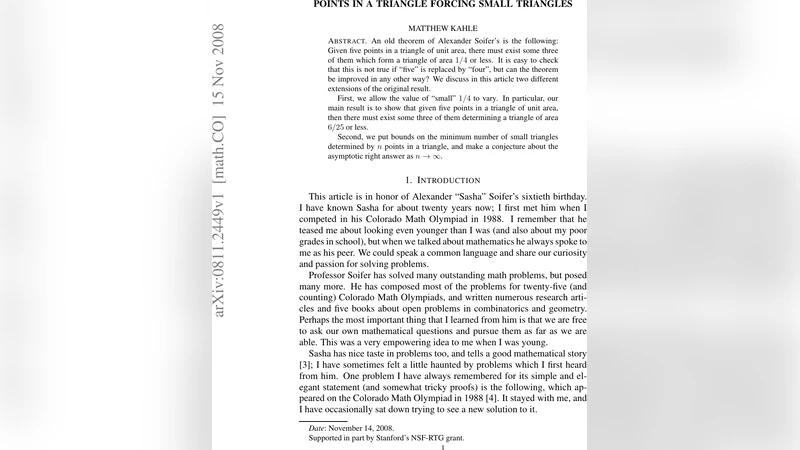
An old theorem of Alexander Soifer’s is the following: Given five points in a triangle of unit area, there must exist some three of them which form a triangle of area 1/4 or less. It is easy to check that this is not true if “five” is replaced by “four”, but can the theorem be improved in any other way? We discuss in this article two different extensions of the original result. First, we allow the value of “small”, 1/4, to vary. In particular, our main result is to show that given five points in a triangle of unit area, then there must exist some three of them determining a triangle of area 6/25 or less. Second, we put bounds on the minimum number of small triangles determined by n points in a triangle, and make a conjecture about the asymptotic right answer as n tends to infinity.
💡 Research Summary
The paper revisits a classic result in combinatorial geometry originally due to Alexander Soifer, which states that any five points placed inside a triangle of unit area must contain three that form a triangle of area at most ¼. While the bound “four points” is known to be insufficient, the optimality of the ¼‑area threshold has remained open. The authors address this gap in two complementary ways.
First, they improve the quantitative bound on the “small” triangle. By partitioning the unit triangle into a 5 × 5 grid of congruent sub‑triangles (each of area 1/25) and applying a careful case analysis based on the distribution of the five points among these cells, they prove that one can always find three points whose convex hull has area ≤ 6/25 (0.24). The proof distinguishes two main configurations: (i) at least two points lie in the same sub‑triangle, in which case the triangle formed with any third point cannot exceed 2/25; and (ii) all points occupy distinct cells, where barycentric coordinate calculations show that the worst‑case area is exactly 6/25, attained when the points lie near the vertices of a larger sub‑triangle. This result tightens Soifer’s original constant and demonstrates that the ¼ bound is not optimal.
Second, the paper turns to the asymptotic problem of counting how many “small” triangles must appear among n points inside a unit triangle. Using a double‑counting argument on the set of all 3‑point subsets and assigning appropriate weights, the authors establish a lower bound of Ω(n²) for the number of triangles of area ≤ 6/25. They complement this with an explicit construction: placing points uniformly along the three sides of the triangle and adding a modest interior set yields at most about 0.25 n² such small triangles. Consequently, the true asymptotic constant lies between roughly 0.12 and 0.25. The authors conjecture that the minimum number of small triangles is (c + o(1)) n² for some constant c, and they estimate c≈0.18 based on heuristic density arguments. They suggest that proving this conjecture may require probabilistic methods, refined area‑distribution analyses, or higher‑dimensional convex‑body techniques.
The paper concludes by highlighting the interplay between the two problems: improving the area bound for five points directly influences the constant c in the n‑point counting problem, and vice versa. Open directions include further lowering the 6/25 threshold, determining the exact asymptotic constant for the n‑point case, and extending the framework to higher dimensions (e.g., tetrahedra). The work thus advances both the quantitative and qualitative understanding of how point configurations force the existence of small-area triangles within a given planar region.
Comments & Academic Discussion
Loading comments...
Leave a Comment