A Middleware road towards Web (Grid) Services
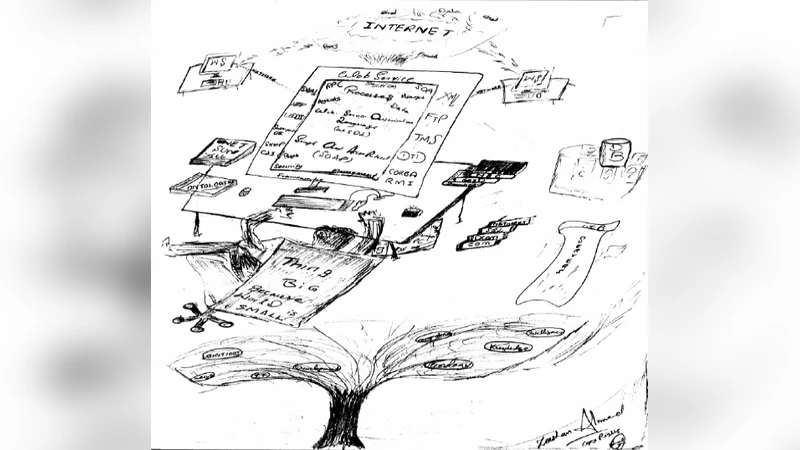
Middleware technologies is a very big field, containing a strong already done research as well as the currently running research to confirm already done research’s results and the to have some new solution by theoretical as well as the experimental (practical) way. This document has been produced by Zeeshan Ahmed (Student: Connectivity Software Technologies Blekinge Institute of Technologies). This describes the research already done in the field of middleware technologies including Web Services, Grid Computing, Grid Services and Open Grid Service Infrastructure & Architecture. This document concludes with the overview of Web (Grid) Service, Chain of Web (Grid) Services and the necessary security issue.
💡 Research Summary
The paper provides a comprehensive overview of middleware research, focusing on the convergence of Web Services and Grid Computing into what the author calls “Web (Grid) Services.” It begins with a brief history of middleware, emphasizing its role in abstracting heterogeneity and managing distributed resources. The author then reviews the core standards of Web Services—SOAP, WSDL, and UDDI—explaining how they enable platform‑independent, loosely coupled interactions. In parallel, the paper outlines the fundamentals of Grid Computing, describing virtualized large‑scale compute and data resources, resource discovery, scheduling, and the critical security and trust mechanisms required for multi‑institutional collaborations.
The central argument is that neither Web Services nor Grid Computing alone can satisfy the emerging needs of complex scientific and industrial workflows. Web Services excel at lightweight, standardized interfaces but lack the performance and resource‑management capabilities of grids. Conversely, Grid Services provide powerful resource orchestration but suffer from limited standardization and accessibility. By integrating the two, the author proposes a hybrid architecture that leverages the accessibility of Web protocols while exploiting the high‑performance, dynamic resource allocation of grids.
To realize this integration, the paper adopts the Open Grid Services Architecture (OGSA) and its implementation framework, the Open Grid Services Infrastructure (OGSI). OGSA defines a service‑oriented view of grid resources, treating each resource as a stateful service with a well‑defined lifecycle. OGSI supplies concrete APIs for service containers, service data, and service addressing, ensuring compatibility with existing Web Service standards. This compatibility enables legacy Web applications to be “grid‑enabled” without extensive rewrites.
Security considerations receive extensive treatment. The author identifies authentication, authorization, confidentiality, integrity, and audit as mandatory across the entire service chain. Standard mechanisms such as X.509 certificates, PKI, token‑based delegation, and WS‑Security are recommended. Moreover, the paper discusses trust‑chain models and policy‑based access control to mediate interactions between resource providers and consumers in a multi‑domain grid environment.
A novel contribution is the concept of a “Web (Grid) Service Chain.” The chain links individual services—e.g., data acquisition, preprocessing, high‑performance analysis, and result visualization—into a cohesive workflow. Each component advertises its capabilities via standard metadata, allowing dynamic discovery, binding, and resource allocation at runtime. The chain model includes provisions for performance monitoring, fault tolerance, and dynamic scaling, ensuring that complex scientific pipelines can be executed efficiently over a distributed grid while remaining accessible through familiar Web interfaces.
In the concluding section, the author summarizes how the paper bridges traditional middleware research with contemporary grid standards, proposing a unified service paradigm that can serve both academic and industrial needs. Future research directions are outlined, including automated service placement, adaptive scaling algorithms, integration of multi‑domain security policies, and optimization techniques for service chain execution. The paper argues that addressing these challenges will solidify Web (Grid) Services as a practical, high‑performance infrastructure for the next generation of distributed applications.
Comments & Academic Discussion
Loading comments...
Leave a Comment