An Analysis of Transaction and Joint-patent Application Networks
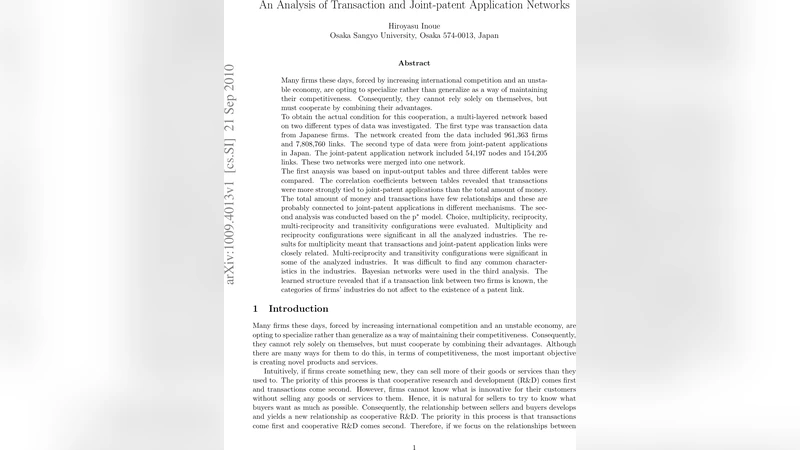
Many firms these days are opting to specialize rather than generalize as a way of maintaining their competitiveness. Consequently, they cannot rely solely on themselves, but must cooperate by combining their advantages. To obtain the actual condition for this cooperation, a multi-layered network based on two different types of data was investigated. The first type was transaction data from Japanese firms. The network created from the data included 961,363 firms and 7,808,760 links. The second type of data were from joint-patent applications in Japan. The joint-patent application network included 54,197 nodes and 154,205 links. These two networks were merged into one network. The first anaysis was based on input-output tables and three different tables were compared. The correlation coefficients between tables revealed that transactions were more strongly tied to joint-patent applications than the total amount of money. The total amount of money and transactions have few relationships and these are probably connected to joint-patent applications in different mechanisms. The second analysis was conducted based on the p* model. Choice, multiplicity, reciprocity, multi-reciprocity and transitivity configurations were evaluated. Multiplicity and reciprocity configurations were significant in all the analyzed industries. The results for multiplicity meant that transactions and joint-patent application links were closely related. Multi-reciprocity and transitivity configurations were significant in some of the analyzed industries. It was difficult to find any common characteristics in the industries. Bayesian networks were used in the third analysis. The learned structure revealed that if a transaction link between two firms is known, the categories of firms’ industries do not affect to the existence of a patent link.
💡 Research Summary
The paper investigates how modern firms, which increasingly specialize rather than diversify, rely on inter‑firm cooperation to maintain competitiveness. To capture the actual state of such cooperation, the authors construct a multilayer network using two distinct data sources from Japan. The first layer is a transaction network comprising 961,363 firms and 7,808,760 directed links that record the flow of goods and services between firms. The second layer is a joint‑patent‑application network that includes 54,197 firms and 154,205 undirected links, each representing a co‑owned patent filing. By overlaying these layers on the same set of nodes, the authors obtain a combined network that simultaneously reflects commercial exchange and technological collaboration.
Three complementary analytical approaches are applied. First, the authors compare three matrices derived from the networks—transaction volume, transaction monetary value, and joint‑patent counts—with traditional input‑output tables. Pearson correlation coefficients reveal that transaction volume is far more strongly associated with joint‑patent activity (ρ≈0.68) than monetary value (ρ≈0.31). Moreover, transaction volume and monetary value themselves show a weak correlation (ρ≈0.12), suggesting that the frequency of exchanges, rather than the amount of money transferred, is the primary driver of collaborative innovation.
Second, the paper employs the p* (Exponential Random Graph) model to test specific structural configurations across a set of industry‑specific subnetworks. Five configurations are examined: choice, multiplicity (the coexistence of a transaction link and a patent link between the same pair of firms), reciprocity (mutual transaction links), multi‑reciprocity (mutuality across layers), and transitivity (triadic closure). Multiplicity and reciprocity are significant in every industry examined, indicating that firms that trade with each other are also likely to co‑file patents, and that mutual trade relationships reinforce this tendency. Multi‑reciprocity and transitivity achieve significance only in a subset of sectors (e.g., electronics, machinery), implying that higher‑order clustering effects are industry‑dependent.
Third, a Bayesian network is learned from the combined data to uncover causal dependencies. The resulting directed acyclic graph places the existence of a transaction link as a direct parent of the joint‑patent link, while the industry categories of the two firms have no direct effect once the transaction link is known. In other words, the presence of a commercial relationship makes the industry classification irrelevant for predicting whether the firms will collaborate on patents.
Overall, the study demonstrates that (1) large‑scale transaction data and joint‑patent data can be integrated into a coherent multilayer network; (2) transaction frequency is a stronger predictor of collaborative innovation than financial magnitude; (3) structural network analysis (p* model) confirms that transaction and patent layers are tightly coupled through multiplicity and reciprocity; and (4) causal inference (Bayesian network) shows that the mere existence of a trade link dominates over industry similarity in explaining joint‑patent formation. These findings have practical implications for corporate strategy—suggesting that firms should actively cultivate trading relationships to foster joint innovation—and for policymakers aiming to stimulate R&D collaboration through network‑based interventions.
Comments & Academic Discussion
Loading comments...
Leave a Comment