Finiteness obstructions and Euler characteristics of categories
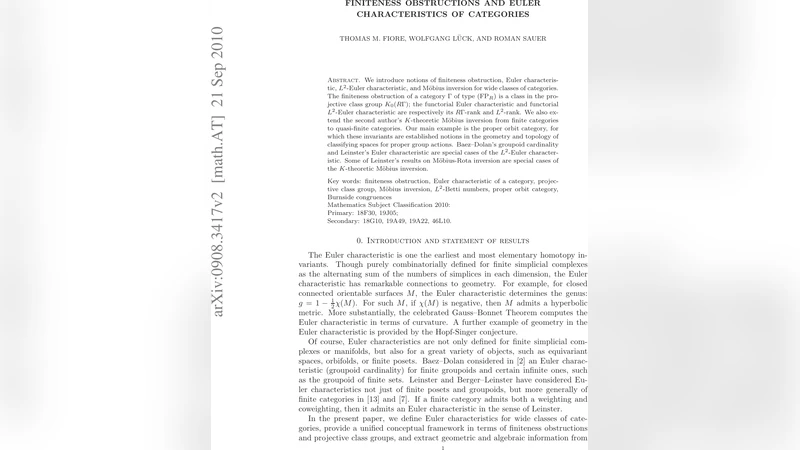
We introduce notions of finiteness obstruction, Euler characteristic, L^2-Euler characteristic, and M"obius inversion for wide classes of categories. The finiteness obstruction of a category Gamma of type (FP) is a class in the projective class group K_0(RGamma); the functorial Euler characteristic and functorial L^2-Euler characteristic are respectively its RGamma-rank and L^2-rank. We also extend the second author’s K-theoretic M"obius inversion from finite categories to quasi-finite categories. Our main example is the proper orbit category, for which these invariants are established notions in the geometry and topology of classifying spaces for proper group actions. Baez-Dolan’s groupoid cardinality and Leinster’s Euler characteristic are special cases of the L^2-Euler characteristic. Some of Leinster’s results on M"obius-Rota inversion are special cases of the K-theoretic M"obius inversion.
💡 Research Summary
The paper develops a unified framework for several invariants of categories—finiteness obstruction, Euler characteristic, L²‑Euler characteristic, and Möbius inversion—by placing them in the context of algebraic K‑theory. The authors begin by fixing a ring R and a small category Γ of type (FP), meaning that the RΓ‑module ℤ (or the constant functor) admits a finite projective resolution. In this situation one can associate to Γ a distinguished element in the projective class group K₀(RΓ); this element is called the finiteness obstruction. It measures the failure of Γ to be “finitely dominated’’ in the sense of Wall.
From the finiteness obstruction two numerical invariants are extracted. The first is the RGamma‑rank, obtained by applying the ordinary rank homomorphism K₀(RΓ) → ℤ (or more generally K₀(R) → ℤ) to the obstruction class. This rank is identified with the functorial Euler characteristic χ_f(Γ). The second invariant uses the von Neumann dimension theory for modules over the group von Neumann algebra of Γ. By taking the L²‑dimension of the obstruction class one obtains the functorial L²‑Euler characteristic χ_f^{(2)}(Γ). Both χ_f and χ_f^{(2)} are functorial with respect to exact functors between module categories, and they agree with the classical Euler characteristic when Γ is a finite category with a weighting.
A major technical contribution is the extension of the K‑theoretic Möbius inversion originally proved by the second author for finite categories to the broader class of quasi‑finite categories. A category is quasi‑finite if each object has only finitely many isomorphism classes of objects mapping to it, though the automorphism groups may be infinite. For such a Γ the authors construct a Möbius function μ: Ob(Γ)×Ob(Γ) → K₀(R) satisfying the usual inversion relation μ∗ζ = δ, where ζ is the zeta matrix of Hom‑sets and δ the identity. This Möbius function allows one to express the finiteness obstruction, and consequently χ_f and χ_f^{(2)}, as alternating sums over chains of objects, generalising Leinster’s combinatorial formulas.
The proper orbit category 𝒪_{𝔽}G serves as the central example. Here G is a discrete group and 𝔽 a family of subgroups closed under conjugation and taking subgroups. Objects are the homogeneous G‑sets G/H with H∈𝔽, and morphisms are G‑equivariant maps. The category 𝒪_{𝔽}G encodes the homotopy theory of proper G‑actions; its classifying space B𝔽G is the universal space for proper actions. The authors compute the finiteness obstruction of 𝒪_{𝔽}G and show that its RGamma‑rank recovers the classical Euler characteristic of B𝔽G, while its L²‑rank yields the L²‑Euler characteristic of B𝔽G, a quantity already known from the work of Lück and others.
Finally, the paper connects these constructions to previously known notions. Baez–Dolan’s groupoid cardinality is identified with the L²‑Euler characteristic of a finite groupoid, and Leinster’s Euler characteristic of a finite category with weighting/co‑weighting appears as the integer‑valued specialization of χ_f^{(2)}. Thus many disparate invariants are unified under the single umbrella of the K‑theoretic finiteness obstruction.
In summary, the authors provide a robust K‑theoretic perspective on finiteness and Euler-type invariants for a wide class of categories, extend Möbius inversion beyond the finite case, and demonstrate that the proper orbit category furnishes a natural testing ground where these abstract notions coincide with established topological invariants. The work opens pathways for further exploration in higher category theory, equivariant topology, and the analysis of infinite group actions via L²‑methods.
Comments & Academic Discussion
Loading comments...
Leave a Comment