Duality for distributive space
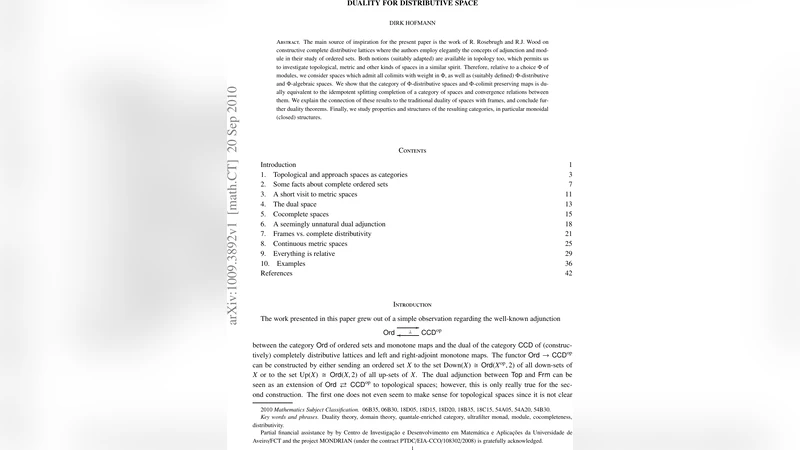
The main source of inspiration for the present paper is the work of R. Rosebrugh and R.J. Wood on constructive complete distributive lattices where the authors employ elegantly the concepts of adjunction and module in their study of ordered sets. Both notions (suitably adapted) are available in topology too, which permits us to investigate topological, metric and other kinds of spaces in a similar spirit. Therefore, relative to a choice $\Phi$ of modules, we consider spaces which admit all colimits with weight in $\Phi$, as well as (suitably defined) $\Phi$-distributive and $\Phi$-algebraic spaces. We show that the category of $\Phi$-distributive spaces and $\Phi$-colimit preserving maps is dually equivalent to the idempotent splitting completion of a category of spaces and convergence relations between them. We explain the connection of these results to the traditional duality of spaces with frames, and conclude further duality theorems. Finally, we study properties and structures of the resulting categories, in particular monoidal (closed) structures.
💡 Research Summary
The paper builds a broad duality framework that lifts the constructive complete distributive lattice theory of Rosebrugh and Wood from order theory to topology, metric spaces and other convergence‑based structures. The authors begin by recalling the key ingredients of Rosebrugh‑Wood’s approach: a notion of module (used to weight colimits) and an adjunction (expressing the universal relationship between colimits and limits). They then fix a class Φ of modules – for example, modules assigning a real weight, a logical truth value, or a distance bound – and use Φ to define a whole family of weighted colimits, called Φ‑colimits.
A Φ‑complete space is one that admits all Φ‑colimits. Within this ambient class they single out two important subclasses. A space is Φ‑distributive when every Φ‑colimit distributes over every Φ‑limit, i.e. the canonical comparison map between the two ways of forming a combined colimit‑limit is an isomorphism. This condition is the topological analogue of complete distributivity in lattice theory. A space is Φ‑algebraic when it is Φ‑distributive and every point can be expressed as a Φ‑weighted join of Φ‑compact points (the latter being a Φ‑generalisation of ordinary compactness).
The central categorical result is a dual equivalence between two categories. On the one hand we have the category 𝔇_Φ whose objects are Φ‑distributive spaces and whose morphisms are maps preserving all Φ‑colimits. On the other hand we have the idempotent‑splitting completion ̂𝔠 of a category 𝔠 whose objects are arbitrary spaces equipped with convergence relations (generalised notions of “neighbourhood” or “Cauchy filter”) and whose morphisms are relation‑preserving maps. The authors construct explicit contravariant functors
F : 𝔇_Φ → ̂𝔠 and G : ̂𝔠 → 𝔇_Φ,
showing that F∘G and G∘F are naturally isomorphic to the identity functors. The proof hinges on the continuity of Φ‑modules and the fact that Φ‑colimits are exactly those colimits that can be described by the convergence relations in 𝔠.
The paper then relates this abstract duality to the classical space‑frame duality (Stone, Joyal‑Tierney, etc.). A frame is a complete lattice of open sets that is completely distributive; when Φ is taken to consist of the trivial module assigning weight 1 to every open set, Φ‑distributive spaces reduce to sober spaces and the dual equivalence collapses to the familiar equivalence between sober spaces and spatial frames. Thus the new theory subsumes the traditional duality as a special case.
Beyond the basic equivalence, the authors investigate monoidal (closed) structures on both sides. The category 𝔇_Φ carries a tensor product given by the product of spaces equipped with the pointwise Φ‑weighting, and it admits an internal hom
Comments & Academic Discussion
Loading comments...
Leave a Comment