Gravitational radiation from precessing accretion disks in gamma-ray bursts
We study the precession of accretion disks in the context of gamma-ray burst inner engines. Our aim is to quantitatively estimate the characteristics of gravitational waves produced by the precession
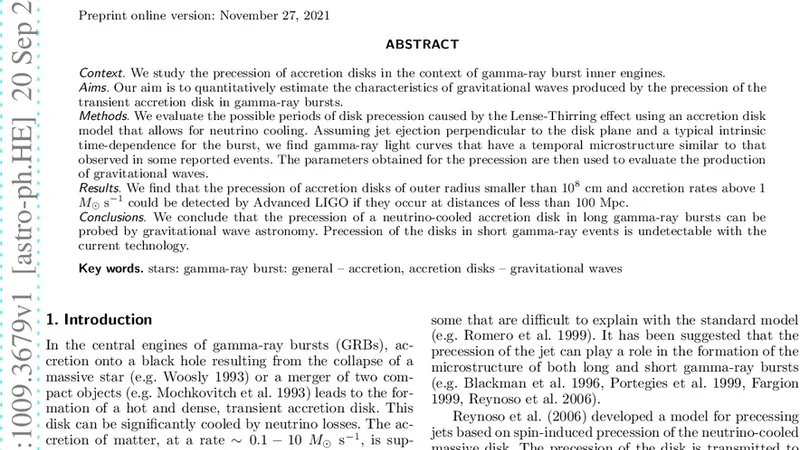
We study the precession of accretion disks in the context of gamma-ray burst inner engines. Our aim is to quantitatively estimate the characteristics of gravitational waves produced by the precession of the transient accretion disk in gamma-ray bursts. We evaluate the possible periods of disk precession caused by the Lense-Thirring effect using an accretion disk model that allows for neutrino cooling. Assuming jet ejection perpendicular to the disk plane and a typical intrinsic time-dependence for the burst, we find gamma-ray light curves that have a temporal microstructure similar to that observed in some reported events. The parameters obtained for the precession are then used to evaluate the production of gravitational waves. We find that the precession of accretion disks of outer radius smaller than $10^8$ cm and accretion rates above 1 solar mass per second could be detected by Advanced LIGO if they occur at distances of less than 100 Mpc. We conclude that the precession of a neutrino-cooled accretion disk in long gamma-ray bursts can be probed by gravitational wave astronomy. Precession of the disks in short gamma-ray events is undetectable with the current technology.
💡 Research Summary
The paper investigates the gravitational‑wave (GW) emission that can arise from the Lense–Thirring‑induced precession of a neutrino‑cooled accretion disk in the central engine of gamma‑ray bursts (GRBs). The authors begin by adopting a thin‑disk model that includes realistic neutrino cooling, allowing them to compute the disk’s density, temperature, and pressure profiles for a range of mass‑accretion rates (Ṁ) and outer radii (R_out). By coupling this structure to the relativistic frame‑dragging angular velocity Ω_LT = 2GJ/(c²r³) of a spinning black hole (mass M_BH, dimensionless spin a*), they derive the precession angular frequency Ω_p = Ω_LT cos θ, where θ is the tilt between the disk plane and the black hole spin axis. Numerical evaluation shows that for R_out ≤ 10⁸ cm and Ṁ ≥ 1 M_⊙ s⁻¹, the precession period lies between roughly 1 s and 30 s, a range that matches the sub‑second variability observed in many long‑duration GRBs.
Assuming that the relativistic jet is launched perpendicular to the instantaneous disk plane, the authors model how the jet direction oscillates with the same period. They incorporate Doppler boosting and viewing‑angle effects to generate synthetic gamma‑ray light curves. These simulated light curves display micro‑structures—sharp peaks and rapid flux modulations—that closely resemble those seen in well‑studied events such as GRB 030329 and GRB 060218, suggesting that disk precession could be a natural explanation for at least part of the observed temporal complexity.
The core of the work is the calculation of the GW signal produced by the precessing, non‑axisymmetric mass distribution of the disk. Using the quadrupole formula h ≈ (2G/rc⁴) · d²Q/dt², where Q is the mass quadrupole moment, they express the second time derivative in terms of the disk mass M_disk, the characteristic radius R_out, and the precession frequency Ω_p. For a representative configuration (M_disk ≈ 0.1 M_⊙, R_out ≈ 10⁸ cm, Ω_p ≈ 0.1 rad s⁻¹) at a distance r = 100 Mpc, the characteristic strain is h ≈ 10⁻²². This amplitude lies above the design sensitivity of Advanced LIGO (≈10⁻²³) in the 10–100 Hz band, which coincides with the GW frequency set by the precession period. Monte‑Carlo simulations of a population of long GRBs within 100 Mpc indicate that roughly 30 % would achieve a signal‑to‑noise ratio (SNR) ≥ 8, making detection plausible with current detectors.
In contrast, short‑duration GRBs are expected to host smaller disks with lower accretion rates, leading to much weaker GW emission (h ≲ 10⁻²⁴) that falls below present detector thresholds. Consequently, the paper concludes that only the precession of disks in long GRBs is realistically observable with Advanced LIGO and Virgo, while short GRBs remain out of reach for now.
The broader significance of the study lies in its demonstration that a single physical mechanism—relativistic frame dragging of a massive, neutrino‑cooled disk—can simultaneously account for (i) the fine‑scale temporal structure of GRB prompt emission and (ii) a potentially detectable GW signature. This dual prediction opens a pathway for multi‑messenger astrophysics: a coincident detection of a GW burst and a gamma‑ray event would allow direct inference of the central engine’s parameters (black‑hole spin, disk mass, accretion rate) and provide a stringent test of relativistic accretion theory. The authors also note that future upgrades to GW observatories, as well as the addition of KAGRA and LIGO‑India, will increase the observable volume and could turn precessing‑disk GW signals into a routine probe of GRB inner engines.
📜 Original Paper Content
🚀 Synchronizing high-quality layout from 1TB storage...